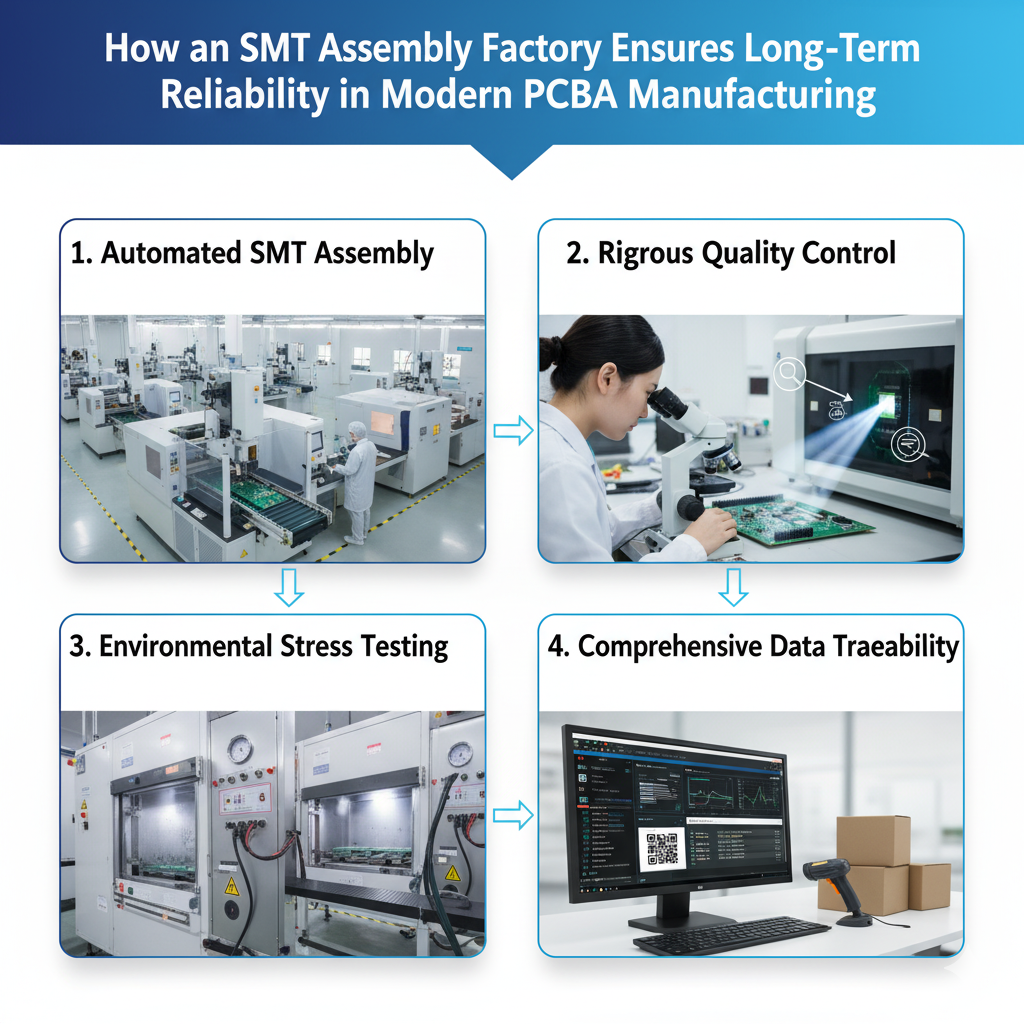
How an SMT Assembly Factory Ensures Long-Term Reliability in Modern PCBA Manufacturing
Behind every successful electronic device is an SMT assembly factory that quietly determines the fate of its reliability. For engineering teams and OEM buyers, finding a factory with stable production, consistent quality, and controlled process variation isn’t about chasing the lowest quote—it’s about securing performance over time.
In modern PCBA manufacturing, solder paste behavior, placement accuracy, and testing coverage collectively define the product’s lifespan. Let’s explore how the right SMT assembly factory transforms these variables into predictable reliability.
Why Solder-Paste Behavior Is the Root of Long-Term Stability
Many engineers treat solder printing as a routine setup, but it’s actually the single largest source of latent failures.
Solder paste viscosity, metal particle size, and stencil aperture ratio decide how evenly the paste spreads, how well it wets the pad, and how much solder remains after reflow.
A professional factory controls these details relentlessly—adjusting printing pressure, squeegee speed, and stencil cleaning intervals—so that every pad receives consistent solder volume.
During high-speed SMT line production, even a slight deviation in paste thickness can cause hidden defects like voids or open joints that only appear after thermal cycles.
That’s why mature suppliers rely on solder-paste inspection (SPI) data and statistical process control rather than “visual judgment.” They understand that reliability starts before the first component is placed.
Component Placement Accuracy Defines Structural Integrity
When building dense boards with 0.4 mm BGAs or 0201 passives, placement accuracy isn’t only about alignment—it determines how mechanical stress spreads across solder joints under heat and vibration.
The table below summarizes how placement precision influences real-world performance in PCBA manufacturing.
| Technical Focus | Engineering Impact |
|---|---|
| Nozzle Calibration & Database | Ensures repeatable pickup and rotation for each component type, avoiding positional drift during high-speed placement. |
| Vacuum Pressure Control | Prevents component bounce or tilt, reducing micro-voids that lead to early fatigue failures. |
| Vision Alignment & Fiducial Compensation | Maintains micron-level accuracy for BGA and QFN pads, critical for signal integrity and long-term durability. |
| Feeder Maintenance Frequency | Consistent feed accuracy prevents misplacement and reduces machine stoppage during continuous runs. |
| Placement Offset Tuning | Balances solder fillet geometry to minimize stress concentration and extend thermal cycle lifespan. |
Even a minor offset—30 µm, for example—can alter solder joint geometry enough to cause premature cracking.
The best PCB assembly service providers embed these calibration protocols into their production routine, not as corrective actions but as preventive design controls.
Reflow Profile Control: Where Physics Meets Manufacturing
Reflow soldering is the crucible where all previous process variables converge—paste chemistry, component tolerance, and copper distribution on the board.
The goal isn’t a fixed “peak temperature,” but a profile optimized for each board’s specific heat capacity and material stack-up.
Too much heat causes brittle intermetallic compounds (IMC) that crack during drop tests. Too little, and cold joints appear weeks later.
A skilled SMT assembly factory validates every thermal curve using X-ray inspection and cross-sectional analysis, ensuring IMC layer thickness stays within IPC standards.
That’s how they make reliability measurable instead of assumable.
Testing Depth: The Invisible Shield of Every Reliable PCBA
A real electronics contract manufacturing partner knows that SMT is only half the story; what follows decides if your product will endure.
Mature factories integrate multi-layered testing processes such as:
-
AOI to detect bridging, misalignment, or insufficient solder
-
ICT to confirm electrical continuity and impedance
-
FCT to test actual functionality under power
-
Burn-in to remove early-life failures
-
X-ray to verify BGA and hidden joint quality
Factories that skip testing aren’t saving you money—they’re selling you uncertainty.
The PCBA testing process defines whether a product survives real-world stress or fails in customer hands.
Key Questions When Selecting an SMT Partner
For OEM, ODM, and design houses, choosing a production partner should focus on data transparency rather than cost claims.
Before signing a contract, ask your factory:
-
Can you provide process capability data for printing and reflow stages?
-
Do you maintain material traceability and lot tracking?
-
How often are feeders, nozzles, and AOI cameras calibrated?
-
What testing coverage and fixture development capabilities are included?
-
How do you handle engineering changes (ECN) between sample and mass production?
Factories that can answer these confidently are not just service providers—they’re extensions of your engineering team.
Final Engineering Takeaway
From consumer electronics to IoT modules, the value of a professional SMT assembly factory lies in how precisely it turns variables into stability.
It’s the discipline in process control, the patience in testing, and the transparency in engineering feedback that distinguish a reliable manufacturing partner from a low-cost vendor.
To explore how our production lines ensure yield stability and consistent quality across complex PCBA builds, visit our official website.
If you’re ready to discuss your next turnkey PCB assembly project, reach our engineering team via the contact page.
We’ll provide insights and technical evaluation before a single board is built.