Choosing the right camera module for industrial vision is a critical decision for buyers developing machine vision systems, smart inspection devices, automation equipment, robotics, AI vision terminals, and industrial monitoring hardware. Unlike consumer camera modules, industrial vision modules must support stable image capture, accurate signal transmission, long working hours, strong PCBA reliability, and consistent batch production.
For industrial buyers, a camera module is not just a sensor and lens. It is part of a larger inspection or automation system. If the image signal is unstable, the PCBA overheats, the interface is incompatible, or the module quality changes from batch to batch, the final device may fail in real production environments.
HCDPCBA supports camera-related electronic projects through one-stop electronics manufacturing services, including PCB prototyping, SMT assembly, PCBA manufacturing, component sourcing, DFMA review, testing, and OEM/ODM production.
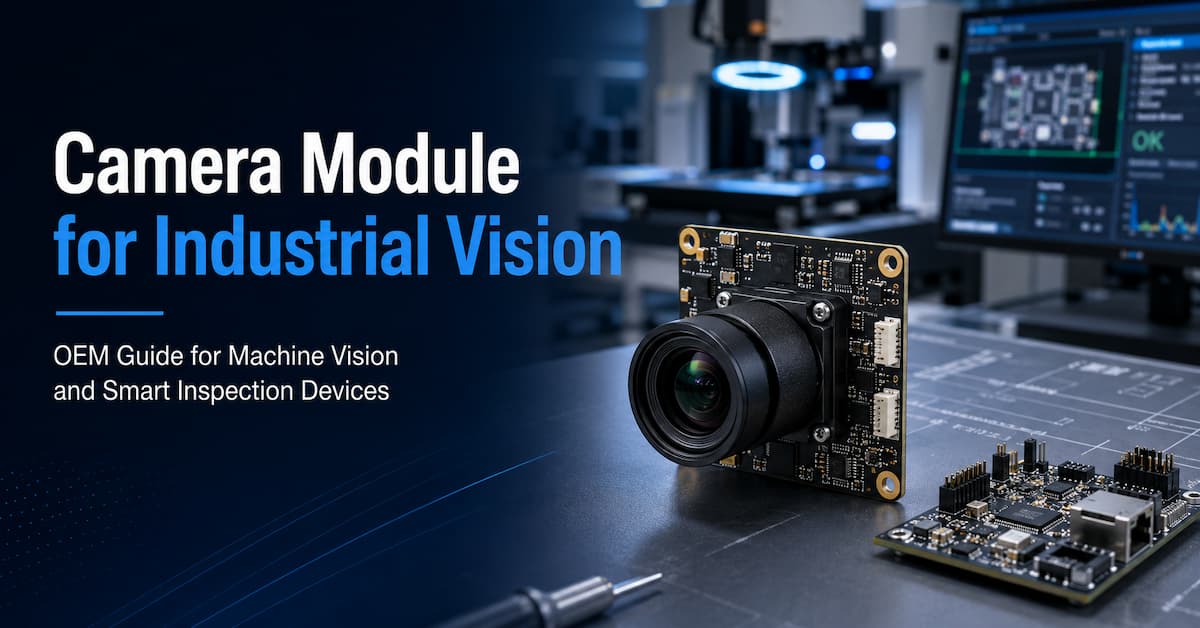
What Is a Camera Module for Industrial Vision?
A camera module for industrial vision is an imaging module designed for machines, equipment, or automated systems that need visual recognition, inspection, monitoring, positioning, measurement, or image-based decision-making.
A typical industrial vision camera module may include:
- CMOS image sensor
- Lens and lens holder
- Camera sensor PCBA
- USB, MIPI, parallel, or custom interface
- Image signal processing circuit
- Power management circuit
- FPC or board-to-board connector
- Optional IR filter or low-light support
- Mounting holes or customized mechanical structure
- Main control board or embedded system interface
Industrial vision projects often require more customization than standard camera products. Buyers may need special board size, lens angle, connector position, cable length, interface type, image format, power requirement, or testing standard.
Why Industrial Vision Camera Modules Need Higher Reliability
Industrial vision devices are often used in factories, warehouses, production lines, robotics systems, testing equipment, and smart terminals. These environments usually require continuous operation and stable performance.
A camera module used in industrial vision must consider:
- Long-time operation stability
- Clear image capture under different lighting
- Stable signal transmission
- Low image noise
- Reliable PCBA soldering
- Strong connector durability
- EMI control
- Heat management
- Mechanical fit with equipment housing
- Batch consistency for production systems
For industrial buyers, a failed camera module may not only cause product returns. It may stop inspection equipment, reduce production efficiency, or affect quality control accuracy.
Main Applications of Industrial Vision Camera Modules
Industrial vision camera modules are used across many automation and smart equipment projects.
| Application | Camera Module Requirement | Typical Buyer |
|---|---|---|
| Machine vision inspection | Clear image, stable frame rate, accurate detail capture | Automation equipment manufacturers |
| Barcode and QR code scanning | Sharp focus, fast recognition, stable signal | Smart terminal suppliers |
| Robotic vision | Compact PCBA, low latency, durable connection | Robotics companies |
| Industrial monitoring | Long operation, stable video, reliable electronics | Industrial equipment brands |
| AI visual recognition | High-quality image input, fast data transfer | AI hardware developers |
| AOI inspection devices | Stable imaging, high detail, controlled lighting compatibility | Inspection equipment manufacturers |
| Smart warehouse systems | Wide viewing angle, reliable data transmission | Logistics automation suppliers |
| Medical or lab equipment | Clear image, controlled quality, long-term reliability | Device developers |
HCDPCBA’s PCBA manufacturing category supports customized electronic board production, while its Camera Series shows camera-related hardware capabilities for security and smart device projects.
What Buyers Should Check Before Choosing an Industrial Vision Camera Module
1. Sensor Quality and Image Stability
The sensor is the core of the camera module. For industrial vision, buyers should focus on stable image quality rather than only high resolution.
Important factors include:
- Resolution
- Sensor size
- Frame rate
- Dynamic range
- Low-light performance
- Image noise level
- Shutter type
- Long-term sensor availability
- Supply chain stability
For inspection and recognition tasks, image consistency is often more important than marketing-level resolution. A stable 2MP or 5MP module may perform better than a higher-resolution module if it has better lens matching, signal quality, and PCBA design.
2. Lens Matching and Field of View
The lens must match the inspection distance, object size, mounting position, and lighting environment. A poor lens choice can cause distortion, blur, reflection issues, or recognition errors.
Buyers should confirm:
- Viewing angle
- Focus distance
- Aperture
- Lens distortion
- Depth of field
- Mounting position
- Object distance
- Lighting environment
- IR or filter requirement
For barcode scanning, a sharp focus at a fixed distance may matter most. For robotic vision, a wider field of view and low distortion may be more important. For inspection equipment, detail clarity and repeatability are key.
3. Camera PCBA Design
A camera module for industrial vision usually requires a compact but stable PCBA. The board must support the sensor, interface, power circuit, connectors, and sometimes additional processing components.
A reliable OEM partner should understand:
- Camera PCBA layout
- High-speed signal routing
- Power supply stability
- EMI control
- Heat management
- Connector placement
- Testing point design
- Mechanical fit with the final device
HCDPCBA supports PCB prototyping, SMT assembly, PCBA manufacturing, component sourcing, testing, and OEM/ODM production, making it suitable for industrial buyers who need customized board-level support.
4. Interface Selection: USB, MIPI, Parallel, or Custom
Interface choice directly affects data transmission, compatibility, image speed, and integration difficulty.
Common options include:
| Interface | Key Advantage | Best For |
| USB | Easy integration and plug-and-play support | Industrial terminals, inspection devices, kiosks |
| MIPI | Compact, high-speed embedded integration | AI devices, robotics, embedded systems |
| Parallel interface | Simple system integration for some platforms | Legacy or cost-sensitive devices |
| Custom connector | Optimized for mechanical design | OEM industrial equipment |
Buyers should confirm the host system before selecting the module interface. Interface mismatch can delay development and increase engineering cost.
5. SMT Assembly and Soldering Reliability
Industrial vision modules may operate for long periods under vibration, heat, or frequent device movement. SMT assembly quality directly affects long-term reliability.
Buyers should check whether the factory can control:
- Component placement accuracy
- Solder paste quality
- Reflow soldering process
- Connector soldering
- Small IC assembly
- AOI inspection
- Batch consistency
- Functional testing
Poor SMT quality may cause intermittent failures, signal instability, or early field defects.
6. Power and Heat Management
Industrial vision modules may work continuously for hours or days. Heat can affect image noise, sensor stability, IC lifespan, and overall product reliability.
Power-related questions include:
- What is the working voltage?
- What is the working current?
- Is standby mode required?
- Will the module run continuously?
- Is the PCBA layout designed for heat control?
- Are heat-sensitive components properly positioned?
- Does the final device need thermal testing?
A camera module for industrial vision should be evaluated under real working conditions, not only short sample demos.
Industrial Vision Camera Module OEM Specification Checklist
Before requesting a quotation, buyers should prepare a clear specification sheet.
| Item | What to Confirm |
| Application | Machine vision, inspection, barcode scanning, robotics, AI vision |
| Resolution | 720P, 1080P, 2MP, 4MP, 5MP, 8MP, or customized |
| Sensor | CMOS sensor type, frame rate, dynamic range, low-light performance |
| Lens | Viewing angle, focus distance, aperture, distortion requirement |
| Interface | USB, MIPI, parallel, FPC, board-to-board, custom connector |
| PCBA | Board size, connector position, mounting holes, heat control |
| Power | Working voltage, current, standby mode, continuous operation |
| Lighting | Normal light, low light, IR, controlled lighting environment |
| Cable | Cable length, shielding, connector type |
| Testing | Image test, interface test, PCBA inspection, aging test |
| OEM needs | Logo, packaging, private label, customized board |
| Quantity | Sample, pilot run, batch production |
| Certification | RoHS, ISO-related quality control, market requirements |
This checklist helps the manufacturer evaluate cost, feasibility, lead time, and technical risks more accurately.
OEM vs ODM Industrial Vision Camera Module Projects
Buyers should choose the right cooperation model based on their project stage.
| Project Type | Meaning | Best For |
| Standard camera module | Use an existing module with limited changes | Fast testing or early development |
| OEM industrial vision camera module | Customize based on buyer’s device and specifications | Industrial equipment brands |
| ODM camera module development | Manufacturer supports design and development | Buyers needing a more complete solution |
| Camera PCBA manufacturing | Build the electronic board inside the module | Engineering teams and device developers |
| Turnkey electronics manufacturing | PCB, SMT, components, testing, and delivery | Buyers needing supply chain control |
If the buyer already has an industrial device design, OEM customization may be suitable. If the buyer needs help with camera electronics, PCBA layout, component selection, and manufacturing planning, ODM and PCBA support become more valuable.
Common Mistakes Buyers Should Avoid
Choosing only by resolution
High resolution does not guarantee better industrial vision performance. Lens quality, image stability, lighting compatibility, and signal transmission may be more important.
Ignoring interface compatibility
A module that works in one system may not work smoothly with another embedded platform. Interface and firmware compatibility should be checked early.
Not testing long-term operation
Industrial vision modules often run continuously. Short demo testing is not enough to confirm reliability.
Overlooking PCBA quality
Poor soldering, unstable power design, weak connectors, or poor EMI control can cause hidden failures in real equipment.
Not checking component supply stability
Industrial products often require long production cycles. Buyers should confirm sensor, IC, connector, and PCB availability before scaling production.
Skipping sample validation
Samples should be tested in the final device environment, including lighting, temperature, installation angle, and working duration.
How HCDPCBA Supports Industrial Vision Camera Module Projects
HCDPCBA can support industrial vision camera module buyers from prototype to production.
PCB prototyping
Prototype production helps buyers verify camera function, PCBA layout, interface compatibility, image quality, and mechanical fit before mass production.
SMT assembly
SMT assembly supports compact camera PCBA production with controlled soldering and component placement.
Component sourcing
Industrial vision camera modules involve sensors, lenses, ICs, connectors, FPCs, cables, and power components. HCDPCBA can help buyers manage BOM sourcing and supply stability.
DFMA review
DFMA review helps identify design risks before production, such as weak connector placement, insufficient testing points, difficult assembly, or unnecessary cost.
Testing support
Testing can include PCBA inspection, power-on testing, image quality testing, interface testing, cable connection testing, and functional verification.
OEM/ODM customization
HCDPCBA can support customized camera electronics, private label requirements, board-level modification, and project-based manufacturing.
Buyers can learn more through HCDPCBA’s About Us page.
Quality Control Points for Industrial Vision Camera Modules
Industrial vision camera modules should be tested for electronic reliability and imaging performance.
| QC Point | Purpose |
| Incoming component inspection | Check sensors, lenses, connectors, FPCs, cables, and PCBs |
| SMT inspection | Verify placement, soldering, and missing components |
| AOI inspection | Detect visible PCBA defects |
| Interface test | Confirm stable USB, MIPI, or custom signal transmission |
| Image quality test | Check clarity, color, focus, frame rate, and noise |
| Power test | Verify voltage, current, and heat behavior |
| Cable and connector test | Confirm physical and signal reliability |
| Functional test | Verify performance in target device conditions |
| Sample approval | Lock production standard before batch production |
A clear testing process helps reduce field failures and improves production consistency.
What Information Should Buyers Provide for a Quote?
To speed up quotation and reduce communication errors, buyers should prepare:
- Application scenario
- Target resolution
- Sensor preference if available
- Lens angle and focus distance
- Interface type
- PCBA size limit
- Connector and cable requirements
- Power requirements
- Working environment
- Expected quantity
- Testing requirements
- OEM/ODM customization needs
- Existing sample, Gerber, BOM, or technical drawings if available
The more complete the project information, the faster the manufacturer can evaluate cost, lead time, and feasibility.
Why Work with HCDPCBA?
HCDPCBA is suitable for buyers who need more than standard camera module sourcing. For industrial vision projects, buyers often need engineering communication, PCBA manufacturing, stable component sourcing, testing, and customization support.
By working with HCDPCBA, buyers can connect camera module development with board-level manufacturing support, including SMT assembly, PCB prototyping, component sourcing, testing, and OEM/ODM production.
This is especially valuable for industrial buyers who need stable production, custom module design, and long-term supply support.
FAQ
1. What is a camera module for industrial vision?
It is a camera module used in machine vision, inspection devices, robotics, barcode scanning, AI recognition, and industrial monitoring systems.
2. What matters most when choosing an industrial vision camera module?
Buyers should check sensor quality, lens matching, interface compatibility, PCBA reliability, heat control, long-term operation, and testing standards.
3. Can industrial vision camera modules be customized?
Yes. Buyers can customize sensor, lens, PCBA size, connector type, cable length, interface, mounting holes, and testing requirements.
4. Which interface is suitable for industrial vision modules?
USB is useful for easier integration, while MIPI is often used for compact embedded systems. The best choice depends on the host device and data requirements.
5. Why is PCBA quality important?
PCBA quality affects signal stability, power performance, heat control, connector reliability, and long-term module operation.
6. Can HCDPCBA support industrial vision camera PCBA production?
Yes. HCDPCBA supports PCB prototyping, SMT assembly, PCBA manufacturing, component sourcing, testing, and OEM/ODM production for camera-related electronic projects.
7. What should I provide for a quote?
You should provide application, resolution, lens requirement, interface type, PCBA size, connector details, power requirement, quantity, and testing needs.
8. Is sample testing necessary before mass production?
Yes. Industrial vision modules should be tested in the final device environment to confirm image quality, interface stability, heat behavior, and long-term reliability.
Conclusion
Choosing a camera module for industrial vision requires more than selecting a sensor and lens. Buyers need to evaluate imaging performance, lens matching, interface design, PCBA reliability, SMT assembly quality, heat control, testing process, and OEM/ODM support.
For automation equipment manufacturers, robotics companies, AI hardware developers, inspection device suppliers, and industrial electronics brands, working with an engineering-focused manufacturing partner can reduce development risk and improve production consistency.
HCDPCBA supports industrial vision camera module projects through PCB prototyping, SMT assembly, PCBA manufacturing, component sourcing, testing, and OEM/ODM electronics manufacturing. If you are developing a custom camera module or camera PCBA for industrial vision devices, you can explore HCDPCBA’s Camera Series or PCBA manufacturing services to plan your next OEM project.