How to Select a Projector Power Supply Board Supplier for OEM Projects
A projector power supply board supplier plays an important role in ensuring that projection products achieve stable electrical performance, consistent production quality, and reliable long-term supply. For projector manufacturers and electronics brands, the supplier selection process should not focus only on PCB assembly capability or unit price. A complete evaluation should include electrical requirements, component sourcing, manufacturing process control, inspection methods, testing scope, and production support.
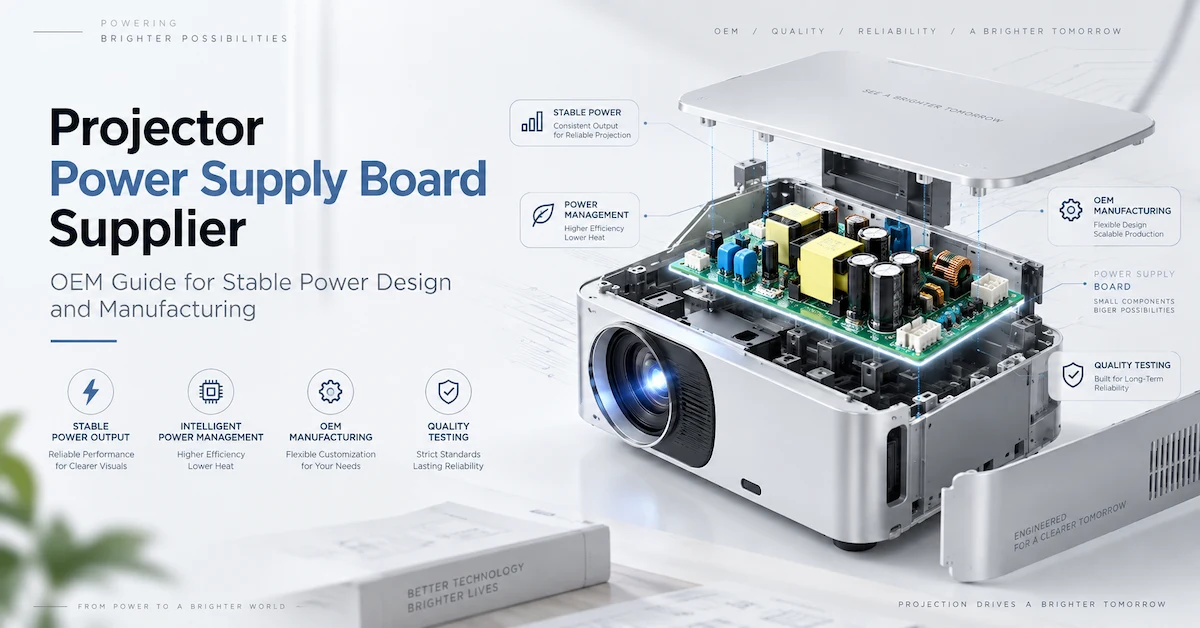
A projector power supply board is usually connected with multiple internal systems, including the main control board, display-related modules, cooling system, light source system, and other electronic components. Therefore, the supplier needs to understand not only PCB assembly but also how the power board integrates into the complete projector architecture.
HCDPCBA provides PCB prototyping, SMT assembly, component sourcing, DFMA, PCBA manufacturing, and OEM/ODM support. Buyers can review HCDPCBA manufacturing capabilities to understand the company's electronic manufacturing services before defining their specific projector project requirements.
Why Projector Brands Need a Professional Power Supply Board Supplier
The power board affects the entire projector system
The power supply board is one of the key electronic assemblies inside a projector. It manages power conversion and distribution between different functional modules, which means manufacturing consistency directly affects product stability.
For projector brands, a suitable supplier should be able to support:
- Custom PCB assembly based on customer designs
- Component sourcing and BOM management
- Manufacturing process control
- Prototype production and engineering review
- Testing requirements defined by the project
- Production scaling after validation
A supplier that only focuses on assembly may not provide enough support when the project requires engineering communication, component alternatives, or production optimization.
Different projector applications require different considerations
Projector products can vary significantly depending on their application.
Portable projector applications
Portable projectors often require compact PCB layouts, efficient power management, and integration with battery systems or compact enclosures.
Smart projector applications
Smart projectors may include additional electronic systems such as wireless communication, operating platforms, display control, and user interfaces.
Commercial projector applications
Commercial projection equipment may focus more on continuous operation, system stability, thermal management, and maintenance requirements.
Because these applications have different priorities, buyers should define the final product requirements before selecting a projector power supply board supplier.
What Information Should Buyers Prepare Before Contacting a Supplier?
A common sourcing problem is requesting quotations before the technical requirements are fully defined. A professional RFQ should provide enough information for the supplier to understand the manufacturing scope.
Before contacting a supplier, buyers should prepare:
| Information Category | Details to Confirm |
|---|---|
| Product application | Portable, smart, commercial, educational, or other projector types |
| PCB files | Gerber files, PCB drawings, and design revision |
| BOM information | Component list, manufacturer part numbers, approved alternatives |
| Assembly requirements | SMT, through-hole components, special processes |
| Electrical requirements | Input/output requirements and system connections |
| Testing requirements | Electrical testing, functional testing, acceptance criteria |
| Production quantity | Prototype, pilot production, or mass production requirements |
| Packaging requirements | Product protection, labels, and delivery requirements |
Providing complete information helps suppliers identify manufacturing requirements and reduces quotation differences caused by unclear assumptions.
Key Technical Factors When Choosing a Projector Power Supply Board Supplier
PCB design and manufacturing compatibility
The supplier should review whether the PCB design is suitable for stable production. Important considerations include:
- Board dimensions
- Layer structure
- Component density
- Connector placement
- Manufacturing accessibility
- Inspection requirements
A design that works during prototype development may still require adjustments before large-scale production.
HCDPCBA supports customized PCB assembly projects through its custom PCB assembly services, helping customers evaluate manufacturing requirements from prototype to production stages.
Component selection and BOM control
The BOM is one of the most important documents in projector electronics manufacturing.
A reliable projector power supply board supplier should help manage:
- Approved component sources
- Component availability
- Alternative component approval
- Material consistency
- BOM revision control
For power-related boards, component changes should be carefully reviewed because different components may influence electrical behavior, thermal performance, and product compatibility.
Thermal management considerations
Projector systems usually generate heat during operation. The power supply board design should consider:
- Heat-generating components
- Airflow conditions
- Component placement
- Product enclosure structure
- Operating environment
Thermal requirements should be defined according to the complete projector design instead of being considered only during PCB assembly.
Manufacturing Process Evaluation for Projector Power Boards
SMT assembly capability
Surface mount technology is a key manufacturing process for modern projector electronics.
During supplier evaluation, buyers should understand:
- Solder paste printing control
- Component placement accuracy
- Reflow soldering management
- Inspection process
- Production consistency
A professional supplier should have a controlled process from incoming materials to finished PCB assembly.
HCDPCBA provides SMT assembly and PCBA manufacturing support as part of its electronics production services. Buyers can review HCDPCBA PCBA solutions when evaluating manufacturing cooperation.
DFMA review before production
Design for Manufacturing and Assembly (DFMA) helps identify production risks before mass manufacturing.
A DFMA review may include:
- Component placement optimization
- Assembly accessibility
- Test-point design
- Connector positioning
- Production efficiency
- Potential manufacturing issues
Early engineering communication can reduce redesign costs and production delays.
Quality Control and Testing Requirements
Inspection methods should match product requirements
A projector power supply board supplier should define inspection methods according to the board structure and project requirements.
Common inspection methods may include:
| Inspection Method | Purpose |
|---|---|
| Visual inspection | Identify visible assembly issues |
| AOI inspection | Check component placement and soldering conditions |
| X-Ray inspection | Review selected hidden solder connections |
| Electrical testing | Verify electrical characteristics |
| Functional testing | Confirm required board functions |
Different testing methods solve different problems. AOI inspection alone does not confirm complete product functionality, and functional testing requirements should be defined according to the projector design.
Testing should be agreed before production
Before mass production, buyers should confirm:
- What items are tested
- Testing conditions
- Acceptance standards
- Test records required
- Handling process for failed boards
A clear testing agreement helps both suppliers and buyers understand production expectations.
How to Compare Projector Power Supply Board Suppliers Before Placing an Order
Choosing a projector power supply board supplier requires comparing the complete manufacturing capability rather than focusing only on the lowest quotation. Different suppliers may provide completely different service scopes. One supplier may only provide SMT assembly, while another may support PCB sourcing, component procurement, engineering review, testing, and production management.
Before making a decision, buyers should compare suppliers based on:
- Manufacturing responsibility
- Engineering support
- Component sourcing capability
- Quality-control process
- Testing coverage
- Production communication
- Long-term supply stability
A lower unit price does not always represent a lower total project cost. If a supplier excludes important processes such as testing preparation, engineering review, or material management, additional costs and risks may appear later.
Compare Different Projector Electronics Manufacturing Models
Assembly Only Service
Under an assembly-only model, the buyer usually provides:
- PCB files
- GOOD
- Components or sourcing instructions
- Assembly drawings
- Testing requirements
The supplier mainly focuses on:
- SMT placement
- Soldering
- Assembly
- Inspection
This model is suitable for companies that already have a mature supply chain and internal engineering resources.
Turnkey PCBA Manufacturing
A turnkey model provides broader support, including:
- PCB sourcing
- Component purchasing
- SMT assembly
- Inspection
- Testing
- Packaging coordination
This approach can reduce communication between multiple suppliers because one manufacturing partner manages more steps.
HCDPCBA provides turnkey PCBA manufacturing services covering different stages from engineering review to production. Buyers can review HCDPCBA turnkey PCBA manufacturing solutions when evaluating supplier cooperation.
OEM/ODM Project Cooperation
For new projector products, some companies may need deeper cooperation.
OEM/ODM cooperation may involve:
- Product requirement analysis
- Engineering support
- Prototype development
- Design improvement
- Manufacturing preparation
- Production support
Before starting an ODM project, both sides should clearly define:
- Design ownership
- Engineering responsibilities
- File access rights
- Modification process
- Production approval procedures
Understand the Cost Factors of Projector Power Supply Board Manufacturing
The cost of a projector power supply board is influenced by multiple factors rather than only PCB assembly quantity.
PCB Design Complexity
Factors include:
- PCB size
- Layer count
- Component density
- Manufacturing difficulty
- Special requirements
More complex designs may require additional engineering review and manufacturing preparation.
Component Selection
Power boards often contain components that influence:
- Electrical performance
- Thermal behavior
- Product stability
- Long-term availability
Selecting alternative components without engineering review may create production or performance risks.
Testing Requirements
Testing requirements can influence manufacturing cost because they may require:
- Additional fixtures
- Programming procedures
- Functional testing time
- Inspection records
A supplier quotation should clearly define what testing services are included.
Production Quantity
Prototype, pilot production, and mass production usually involve different cost structures.
| Production Stage | Main Purpose | Main Considerations |
|---|---|---|
| Prototype | Verify design feasibility | Engineering review, small quantity, design improvement |
| Pilot Production | Verify manufacturing stability | Process optimization, testing, documentation |
| Mass Production | Repeatable delivery | Supply chain control, quality consistency |
How to Prepare an RFQ for a Projector Power Supply Board Supplier
A detailed RFQ helps suppliers provide more accurate feedback.
Buyers should prepare:
Product Information
Include:
- Projector application
- Product type
- Functional requirements
- Target market
- Production stage
Technical Documents
Provide:
- PCB design files
- GOOD
- Schematics if available
- Assembly drawings
- Component specifications
- Testing requirements
Manufacturing Requirements
Clarify:
- Expected quantity
- Prototype requirements
- Mass production plans
- Packaging requirements
- Delivery expectations
Quality Requirements
Define:
- Inspection standards
- Functional testing requirements
- Documentation requirements
- Acceptance criteria
A complete RFQ allows the supplier to identify manufacturing challenges before production begins.
Why Engineering Communication Matters During Project Development
A professional projector power supply board supplier should not only manufacture according to files but also communicate manufacturing concerns before they become production problems.
Important communication points include:
Before Prototype Production
Discuss:
- PCB manufacturability
- Component availability
- Assembly challenges
- Testing methods
During Prototype Review
Evaluate:
- Assembly quality
- Functional performance
- Design improvements
- Manufacturing adjustments
Before Mass Production
Confirm:
- Good ending
- PCB revision
- Approved samples
- Testing process
- Production documentation
Clear communication reduces misunderstandings between engineering teams and manufacturing teams.
Frequently Asked Questions
What should I consider when selecting a projector power supply board supplier?
Consider manufacturing capability, component sourcing, engineering support, testing methods, quality-control processes, and the supplier’s ability to support your production stage.
Can a PCBA factory manufacture projector power supply boards?
Yes, if the factory has suitable PCB assembly capability and can meet the specific design, component, testing, and production requirements of the projector project.
What documents are needed for projector power board quotation?
Usually include PCB files, BOM, assembly drawings, quantity requirements, testing requirements, and product application information.
Should I choose assembly-only or turnkey PCBA service?
It depends on your internal resources. Assembly-only service suits companies managing their own supply chain, while turnkey PCBA reduces supplier coordination by combining multiple manufacturing steps.
Why is BOM management important for projector electronics?
Because component changes can affect electrical performance, production consistency, availability, and product compatibility.
Does AOI inspection guarantee projector PCB quality?
No. AOI helps identify visible assembly issues, but electrical testing and functional testing may still be required depending on the product requirements.
How can buyers reduce projector PCB manufacturing costs?
Review design optimization, component selection, production quantity, manufacturing efficiency, and testing requirements together instead of focusing only on assembly price.
Can suppliers support projector prototype development?
Many electronics manufacturers support prototype production, but buyers should confirm the required engineering support, testing scope, and transition process before moving into mass production.
What is the difference between a projector power board supplier and a general PCB supplier?
A projector power board supplier should understand the specific requirements of power-related assemblies, including component selection, electrical requirements, thermal considerations, and integration with the projector system.
How do I request a quotation from a projector power supply board supplier?
Prepare your PCB files, BOM, application details, quantity, testing requirements, and production expectations, then submit the information for technical evaluation before comparing quotations.
Conclusion
Selecting the right projector power supply board supplier requires evaluating manufacturing capability, engineering communication, quality control, testing requirements, and long-term production support rather than comparing price alone.
A reliable supplier should be able to understand the role of the power board inside the complete projector system, manage components and production processes, support prototype-to-production transition, and maintain consistency across repeat orders.
HCDPCBA provides PCB prototyping, SMT assembly, component sourcing, DFMA, testing, and OEM/ODM electronics manufacturing services. Buyers can review HCDPCBA products and manufacturing solutions and submit project requirements through the HCDPCBA Contact Us page to discuss projector electronics manufacturing needs based on their actual design, production goals, and quality requirements.