What Should Buyers Expect From an SMT Assembly Factory in China?
When an overseas buyer searches for SMT assembly factory China, the real requirement is usually not surface-mount placement alone. The buyer needs a manufacturing system that can receive controlled production files, manage components, prepare the assembly process, place and solder parts consistently, inspect the resulting boards, perform the agreed electrical or functional verification, and reproduce the same approved configuration when quantities increase. HCDPCBA describes its business around PCB prototyping, SMT assembly, DFMA, component sourcing, SMT/DIP and final assembly, and testing support, so the relevant sourcing discussion should cover the complete project scope rather than treating SMT as an isolated production step. Buyers can first review HCDPCBA's manufacturing capabilities and then determine which stages should actually be included in their quotation.
Which Buyers Benefit Most From a China SMT Assembly Partner?
A China SMT assembly partner is particularly relevant to electronics brands, hardware startups, design houses, industrial equipment manufacturers, IoT companies, security-device developers, consumer-electronics brands, medical-device teams, and automotive-related electronics companies that need prototypes, pilot builds, or repeated PCBA production. It becomes especially useful when purchasing wants to reduce coordination among separate PCB, component, assembly, and testing suppliers. However, an assembly factory is not automatically the right solution for a project that has no released BOM, unstable firmware, unresolved mechanical interfaces, or undefined acceptance criteria. In those cases, the buyer should first establish whether engineering review, DFMA, sourcing support, or ODM work is needed. HCDPCBA's turnkey PCBA manufacturing guide distinguishes a broader one-stop manufacturing model from simple assembly and gives buyers a useful framework for deciding how much responsibility they want the supplier to take.
Prepare a Manufacturing Package Before Requesting an SMT Quote
An SMT quotation becomes meaningful only when the factory knows what it is being asked to build. Sending only Gerber files and an estimated quantity may be enough for an early budget discussion, but it is not enough to define a production deliverable. A complete RFQ should identify the PCB revision, approved BOM, placement data, assembly drawings, quantities, component-supply method, programming requirements, inspection scope, functional requirements, and any mechanical or environmental constraints that affect assembly. The following table is a buyer-side RFQ framework rather than a statement that every HCDPCBA project uses identical specifications.
| Requirement Area | What the Buyer Should Provide or Confirm | Why It Matters to SMT Production |
|---|---|---|
| PCB files | Gerber/drill data, fabrication drawing and current revision | Prevents production against obsolete board data |
| BOM | Manufacturer part numbers, quantity, package and approved alternatives | Defines purchasing and placement requirements |
| Placement data | Pick-and-place/CPL coordinates and orientation information | Supports programming of placement equipment |
| Assembly drawing | Polarity, special placement notes, connectors and mechanical restrictions | Resolves details not obvious from coordinates alone |
| Quantity | Prototype, pilot and forecast production quantities | Influences material purchasing and production planning |
| Component supply | Customer-supplied, factory-sourced or mixed | Determines incoming-material responsibility |
| Firmware | Programming file, version and programming method where required | Controls software configuration during production |
| Inspection | AOI, X-Ray or other agreed inspection requirements | Defines inspection coverage |
| Functional testing | Power, interface, communication or product-specific tests | Defines fixtures and shipment criteria |
| Delivery requirements | Packaging, labels, traceability and target schedule | Establishes the final manufacturing deliverable |
Understand the SMT Process Instead of Auditing Only the Machine List
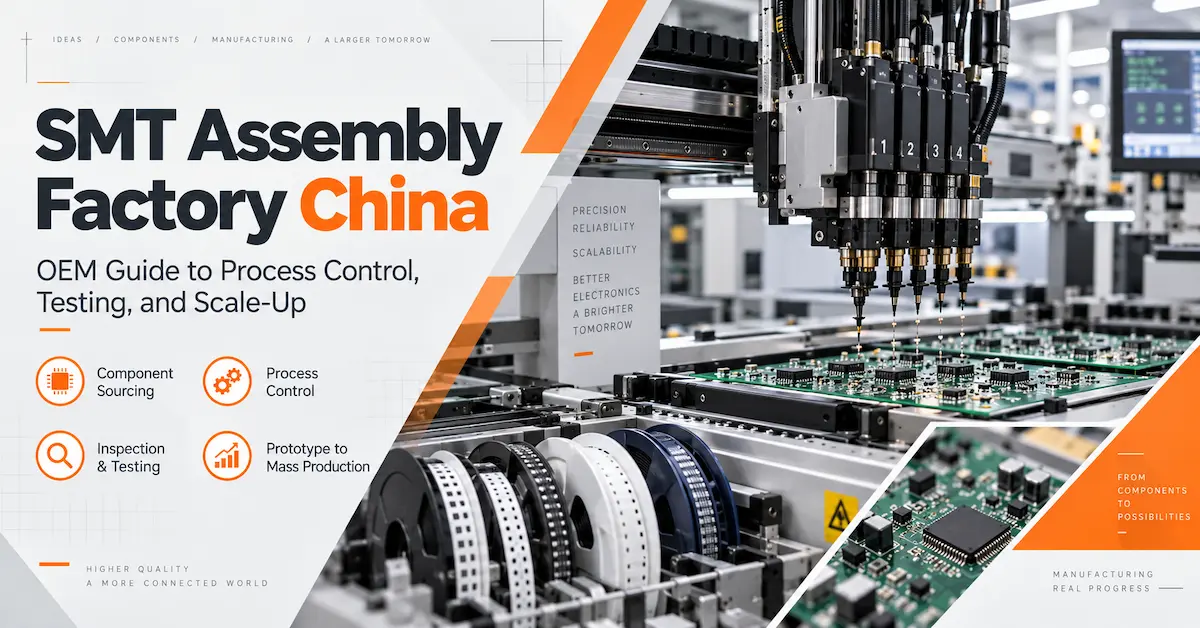
The value of an SMT factory comes from process control rather than the presence of individual machines. A typical SMT build moves through material preparation, solder-paste printing, component placement, reflow soldering, inspection, and any required downstream assembly or testing. Each stage introduces variables that need to be controlled: stencil and paste conditions influence deposit consistency; placement depends on correct feeder setup, package data, orientation, and machine programming; reflow requires an appropriate thermal profile for the board and assembly; inspection must distinguish cosmetic variation from defects that affect acceptance. HCDPCBA's existing SMT assembly factory article similarly focuses on process stability, material traceability, testing coverage, equipment maintenance, and engineering-change control rather than simply listing equipment. When auditing a supplier, ask how these controls are documented and applied to your board instead of asking only how many SMT lines the factory operates.
Component Sourcing Is Part of SMT Risk Control
A technically capable assembly line cannot compensate for the wrong component, an unapproved substitution, incorrect packaging, or uncontrolled material storage. For this reason, component sourcing should be evaluated together with SMT production. Buyers should define approved manufacturer part numbers, identify critical components that cannot be substituted without authorization, clarify who owns excess or obsolete material, and establish a process for shortages or end-of-life parts. If the factory is responsible for sourcing, the quotation should state what is included and how alternatives are proposed. HCDPCBA's About Us page describes component sourcing alongside assembly and testing, while its turnkey manufacturing content treats BOM management and procurement as part of the PCBA workflow. This makes it appropriate to include sourcing responsibility in the initial supplier discussion rather than treating it as a separate purchasing issue after the SMT quote has already been accepted.
Use DFMA Before Fine-Pitch or High-Density Boards Enter Production
A board can be electrically correct while still creating unnecessary assembly risk. DFMA should therefore examine component footprints, polarity, spacing, board edges, panelization, connector orientation, test-point accessibility, component-height restrictions, and any areas that complicate printing, placement, reflow, inspection, or downstream assembly. For designs containing BGA, QFN, fine-pitch ICs, dense connectors, or mixed assembly technologies, buyers should ask how hidden joints and difficult-to-inspect locations will be handled. HCDPCBA lists DFMA among its published services and presents custom PCB assembly from prototype to larger production quantities, so buyers can use HCDPCBA's custom PCB assembly service as a starting point for discussing manufacturability before releasing a pilot build. DFMA should identify questions for engineering approval; it should not silently change electrical or mechanical requirements.
Inspection and Functional Testing Solve Different Problems
An SMT assembly factory China buyer should not accept “100% tested” without asking what the phrase means. AOI can help detect selected visible placement and soldering issues, while X-Ray can provide visibility into selected hidden solder joints such as those beneath certain packages. Electrical or functional tests answer different questions about whether the assembled board behaves as required. HCDPCBA publicly lists AOI and X-Ray as quality-control resources and describes assembly/testing within its manufacturing services, but the exact inspection and functional-test scope still needs to be agreed for each project. Buyers should define which boards are tested, what functions are checked, whether a dedicated fixture is needed, what pass/fail limits apply, and what records are expected with production. Equipment availability is evidence of capability; it is not by itself evidence that every order receives every possible test.
Audit Process Control, Traceability, and Change Management
Factory audits are more useful when they follow the life of one real order rather than moving quickly through a showroom of equipment. Ask how the incoming BOM is checked against the released version, how production programs are approved, how reels and lots are identified, how first-article results are reviewed, how nonconforming boards are segregated, and how rework is documented. Then ask what happens when a component, PCB revision, firmware file, test requirement, or assembly instruction changes between batches. HCDPCBA's existing PCBA factory article emphasizes repeatability across batches rather than a successful first production run, which is an important distinction for OEM buyers. A supplier that can build five prototypes is not automatically ready to reproduce the same configuration across recurring production unless materials, files, processes, and changes are controlled.
Do Not Treat Certifications as a Substitute for Project Evidence
Quality-system or compliance documents can be important during supplier qualification, but buyers should verify the actual certificate holder, manufacturing site, scope, issuing body, and current validity rather than relying only on a logo shown on a website or sales presentation. Product-level regulatory requirements should also be separated from factory-level quality-system documentation because the destination market, product architecture, radio modules, power design, materials, or application may create additional requirements. During an SMT assembly factory China evaluation, ask which documents apply to the manufacturing site and which remain the responsibility of the finished-product owner. The same principle applies to IPC or customer-specific workmanship requirements: if a project must follow a particular acceptance standard, identify the edition, class, inspection method, and contractual requirement rather than assuming that the phrase “IPC compliant” has identical meaning for every order.
Prototype, Pilot, and Mass Production Should Be Separate Gates
A prototype is primarily useful for learning whether the design can be assembled and evaluated; a pilot build is useful for validating whether the manufacturing package, sourcing plan, programming process, inspection, functional testing, and documentation can operate together; mass production should begin only after important open issues have been resolved and the approved configuration has been released. HCDPCBA states that it supports PCB prototyping and SMT assembly across different quantities, and its turnkey manufacturing material describes a workflow spanning sourcing, SMT/THT assembly, testing, and delivery. Buyers should therefore request a project schedule that separates engineering clarification, material procurement, PCB fabrication, SMT setup, assembly, testing, and shipment rather than treating “lead time” as one unexplained number.
How Should Buyers Compare SMT Assembly Service Models?
Searching SMT assembly factory China often returns suppliers that appear similar but quote very different scopes. Before comparing unit prices, determine whether each quotation is for customer-supplied assembly, turnkey PCBA, or a broader OEM/ODM manufacturing program. The table below compares service structures rather than invented product models, because SMT assembly is a manufacturing service and the appropriate route depends on how much of the supply chain the buyer wants to control.
| Manufacturing Route | Buyer Normally Manages | Factory Scope to Confirm | Best Fit | Main Risk to Review |
|---|---|---|---|---|
| Consigned SMT assembly | PCB/components, released files and acceptance requirements | SMT, agreed inspection, downstream assembly and testing | Buyers with established sourcing teams | Missing material, excess parts and unclear responsibility for supplied components |
| Turnkey PCBA | Released design, approved BOM, quantity and acceptance requirements | PCB sourcing, component procurement, SMT/THT, inspection, testing and delivery | OEMs wanting fewer suppliers to manage | Substitution approval, quotation exclusions and material lead time |
| OEM/ODM manufacturing | Product requirements plus buyer approvals | Engineering support, sourcing, prototype/pilot, manufacturing and agreed system integration | New or substantially customized products | Design ownership, firmware, validation and change-control responsibility |
HCDPCBA's OEM electronics manufacturer China guide uses a similar distinction between an assembly-only supplier and a broader one-stop manufacturing partner, making scope comparison more meaningful than comparing headline unit prices.
What Really Drives SMT Assembly Cost?
SMT pricing is affected by more than board quantity. Cost can be influenced by component count, package types, fine-pitch or BGA content, double-sided assembly, stencil and setup requirements, component sourcing, PCB panelization, manual or THT operations, programming, X-Ray or other inspection requirements, functional-test fixtures, test cycle time, rework expectations, packaging, and order frequency. The buyer should therefore separate one-time costs from recurring costs and request the same manufacturing scope from each potential supplier. A low assembly quotation can become expensive if it excludes sourcing work, engineering review, fixture preparation, functional verification, rework responsibility, or controlled documentation. Cost reduction is more useful when it comes from DFMA, panel utilization, BOM optimization, approved alternatives, efficient test strategy, or stable repeat orders rather than simply removing controls that were included to protect product quality. HCDPCBA's turnkey guide makes the same broader point that PCBA economics depend on an integrated manufacturing workflow rather than placement alone.
Capacity and Lead Time Should Be Discussed as Conditions, Not Slogans
Factory capacity matters only when it is related to your product and forecast. Ask how prototype, pilot, and repeat orders are scheduled; what happens when a component has a long procurement cycle; whether the project needs new fixtures; how mixed SMT and THT work is planned; and what conditions must be satisfied before the quoted production clock begins. Published machine speed or nominal monthly capacity does not automatically predict the delivery date of a specific board. Likewise, a fast prototype service does not guarantee that a later large order will use the same commercial or scheduling conditions. HCDPCBA's About Us page states that its SMT service supports both small and larger batches, but buyers should still obtain a project-specific schedule based on component availability, PCB requirements, complexity, testing, quantity, and release status before committing customer delivery dates.
Define OEM, ODM, IP Protection, and Engineering Changes in Writing
For build-to-print OEM work, identify who controls the schematic, PCB files, BOM, firmware, test specification, approved alternatives, and production release. For ODM projects, additionally define who performs design work, owns source files, manages firmware, prepares prototypes, develops test fixtures, supports validation, and approves later design changes. Confidentiality and file access should be agreed before transferring sensitive data. Engineering-change control is equally important: if an ECN changes a component, PCB revision, firmware, test limit, label, or mechanical part, determine who can authorize that change and how the approved version is linked to future orders. HCDPCBA describes confidentiality and one-to-one service on its website as part of its manufacturing approach; buyers should convert those general commitments into project documents appropriate to their own IP and change-control requirements.
What Should You Send HCDPCBA for an SMT Assembly Evaluation?
A useful inquiry should include Gerber and drill files, BOM with manufacturer part numbers, pick-and-place data, assembly drawings, PCB quantity, desired prototype and production volumes, component-supply preference, firmware requirements, inspection and testing needs, special assembly instructions, packaging requirements, and the requested project schedule. If the product is still under development, identify unresolved items so DFMA or OEM/ODM support can be evaluated separately from routine assembly. Buyers can first review HCDPCBA's PCB and PCBA products and its turnkey manufacturing guide, then submit the actual manufacturing package through HCDPCBA Contact Us. A detailed RFQ gives the factory enough information to identify assumptions, exclusions, sourcing risks, testing needs, and the correct production route instead of returning only a provisional unit price.
Frequently Asked Questions
1. What files should I send to an SMT assembly factory in China for quotation?
For a mature PCBA design, prepare Gerber and drill data, BOM, pick-and-place files, assembly drawings, required quantities, and inspection or functional-test requirements. Schematics, firmware, mechanical drawings, and programming instructions should also be provided when they affect manufacturing or test preparation.
2. Can an SMT factory handle both prototype and mass production?
Some factories support both, but the buyer should verify how the workflow changes between stages. Prototype success should be followed by a controlled pilot build that confirms materials, programs, inspection, test fixtures, documentation, and production instructions before quantities increase. HCDPCBA states that its SMT service covers different production quantities, but the actual project schedule and commercial conditions should be confirmed for each order.
3. What is the difference between SMT assembly and turnkey PCBA manufacturing?
SMT assembly primarily concerns placing and soldering surface-mount components onto PCBs according to the released manufacturing package. Turnkey PCBA can extend the scope to PCB sourcing, component purchasing, BOM management, SMT/THT assembly, inspection, programming, functional testing, packaging, and delivery, depending on the agreed project.
4. Should I choose the SMT assembly factory China supplier with the lowest unit price?
Not until the quotation scope is normalized. Compare whether PCB procurement, components, stencils, engineering review, inspection, programming, fixtures, functional testing, rework, packaging, and documentation are included. Two suppliers quoting different deliverables cannot be meaningfully compared by unit price alone.
5. How should component substitutions be controlled?
Use an approved BOM and identify parts that require engineering authorization before replacement. Require the factory to propose an alternative with manufacturer part number and relevant technical information, then record the approved change before production. Critical functional parts should not be substituted only because another component has the same package or nominal value.
6. Are AOI and X-Ray enough to guarantee a working PCBA?
No inspection method proves every product function. AOI and X-Ray can support assembly-quality inspection, while electrical or functional verification is used to address board behavior under defined conditions. The buyer should establish an acceptance plan that reflects the board architecture and intended application.
7. How should I evaluate a China SMT factory remotely?
Request company and manufacturing information, relevant quality documents, a clear production flow, sample quality records where appropriate, photos or video of the actual facility, explanations of traceability and engineering-change control, and a technical review of your own board. A useful remote audit asks how one order moves through the factory rather than relying only on a general company presentation.
8. What determines SMT assembly lead time?
PCB fabrication, component availability, material purchasing quantities, assembly complexity, production scheduling, programming, fixture preparation, inspection, functional testing, order quantity, and engineering-release status can all influence timing. Ask for a schedule tied to defined start conditions rather than a generic number.
9. Can HCDPCBA provide component sourcing together with SMT assembly?
HCDPCBA's published service information includes component sourcing, SMT/DIP assembly, final assembly, DFMA, and testing support. The buyer should still confirm the exact procurement scope, approved component sources, alternative-part process, and commercial responsibility for the specific project.
10. What is the best way to reduce risk before a large SMT order?
Freeze the approved PCB revision, BOM, firmware, assembly drawings, test requirements, and packaging instructions; complete a prototype or pilot build; close manufacturing issues; approve any component alternatives; and define change control before scaling. The objective is to make the larger order a controlled repetition of an approved process rather than another engineering experiment.
Conclusion
Selecting an SMT assembly factory China buyers can use for long-term OEM production requires a broader evaluation than placement equipment, quoted unit price, or a successful first sample. A reliable sourcing decision should consider manufacturing-file control, component sourcing, DFMA, solder-paste and reflow process management, inspection, functional testing, traceability, engineering changes, prototype-to-pilot transition, and the commercial boundaries of the quotation. HCDPCBA positions its manufacturing services around PCB prototyping, SMT assembly, component sourcing, DFMA, SMT/DIP and final assembly, and testing support, providing a basis for buyers that want either assembly support or a broader turnkey PCBA workflow. Before comparing suppliers, define what a finished and accepted PCBA means for your product; then provide the same technical package and acceptance requirements to each candidate. For a project-specific assessment, submit your Gerber files, BOM, quantities, assembly information, component-sourcing preference, and testing requirements through HCDPCBA Contact Us so the quotation can be built around the actual manufacturing scope rather than a generic SMT price.