Low-Light Camera Module: High-Sensitivity Imaging for Night Vision and Low-Illumination Environments
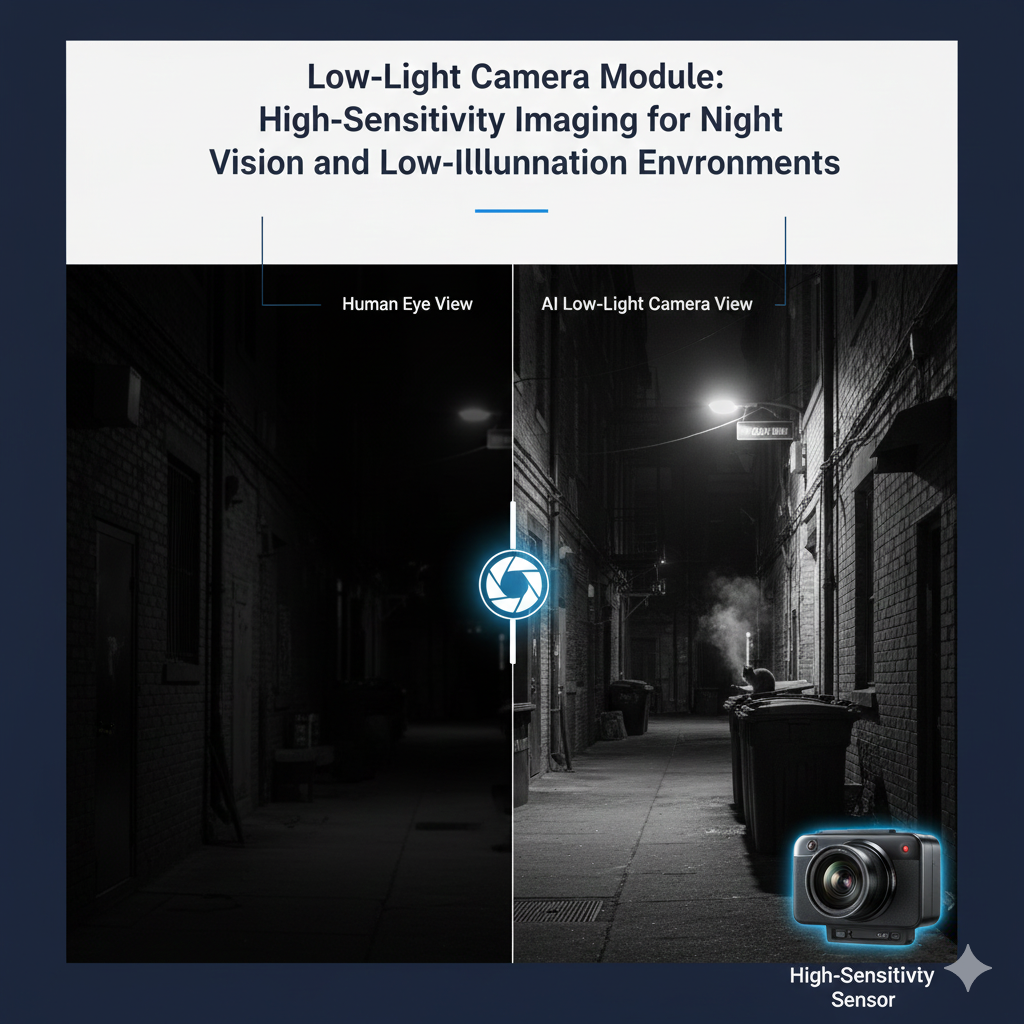
When the human eye fails to perceive, the camera must compensate.
A low-light camera module is built to capture clarity in the absence of light — combining starlight-level CMOS sensors, optical calibration, and precision PCBA design to reveal detail in the dark.
Unlike standard modules, it doesn’t rely on strong illumination. Instead, it converts even the faintest photon into stable, noise-free visual data. This capability makes it essential in smart surveillance, automotive night vision, and industrial detection where visibility defines safety and accuracy.
1. Core Imaging Architecture: Sensitivity Meets Precision
At the heart of every low-illumination camera lies a next-generation back-illuminated CMOS (BSI) sensor with enhanced quantum efficiency.
Each design element — from pixel structure to optical interface — is engineered to maximize photon utilization.
| Technical Element | Description | Performance Benefit |
|---|---|---|
| Large Pixel Pitch (2.9–4.0μm) | Greater light-absorbing surface area | Improves low-light brightness |
| Back-Illuminated Sensor (BSI) | Metal layers behind light path | +30% sensitivity gain |
| Stacked Pixel Architecture | Separates logic from photosites | Reduces cross-talk and thermal noise |
| High ISO Amplifier Chain | Optimized analog front-end | Prevents detail loss in dim scenes |
| WDR + HDR Control | Multi-exposure blending | Retains contrast between bright and dark areas |
This architecture allows the module to render full-color night scenes at illumination levels below 0.01 lux, approaching human visual adaptation in darkness.
2. Optical System: Light Management by Design
Optical precision defines how efficiently a camera uses available light.
Factories that manufacture low-light camera modules optimize each element of the optical path for brightness retention and distortion control.
-
Ultra-wide aperture lenses (F1.0–F1.4) maximize photon intake.
-
Anti-reflective multi-layer coatings prevent lens flare from light sources.
-
IR-cut filter switching enables natural color during day and IR-boosted clarity at night.
-
Glass lens elements replace plastic for better refraction stability in temperature variations.
-
Automated optical axis calibration ensures sensor-lens alignment within ±3µm.
Each improvement enhances light transmission efficiency, producing balanced brightness and focus uniformity even in uneven illumination.
3. Noise Reduction and Signal Optimization
Low light introduces more noise — and this is where electronic design becomes critical.
The image enhancement PCBA functions as a stabilization and compensation engine, balancing brightness with signal integrity.
Key signal optimization measures include:
-
Dual-stage temporal + spatial noise filtering to reduce random pixel noise.
-
Low-ripple power rails (≤20mV) for stable voltage across analog circuits.
-
Differential impedance routing (90Ω) for clean MIPI/LVDS data lines.
-
AI-based denoise firmware performing real-time noise pattern recognition.
-
Gain balancing algorithms that enhance shadows without color washout.
The result is a clean, bright, and accurate image output — even when light is nearly nonexistent.
4. Thermal and Power Management for Continuous Night Operation
Continuous 24-hour imaging in outdoor or enclosed environments can cause thermal instability and signal drift.
To ensure reliability, low-light modules incorporate advanced thermal and power balancing mechanisms:
| Design Layer | Implementation | Purpose |
|---|---|---|
| High-Tg FR-4 PCBs (≥170°C) | Improved heat endurance | Long-term reliability |
| Copper-filled thermal vias | Efficient heat conduction | Prevents thermal blooming |
| AI-controlled exposure timing | Adaptive current control | Maintains steady brightness |
| Passive aluminum housing | Integrated heat path | Eliminates fan requirement |
| Protective conformal coating | Moisture and dust resistance | Extends component lifespan |
These measures ensure that image performance remains stable across temperature shifts, vibration, and humidity — conditions common in automotive and surveillance applications.
5. Real-World Applications: Where Low-Light Vision Defines Safety
Low-light modules are deployed wherever illumination is inconsistent, yet precision is critical.
-
Smart Surveillance Systems – Color night vision with starlight-level clarity for 24/7 operation.
-
Automotive ADAS Cameras – Enhanced pedestrian and lane visibility in low light or tunnels.
-
Industrial Monitoring – Defect and alignment detection in dim or reflective environments.
-
Smart Home Security Devices – Doorbell and motion cameras capturing color detail under moonlight.
-
Marine and Aerial Systems – Reliable performance in fog or low-visibility weather.
In all these cases, brightness consistency and low noise define real-world usability — not just sensor specifications.
6. Testing and Quality Validation for Professional Reliability
A low-light camera module must not only perform under controlled tests — it must remain reliable after years of exposure to challenging conditions.
Manufacturers conduct extensive multi-dimensional validation:
| Test Type | Purpose | Standard or Range |
|---|---|---|
| Low-Illumination Performance Test | Validate color and brightness retention | <0.01 lux conditions |
| Thermal Shock Cycle | Assess material and solder endurance | -40°C to +85°C, 200 cycles |
| Signal Integrity Test | Measure data consistency across layers | MIPI Eye Diagram Compliance |
| Humidity Resistance Test | Prevent optical fogging | 60°C / 90% RH for 72 hours |
| Aging Test | Long-duration burn-in reliability | 72–120 hours continuous runtime |
This ensures each module is not only precise but production-ready for industrial and consumer-grade integration.
7. Advantages of Choosing a Professional Low-Light Module Manufacturer
Partnering with a specialized low-light camera module manufacturer provides OEMs with:
-
Full in-house integration – From sensor bonding to PCBA to optical calibration.
-
Proven starlight imaging expertise – Optimized for low illumination and HDR environments.
-
AI-enhanced signal processing firmware – Adaptive scene and brightness control.
-
Global supply readiness – Supporting automotive, security, and industrial clients.
-
Customization flexibility – Lens, board shape, or communication protocol tailored to specific use cases.
Such integrated manufacturing capability ensures not only high performance but consistent quality across production volumes.
Precision in Every Pixel
Seeing clearly in darkness is not luck — it’s the result of design discipline.
A professional low-light camera module combines sensor sensitivity, optical efficiency, and circuit precision to convert shadows into data and uncertainty into confidence.
For custom starlight or low-illumination camera solutions, explore our imaging systems at www.hcdpcba.com or connect with our engineers through the contact page.
Because the difference between light and dark — is engineering.