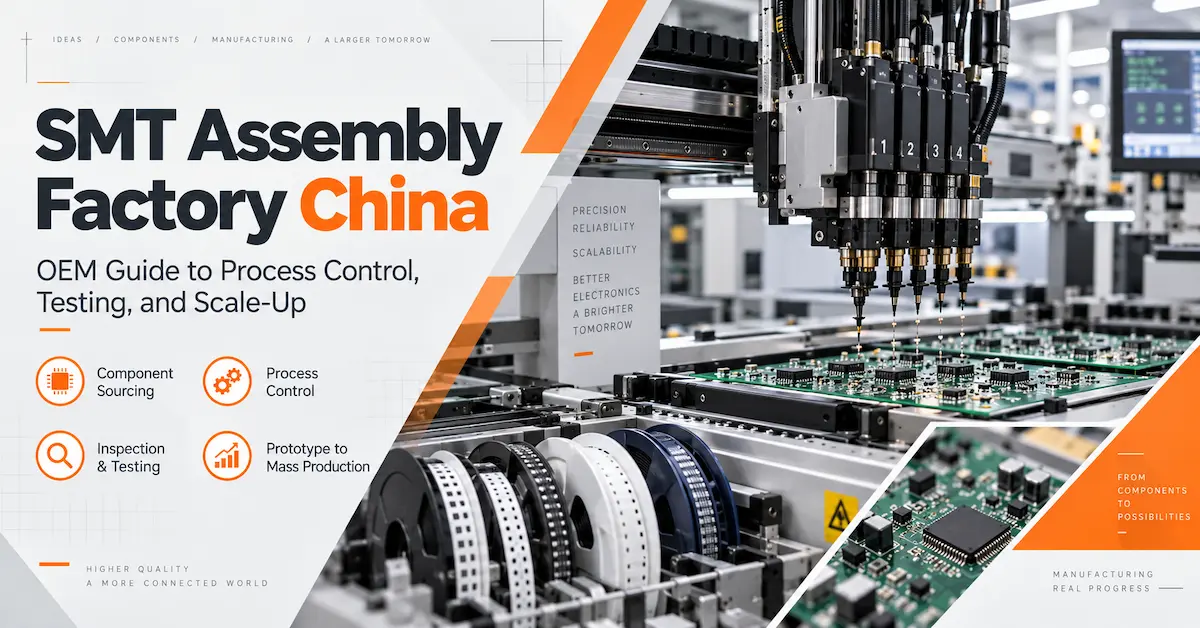
What Is an AI Device PCBA and Why Does It Require Specialized Manufacturing?
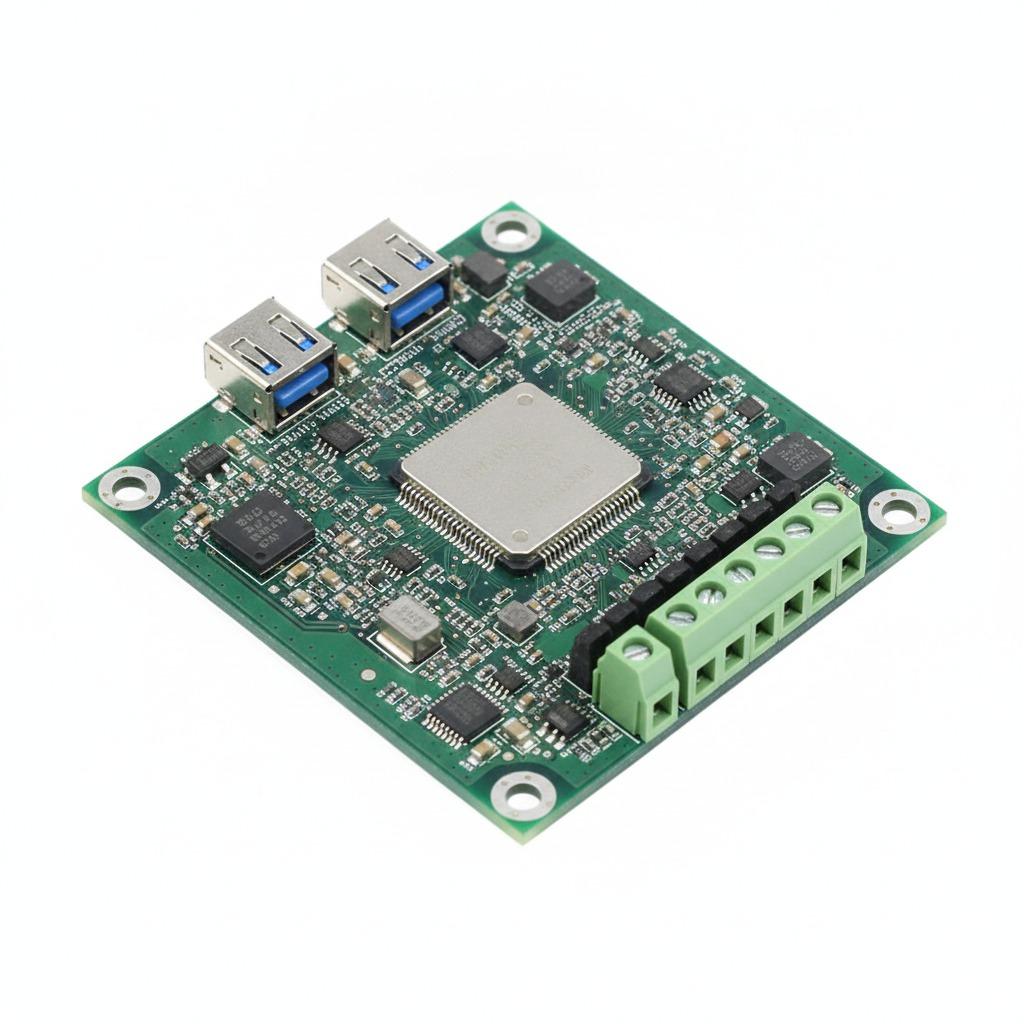
An AI device PCBA is the electronic foundation that enables intelligent hardware products to collect data, process information, communicate with other systems, and execute automated functions. Unlike traditional electronic boards that mainly handle fixed control tasks, AI-oriented devices often combine computing modules, sensors, communication interfaces, power management, storage, and software-related hardware requirements into a compact system.
For companies developing AI terminals, smart devices, edge-computing products, intelligent cameras, robotics equipment, or connected industrial devices, selecting an AI device PCBA manufacturer requires evaluating more than SMT assembly capability. The supplier needs to understand how hardware architecture, component sourcing, manufacturing processes, testing requirements, and production control work together.
HCDPCBA provides PCB prototyping, SMT assembly, component sourcing, DFMA review, PCBA manufacturing, testing, and OEM/ODM electronics manufacturing services. These capabilities are relevant for AI hardware projects where customers need customized boards or production support. Buyers can review HCDPCBA manufacturing capabilities to understand the company's electronics manufacturing scope.
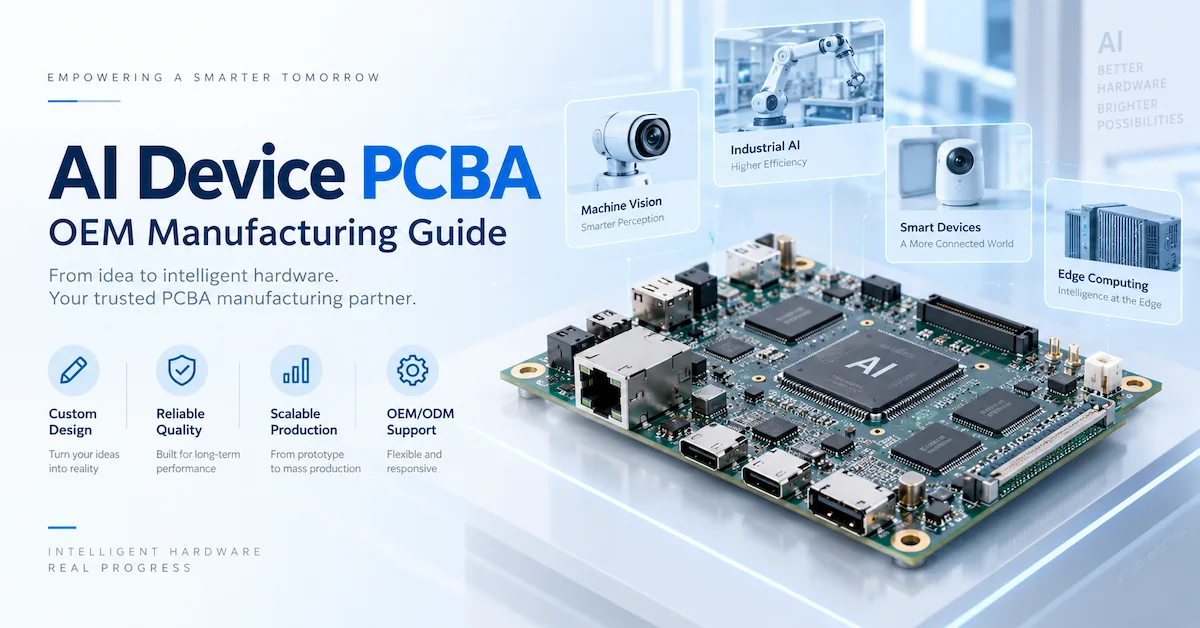
Which Companies Need AI Device PCBA Manufacturing?
AI Hardware Startups
AI startups often need manufacturing support after completing early hardware concepts. Their challenges may include:
- Moving from development boards to custom PCBA
- Reducing prototype size
- Improving production consistency
- Managing component sourcing
- Preparing for pilot production
For these companies, an AI device PCBA supplier should provide manufacturing feedback during the transition from prototype design to production-ready hardware.
Smart Device Brands
Consumer electronics brands developing intelligent products may require customized PCBA solutions for:
- Smart home devices
- AI assistants
- Intelligent control terminals
- Connected appliances
- Smart monitoring products
These projects usually require coordination between electronics, software, mechanical design, and manufacturing.
Industrial AI Equipment Companies
Industrial AI devices may require more specialized hardware integration, including:
- Sensor interfaces
- Communication modules
- Control systems
- Industrial connectivity
- Long-term production support
The manufacturing requirements depend heavily on the operating environment and product architecture.
Who May Not Need Custom AI Device PCBA?
Not every intelligent product requires a completely customized PCB.
A custom AI board may not be necessary when:
- A standard development platform already meets the product requirements
- The hardware architecture is still changing frequently
- The application requirements are not yet defined
- Production quantity is too uncertain for manufacturing planning
In these situations, buyers should first define the product requirements before investing in a customized production design.
Start With the AI Device Application Before Designing the PCBA
A common mistake in AI hardware development is selecting components before defining the actual application.
An AI device PCBA designed for a smart camera, robot, industrial monitoring system, or smart terminal may require completely different priorities.
| Application | Typical Hardware Considerations |
|---|---|
| AI camera device | Image processing, camera interfaces, storage, communication and power management |
| Smart home AI device | Wireless connectivity, sensors, user interface and low-power operation |
| Industrial AI equipment | Stable communication, control interfaces and continuous operation requirements |
| AI robotics system | Motor control, sensors, processing modules and real-time communication |
| Portable AI terminal | Compact design, battery management and thermal control |
The application determines:
- Processing requirements
- Sensor connections
- Communication methods
- Power architecture
- PCB size limitations
- Testing requirements
Before requesting an AI device PCBA quotation, buyers should prepare a clear product definition instead of only providing a keyword such as “AI board.”
Important Technical Factors When Choosing an AI Device PCBA Manufacturer
Processing and Computing Architecture
AI hardware products often depend on processing capability, memory resources, and software compatibility. However, the PCB manufacturer should not select these elements without a defined product architecture.
Buyers should clarify:
- Processing module requirements
- Memory configuration
- Storage requirements
- Operating system or firmware environment
- Interface requirements
- Expansion options
The selected hardware platform influences:
- PCB layout
- Power design
- Thermal management
- Component sourcing
- Manufacturing complexity
For AI hardware projects, the PCBA supplier should understand how the processing module connects with other electronic systems rather than treating it as an isolated component.
Sensor and Data Interface Integration
Many AI devices depend on data collection from different sensors.
Depending on the product, the board may need to support:
- Camera interfaces
- Environmental sensors
- Motion sensors
- Audio input
- Communication modules
- External peripherals
The buyer should define:
- Sensor types
- Interface protocols
- Data requirements
- Physical connection methods
- Testing requirements
A sensor connection that works during prototype development may still require additional validation before mass production.
Communication and Connectivity Design
AI devices often rely on communication capabilities such as:
- Wireless connection
- Ethernet
- USB
- Serial communication
- Other project-specific interfaces
Connectivity requirements affect:
- PCB routing
- Component placement
- Antenna position
- Power stability
- Testing procedures
A reliable AI device PCBA manufacturer should review these requirements during engineering evaluation instead of only during final testing.
AI Device PCBA Design Requires Strong Power Management
AI hardware often combines computing modules, sensors, communication systems, and peripheral devices. These different sections may have different power requirements.
Power design considerations include:
- Input voltage requirements
- Power conversion
- Voltage regulation
- Current demand
- Standby consumption
- Thermal generation
- Protection requirements
A board that works correctly in a laboratory prototype may face challenges when installed inside a compact product enclosure.
The supplier should evaluate:
- Power distribution layout
- Component placement
- Heat-generating areas
- Cooling conditions
- Production testing requirements
HCDPCBA provides custom PCB assembly services covering prototype and production requirements, allowing buyers to discuss manufacturing feasibility before moving into volume production.
Component Management for AI Hardware Production
Why BOM Control Matters
AI devices often include critical components such as:
- Processing modules
- Memory devices
- Communication components
- Sensors
- Power-management ICs
- Connectors
A component change can affect:
- Firmware compatibility
- Electrical performance
- Mechanical integration
- Product validation
- Production stability
A professional AI device PCBA supplier should establish clear BOM management rules.
Important BOM Management Questions
Before production, buyers should confirm:
- Which components are fixed?
- Which alternatives are allowed?
- Who approves substitutions?
- How are obsolete components handled?
- How are revisions recorded?
Component replacement should not be treated as a simple purchasing decision when it affects product functionality.
Manufacturing Process Evaluation for AI Device PCBA
SMT Assembly Capability
AI boards often contain compact layouts, high-density components, and complex assemblies.
When evaluating an AI device PCBA manufacturer, buyers should review:
- SMT placement capability
- Soldering process control
- Component handling
- Inspection methods
- Production consistency
The goal is not only to assemble one working prototype but to create a repeatable manufacturing process.
DFMA Review Before Production
Design for Manufacturing and Assembly helps identify issues before mass production.
A DFMA review may examine:
- Component placement
- Assembly sequence
- PCB manufacturability
- Connector accessibility
- Test-point design
- Mechanical compatibility
HCDPCBA includes DFMA within its electronics manufacturing services, helping customers evaluate production requirements before manufacturing begins.
Quality Control and Testing Requirements for AI Device PCBA Production
A reliable AI device PCBA manufacturer should define quality control according to the actual product architecture instead of applying the same testing method to every electronic board. AI hardware often combines computing modules, communication systems, sensors, storage, and power circuits, which means a production test strategy should verify the functions that are important for the finished device.
Inspection Methods Should Match Board Complexity
Different inspection methods solve different manufacturing problems.
| Inspection Method | Main Purpose |
|---|---|
| Visual inspection | Identify visible assembly problems and production abnormalities |
| AOI inspection | Detect selected component placement and soldering issues |
| X-Ray inspection | Inspect selected hidden solder connections |
| Electrical testing | Verify electrical characteristics according to requirements |
| Functional testing | Confirm specific board functions under defined conditions |
A buyer should not assume that one inspection method can replace all others. AOI can support assembly inspection, but it does not verify firmware behavior, communication functions, sensor performance, or complete product operation.
Functional Testing Should Be Defined Before Production
For AI devices, functional testing should be connected with the actual product purpose.
Possible verification items may include:
- Power startup behavior
- Communication interfaces
- Sensor connection
- Camera or image input
- Data transmission
- Peripheral control
- Programming verification
- System interaction
The final test plan should be agreed before mass production because testing requirements influence fixtures, production time, documentation, and cost.
HCDPCBA provides PCB assembly and testing support as part of its electronics manufacturing services. Buyers can review HCDPCBA PCBA solutions when evaluating manufacturing requirements.
Prototype to Mass Production: How AI Hardware Projects Should Scale
Moving from prototype to mass production is one of the biggest challenges for AI hardware companies. A prototype proves that the concept can work, but it does not automatically prove that the product can be manufactured consistently.
A structured production transition usually includes several stages.
Prototype Stage
The purpose of prototype production is to verify:
- Hardware architecture
- Component selection
- Basic functionality
- Mechanical compatibility
- Initial software interaction
At this stage, design changes are expected.
Engineering Validation Stage
Before larger production, the team should confirm:
- Final PCB revision
- Approved BOM
- Firmware version
- Component availability
- Manufacturing process
- Test requirements
Pilot Production Stage
Pilot production helps identify manufacturing issues such as:
- Assembly difficulties
- Testing problems
- Component supply risks
- Programming errors
- Production documentation gaps
Mass Production Stage
Before volume manufacturing begins, the approved configuration should include:
- Controlled PCB files
- Approved BOM
- Production instructions
- Test procedures
- Quality requirements
- Change-control process
HCDPCBA supports PCB prototyping, SMT assembly, component sourcing, DFMA, testing, and OEM/ODM manufacturing, allowing AI hardware companies to discuss different production stages according to project requirements.
How to Compare Different AI Device PCBA Manufacturing Models
When selecting an AI device PCBA manufacturer, buyers should compare responsibility and service scope instead of comparing only unit price.
| Manufacturing Model | Buyer Provides | Supplier Scope | Suitable For |
|---|---|---|---|
| Build-to-print PCBA | PCB files, BOM, drawings and test requirements | Assembly, inspection and agreed testing | Companies with completed hardware designs |
| Turnkey PCBA | Product design files and manufacturing requirements | PCB sourcing, component procurement, assembly, testing and delivery support | Companies wanting fewer suppliers |
| OEM Manufacturing | Product requirements and approved specifications | Manufacturing execution with customized production support | Brands developing their own AI hardware |
| ODM Development | Product concept and functional requirements | Engineering support, prototype development and production preparation | New products requiring deeper customization |
These are project cooperation models rather than fixed service packages. Buyers should confirm actual responsibilities before starting development.
Cost Factors That Influence AI Device PCBA Projects
The cost of an AI device PCBA is affected by many factors beyond assembly price.
Important cost elements include:
PCB Design Complexity
Higher-density boards may require more engineering attention because of:
- Component placement
- Routing requirements
- Manufacturing difficulty
- Testing accessibility
Component Selection
AI hardware often uses specialized electronic components. Cost can be influenced by:
- Component availability
- Supply-chain stability
- Approved alternatives
- Procurement quantity
Testing Requirements
Additional testing may require:
- Custom fixtures
- Programming tools
- Functional verification time
- Production documentation
Production Volume
Prototype, pilot production, and mass production usually have different cost structures.
A supplier quotation should clearly separate:
- Engineering cost
- Prototype cost
- Tooling or fixture cost
- Production unit cost
- Testing cost
- Additional services
Comparing only the unit price may hide important differences between suppliers.
OEM and ODM Cooperation for AI Device PCBA
AI hardware projects often require close cooperation between the product owner and manufacturing partner.
OEM Cooperation
In an OEM project, the buyer usually provides:
- Product requirements
- PCB design
- BOM
- Firmware
- Testing requirements
The manufacturer focuses on production execution.
ODM Cooperation
ODM projects usually involve deeper participation, such as:
- Hardware optimization
- Manufacturing improvement
- Prototype support
- Component suggestions
- Production preparation
Before starting an ODM project, both parties should define:
- Design ownership
- Confidentiality requirements
- File access
- Engineering responsibility
- Change approval process
- Production documentation
HCDPCBA provides OEM/ODM electronics manufacturing support. Buyers can review HCDPCBA OEM and ODM manufacturing capabilities when planning customized AI hardware projects.
What Should Buyers Send for an AI Device PCBA RFQ?
A detailed RFQ helps manufacturers understand the actual project requirements.
Buyers should prepare:
Technical Documents
Including:
- Gerber files
- PCB drawings
- BOM
- Pick-and-place files
- Assembly drawings
- Schematics when required
- Firmware or programming information
Product Requirements
Including:
- Device application
- Processing requirements
- Sensor requirements
- Communication methods
- Power architecture
- Mechanical limitations
Production Information
Including:
- Prototype quantity
- Expected production volume
- Target schedule
- Packaging requirements
- Testing requirements
A complete RFQ allows the supplier to identify:
- Manufacturing risks
- Component challenges
- Testing requirements
- Production approach
Buyers can review HCDPCBA's PCB and PCBA product range and submit project information through the HCDPCBA Contact Us page.
Frequently Asked Questions
1. What is an AI device PCBA?
An AI device PCBA is a customized electronic assembly used inside intelligent hardware products. It may integrate processing modules, sensors, communication interfaces, power management, storage, and control functions depending on the application.
2. What industries use AI device PCBA solutions?
AI device PCBA solutions can be applied to areas such as smart devices, industrial equipment, robotics, intelligent cameras, automation systems, and connected electronics. The required hardware architecture depends on the specific application.
3. What information should I provide when requesting an AI PCBA quotation?
Provide PCB files, BOM, application details, quantity requirements, testing requirements, communication interfaces, power requirements, and any mechanical limitations. More complete information allows the supplier to evaluate manufacturing requirements accurately.
4. Can an AI device PCBA supplier support prototype production?
Many PCBA manufacturers support prototype production, but buyers should confirm whether the supplier can also support engineering review, component sourcing, testing, and transition to mass production.
5. How important is component management for AI hardware?
Component management is critical because changes in processors, memory, communication modules, sensors, or power components may affect product performance and validation requirements.
6. Does SMT assembly capability mean a supplier can manufacture AI devices?
Not necessarily. SMT is an important manufacturing process, but AI device production may also require engineering support, testing, programming, component management, and system-level understanding.
7. How should AI PCBA quality be tested?
Testing should be based on the product requirements. It may include assembly inspection, electrical testing, programming verification, communication testing, sensor verification, and functional testing.
8. What is the difference between turnkey PCBA and ODM?
Turnkey PCBA usually focuses on manufacturing services based on an existing design, while ODM involves deeper participation in product development and engineering.
9. How can buyers reduce AI PCBA production risks?
Define requirements early, control BOM revisions, approve components, establish testing standards, conduct pilot production, and maintain clear engineering-change procedures.
10. How do I choose the right AI device PCBA manufacturer?
Evaluate manufacturing capability, engineering support, component management, testing methods, quality control, communication process, and the supplier’s ability to support your product stage.
Conclusion
Choosing the right AI device PCBA manufacturer requires evaluating more than PCB assembly capability. AI hardware projects combine electronics, computing, sensors, communication, power management, software interaction, and manufacturing requirements, making supplier selection a comprehensive engineering and production decision.
A reliable manufacturing partner should help buyers transform a hardware concept into a controlled production process through clear specifications, component management, DFMA review, testing planning, prototype validation, and mass-production support.
HCDPCBA provides PCB prototyping, SMT assembly, component sourcing, DFMA, testing, and OEM/ODM electronics manufacturing services for customized electronic projects. Buyers can review the company's manufacturing capabilities and submit their AI hardware requirements through the HCDPCBA Contact Us page to discuss a production approach based on their actual product design and manufacturing goals.