Low Cost PCBA Manufacturing for Sustainable Cost Reduction and Stable Production
In PCBA projects, cost pressure rarely appears suddenly.
It accumulates quietly—through yield loss that seems acceptable at first, sourcing changes made under time pressure, and production adjustments that are never fully standardized.
Many companies react by negotiating lower unit prices. In reality, this often addresses only a small portion of the problem.
Low cost PCBA manufacturing works differently. It focuses on structural improvements that reduce total cost across yield, labor efficiency, sourcing stability, and long-term production repeatability.
Key Cost Drivers in PCBA Production and How They Are Controlled
Cost in PCBA production is concentrated in a few predictable areas. What separates efficient manufacturers from expensive ones is not awareness, but control.
The most common cost drivers—and their practical solutions—include:
-
Yield loss during early assembly stages
Controlled through optimized stencil design, solder paste selection matched to pad geometry, and stable reflow profiles. Manufacturers applying closed-loop SPI + AOI feedback typically improve first-pass yield by 3–6%, directly reducing scrap and rework cost. -
Manual rework and touch-up labor
Reduced by improving component placement accuracy and reducing solder defect recurrence. Process tuning alone can lower rework labor hours by 20–35% in stable production runs. -
Unplanned component substitutions
Addressed by qualifying alternates during NPI or pilot stages rather than during production. This avoids emergency procurement, which can inflate component cost by 8–15% per lot. -
Over-inspection and inefficient testing flow
Solved by aligning inspection depth with actual failure risk instead of blanket testing, reducing test time without increasing field return rates.
These controls form the operational backbone of low cost PCBA manufacturing, targeting cost at its origin rather than compensating later.
Process Optimization as the Foundation of Cost Control
Process optimization is not a single adjustment but a sequence of locked decisions.
In cost-focused production, optimization typically follows a defined path:
-
Assembly parameter stabilization
Solder paste type, stencil thickness, placement speed, and reflow temperature windows are fixed after pilot validation. This reduces variability between shifts and lots. -
Line balancing and takt alignment
Workstations are balanced to prevent bottlenecks. Even small imbalances can add idle labor time equivalent to 5–10% of total assembly cost in medium-volume lines. -
Defect recurrence elimination
Instead of fixing individual defects, root causes are addressed. Eliminating top three recurring defect types often reduces total defect rate by 30–50%. -
Work instruction standardization
Clear, visual work standards reduce operator-dependent variation, particularly in mixed-skill environments.
When applied consistently, these measures reduce per-unit assembly cost without sacrificing output stability.
Sourcing Discipline and Scaled Cost Efficiency
Component sourcing and production scaling are tightly connected. Cost efficiency improves only when both are planned together.
In structured low cost PCBA manufacturing, sourcing strategies are defined alongside volume planning:
-
Approved alternates are qualified early, reducing spot-buy premiums.
-
Component packages are selected not only for performance, but for long-term availability.
-
Order consolidation and forecast alignment improve procurement leverage.
As production scales under stable sourcing conditions, manufacturers typically observe:
-
5–10% reduction in component cost through consolidated purchasing
-
10–18% reduction in total assembly cost as setup and learning effects stabilize
-
Improved gross margin by 4–8 percentage points over fragmented or reactive production models
These gains are cumulative and sustainable, not one-time savings.
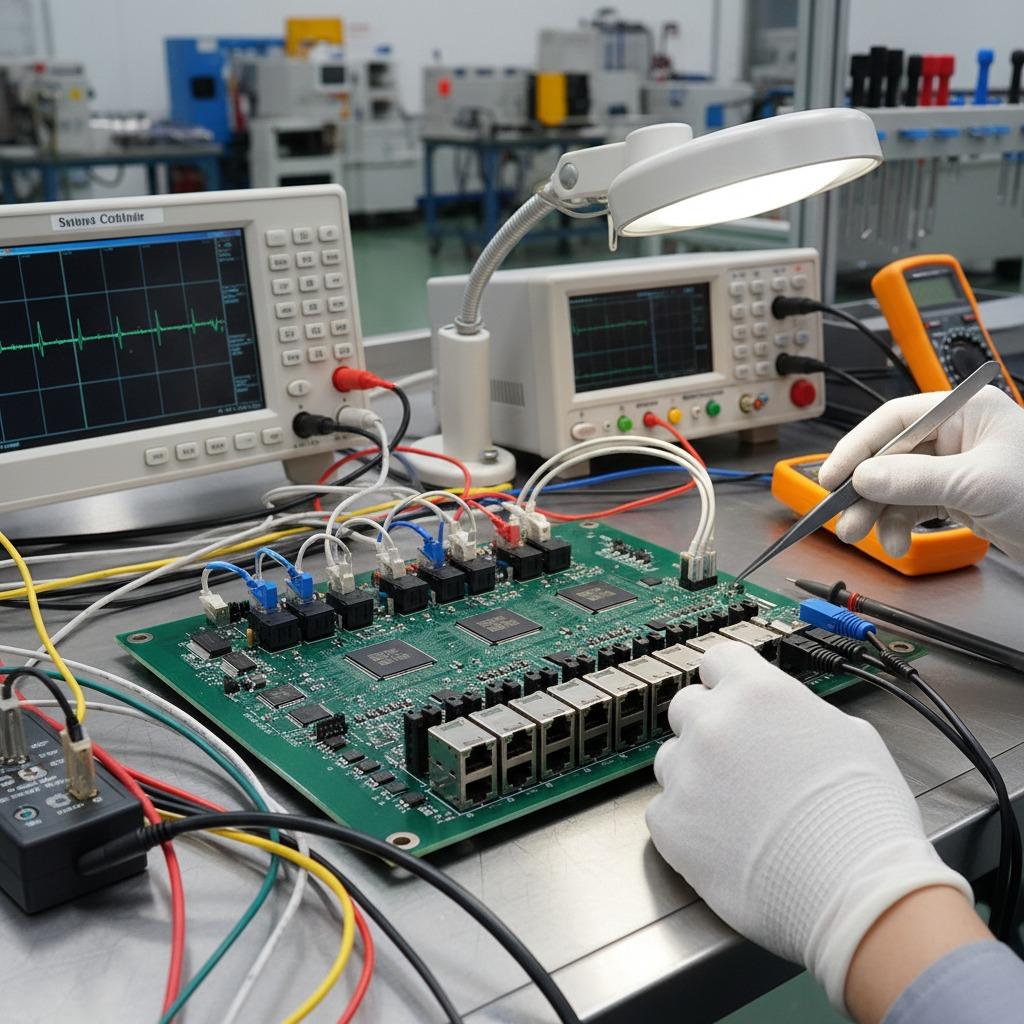
Inspection and Testing Without Excess Overhead
Inspection must prevent defects, not inflate cost. The goal is proportional control.
Cost-Optimized Inspection and Testing Structure
| Inspection Stage | Applied Scope | Measured Impact |
|---|---|---|
| SPI (Solder Paste Inspection) | Critical pads only | 20–30% reduction in solder-related rework |
| AOI | Post-reflow, defect-focused | 3–5% yield improvement |
| Electrical Test | Power & signal integrity | Eliminates functional escapes |
| Functional Sampling | 5–10% of batch | Maintains confidence with minimal cycle time |
| Trend Analysis | Batch-to-batch comparison | Prevents gradual process drift |
By aligning inspection depth with defect probability, manufacturers reduce test time while maintaining product reliability.
Where Cost-Controlled PCBA Production Is Most Valuable
Industries with stable demand and competitive pricing pressure benefit most from this approach, including:
-
Consumer electronics platforms
-
Smart home and IoT devices
-
Power supply and energy products
-
Imaging and communication equipment
In these markets, predictable cost structure is often more valuable than short-term price reductions.
Frequently Asked Questions
Q1: Can cost be reduced without redesigning the PCB?
Yes. Yield improvement, sourcing discipline, and inspection optimization often reduce total cost more than design changes.
Q2: How long does it take to see cost improvement?
Most manufacturers observe measurable savings within 2–3 production cycles once processes stabilize.
Q3: Is low cost compatible with long-term reliability?
When cost reduction is driven by process control rather than shortcuts, reliability often improves.
Why Sustainable Cost Reduction Requires Structure
Low cost PCBA manufacturing is not a pricing tactic. It is a structured production approach that lowers waste, stabilizes yield, and aligns sourcing with real demand. When cost control is built into processes rather than negotiated at the last minute, manufacturers gain predictable margins, stable delivery schedules, and long-term operational resilience. For teams evaluating production partners, understanding how yield optimization, sourcing discipline, and inspection alignment work together is essential to achieving sustainable cost reduction rather than short-lived savings.
If you are assessing whether a manufacturer’s process structure can genuinely support cost-controlled PCBA production at scale, reviewing real production capabilities, quality controls, and sourcing strategies is a practical first step. You can learn more about our PCBA manufacturing scope, technical strengths, and long-term cost-control approach by visiting our official website:
👉 https://www.hcdpcba.com
For projects that require a more targeted evaluation—such as identifying where yield losses occur, how component alternatives are managed, or how production scale affects unit cost—direct communication is often more effective than general comparisons. You are welcome to discuss your specific PCBA cost optimization or production planning requirements with our team here:
👉 https://www.hcdpcba.com/en/contact-us