Low Power Consumption Solar Camera Board Overview
The Low Power Consumption Solar Camera Board is designed for buyers who need imaging or sensing hardware in places where wired power is limited, expensive, or inconvenient. In off-grid security, remote inspection, and outdoor IoT projects, the main problem is usually the same: the device must keep working with minimal energy while still supporting a stable camera module and reliable board-level integration. This type of product addresses that gap by combining a compact PCB assembly, an integrated lens module, and a solar-oriented top surface in one small enclosure.
From the visible construction, the unit appears suited to low-power monitoring and embedded vision applications. It is not just a bare camera board; it looks like a mechanically packaged electronic assembly with mounting points, a rigid front face, and an angled support structure that can help with positioning. For product developers, that means less work in early prototyping and a clearer path toward a field-deployable module.
Product Structure and Visible Features
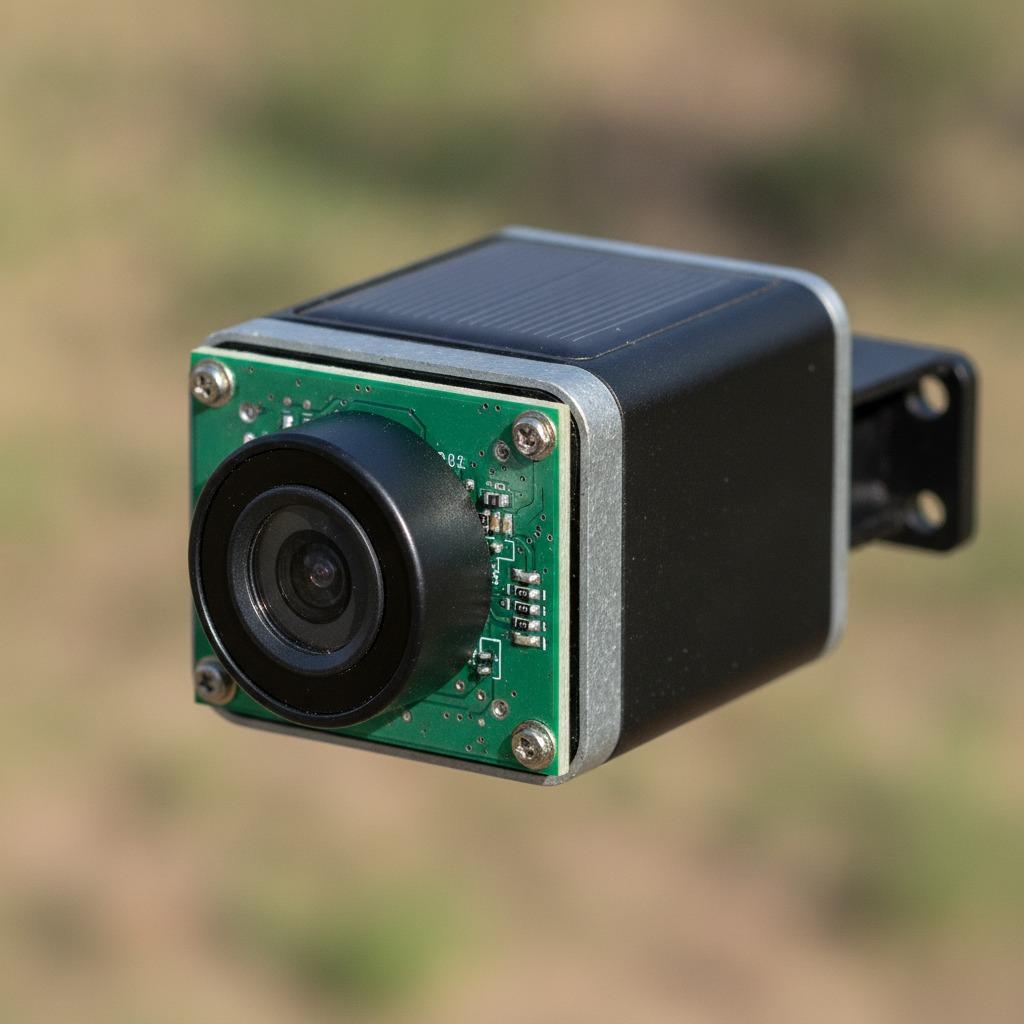
The board shown in the preparation data has a compact, rectangular form factor. A camera lens is centered or front-mounted in a metal bezel, with corner screws or standoffs supporting the assembly. Green PCB edges are visible, and the housing includes metallic-looking surfaces plus a top area that resembles solar-cell segments. Some versions appear to use a vented lower housing or heatsink-style enclosure, which may help with mechanical protection and thermal management.
Because only visible details are provided, several internal characteristics remain unknown. Resolution, wireless connectivity, storage, battery capacity, weatherproof rating, and exact solar output are not confirmed. Buyers should treat the unit as a hardware platform or integrated module rather than assuming final product specifications that are not shown.
Key Capabilities Buyers Usually Look For
Low-energy operation
The central value of a solar-assisted board is reduced dependence on external power. That matters in remote monitoring, temporary installations, and locations where cable runs are difficult. If the solar surface is functional, it can support longer runtime or reduce battery cycling. If it is partly decorative or semi-functional, the mechanical layout still signals a design intended for energy-aware operation.
Compact camera integration
The lens module is already integrated into the assembly, which helps reduce optical alignment work during system build. For OEMs, that can simplify enclosure design and shorten time to prototype.
Mounting flexibility
Corner holes and a rear bracket suggest the board can be fixed in place and angled for a specific field of view. That is useful in perimeter observation, agricultural sensing, robotics, and inspection systems.
Materials and Finish Options
Based on the image, the assembly uses a mix of FR-4 printed circuit board material, a dark solar-panel-like top surface, metallic or coated side panels, and a black camera lens housing. In custom manufacturing, buyers may request different enclosure finishes, protective coatings, lens rings, fastener styles, or surface treatments to match indoor or outdoor use cases. For electronics projects, finish selection often depends on heat, corrosion exposure, and mechanical stress rather than appearance alone.
Manufacturing and Assembly Considerations
For an OEM Security PCBA Manufacturer, this type of product typically requires coordinated PCB fabrication, SMT assembly, optical module placement, and mechanical enclosure integration. If the top layer includes photovoltaic components, that adds another integration step because the solar area must be aligned with the board, housing, and power path. A stable camera design also depends on precise lens positioning and clean assembly around the image path.
Hcdpcba’s service scope includes PCB prototyping, SMT assembly, component sourcing, assembly, testing, DFMA support, and OEM/ODM services. That is relevant for teams developing a custom camera module or edge device because camera boards often need repeated design tuning before volume production.
Application Scenarios
This product concept fits outdoor security cameras, low-power surveillance nodes, remote environmental monitoring, smart agriculture, asset tracking, and embedded vision systems. It may also suit robotics or inspection tools where the camera must be compact and independently powered. In such environments, buyers usually value low idle consumption, mechanical durability, and a form factor that can be mounted quickly in the field.
When the design includes edge processing or detection logic, the board may also work as an AI Human Detection PCBA platform, provided the actual processor and software stack support that function. Since those internals are not visible here, any AI feature should be confirmed at the specification stage.
Quality Control and Buyer Decision Factors
For buyers, the most important questions are practical: Is the lens module aligned consistently? Can the PCB be assembled repeatably? Does the enclosure protect the electronics? Is the power budget realistic for the expected duty cycle? These are the issues that determine field reliability more than appearance.
Incoming inspection, SMT process control, functional testing, and mechanical fit checks are important for this category. If the product is intended for outdoor use, buyers should also ask about sealing strategy, condensation risk, and thermal performance. If the design is connected to a network or recording system, verify interface compatibility early to avoid late-stage rework.
Customization Guidance
Custom projects may need changes to lens angle, board size, mounting holes, enclosure finish, connector layout, power management, or sensor integration. Some customers also combine this class of hardware with a PoE Camera PCBA architecture when solar power is not sufficient alone and wired backup is preferred. The right configuration depends on whether the priority is autonomy, image quality, installation speed, or long-term serviceability.
If you are developing a new camera module, share your target environment, power source, mechanical envelope, and interface requirements early. That helps the manufacturer evaluate feasibility and reduce redesign cycles.
Request OEM and Assembly Support
For custom PCB assembly, camera module integration, and low-power device development, hcdpcba can support prototype to production workflows. If you need a compact solar-assisted camera board for an off-grid or remote application, provide your drawings, functional goals, and expected operating conditions to start the review.
Contact hcdpcba to discuss OEM/ODM options, PCB fabrication, SMT assembly, and integrated testing for your next low-power vision project.