Product Overview
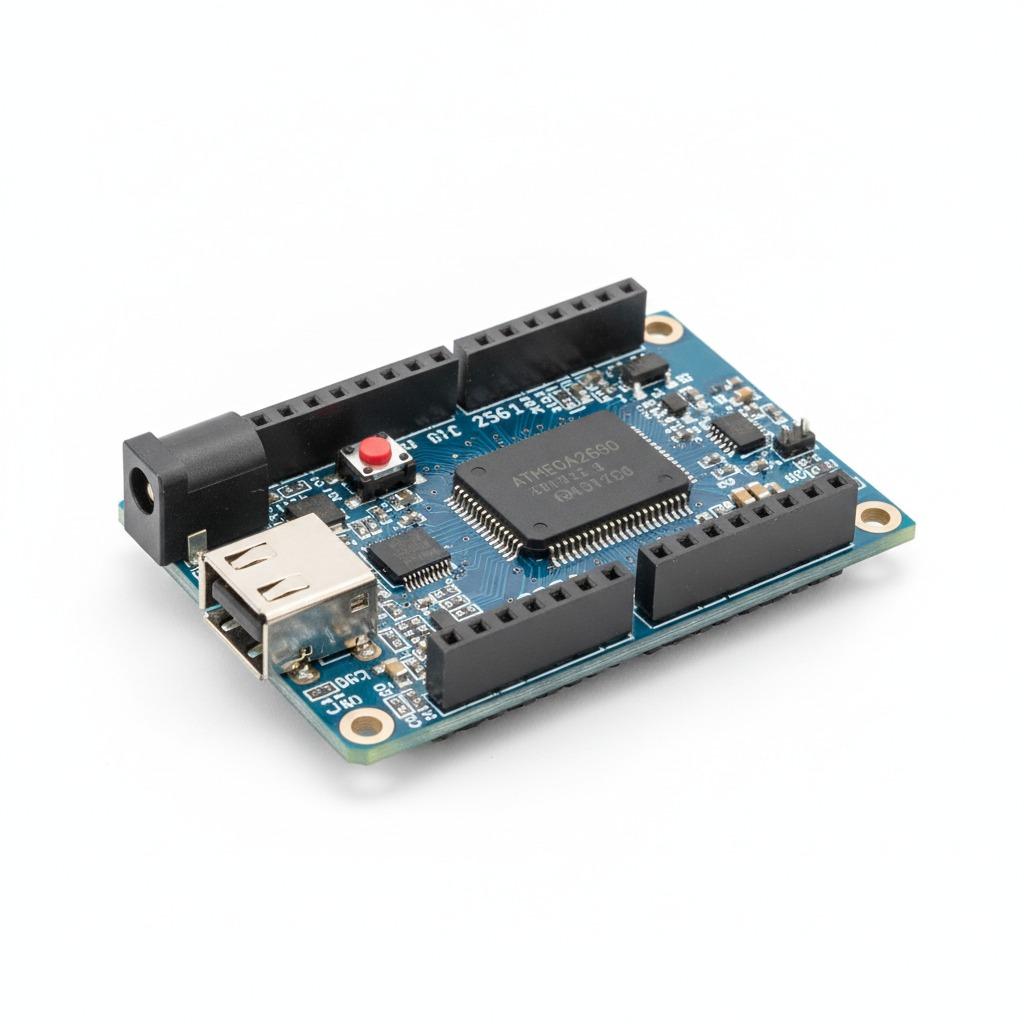
admin.pinshop.com is presented here as a sourcing entry point for an Arduino Mega 2560-style development board that helps engineers, educators, and makers solve a common prototyping problem: not enough I/O on smaller controller boards. When a project needs multiple sensors, relay channels, motor drivers, or serial peripherals at the same time, a full-size Mega-class board gives a cleaner starting point than repeatedly expanding a limited controller. The board shown is a blue PCB with a large central microcontroller package, a USB Type-B port, a DC barrel jack, a reset button, and long rows of pin headers for direct wiring.
This is best viewed as an Arduino-compatible embedded development platform rather than a finished consumer product. The image indicates a standard Mega-format layout, but the exact chipset, revision, and manufacturer are not confirmed from the photo alone. Buyers should treat the visual details as the reliable reference: the board supports USB programming and external power input, and it is designed for general-purpose control, testing, and education.
Key Specifications and Visible Capabilities
The most obvious feature is the high pin density. Compared with smaller boards, the Mega-class layout provides many more edge headers, which matters when a design must connect several inputs and outputs without adding too many expanders. The board also includes onboard status LEDs, clock components, voltage regulation hardware, and a reset switch, all of which are typical elements of a practical development platform.
Visible hardware points
• Blue rigid PCB with white silkscreen labels
• USB Type-B connector for programming and power through a cable
• DC barrel jack for external supply input
• Multiple stacked female headers for shields and breakout wiring
• Large square microcontroller package near the center
• Onboard reset button and indicator LEDs
The photo also shows a USB cable, but whether it is included with the board depends on the sale configuration. If you are evaluating a ch340g usb board variant, confirm the USB-to-serial bridge used on the assembly. Some compatible boards use CH340G, while others use different interfaces; the exact bridge in this image is not verified.
Materials, Finish, and Build Structure
The board appears to use an FR-4 fiberglass substrate with a blue solder mask and standard plated-through holes. That construction is common for mass-produced controller boards because it balances rigidity, cost, and assembly reliability. The connectors and headers are black plastic with metal contacts, while the USB and power interfaces are metal-shielded for wear resistance during repeated cable insertion.
The assembly itself suggests a mix of surface-mount and through-hole manufacturing. That combination is normal for embedded development hardware: small support components can be mounted by SMT, while headers, power jacks, and USB connectors often use through-hole or reinforced mounting for mechanical strength.
Manufacturing Process and Assembly Reference
From a production standpoint, this product fits the workflow of PCB fabrication, SMT placement, through-hole assembly, and functional test. Hcdpcba provides services in PCB prototyping, SMT贴片, component sourcing, assembly, and testing, which aligns with the kind of manufacturing needed for boards like this. For buyers planning their own variant, DFMA review is useful because connector placement, header spacing, and power input choices affect both assembly cost and field usability.
If your target is an improved version mega2560 r3, pay attention to the layout details that usually distinguish one revision from another: connector placement, reset circuit arrangement, and USB interface implementation. Those points may look minor, but they influence enclosure fit, shield compatibility, and ease of debugging.
Applications and Buyer Use Cases
This board is a practical fit for robotics, motion control, sensor interfacing, automation benches, STEM labs, and firmware development. A larger I/O count is useful when the project includes multiple switches, analog sensors, stepper drivers, servo outputs, or serial modules. It is also common in test fixtures where technicians need many accessible pins for rapid diagnostics.
For education, the board gives learners a straightforward way to explore digital input/output, PWM, serial communication, and basic control logic. For product development, it serves as a prototype controller before the team moves to a custom PCBA.
Customization and Sourcing Guidance
When comparing options, buyers should think about the USB interface, header population, board revision, and whether they need a bare board or a cable bundle. A factory price mega2560 board quote usually depends on BOM choice, assembly complexity, test requirements, and order quantity. If your application needs a specific USB bridge, confirm it early; if you need a ch340g mega2560 board, ask for that version explicitly instead of assuming compatibility.
Customization may also include silkscreen changes, connector substitutions, revised power input, or packaging for OEM and ODM programs. For larger programs, it is worth reviewing pin labeling, assembly tolerances at the connector level, and any downstream shielding or enclosure constraints.
Quality Control and Purchasing Factors
For this class of board, quality control usually focuses on solder joint integrity, connector alignment, header straightness, power rail stability, and continuity testing. Buyers should also verify that the board boots reliably, enumerates over USB, and accepts program upload without intermittent connection issues. Because the image does not confirm the exact controller or USB bridge, it is smart to request a sample or inspection report before scaling production.
Decision factors are often practical rather than promotional: I/O count, mechanical robustness, compatibility with your existing shields, and support for your preferred development workflow. A well-assembled board reduces debugging time later, which is especially important in lab environments and production test systems.
Contact and Next Step
If you are sourcing an Arduino Mega 2560-style board for prototyping or OEM integration, hcdpcba can support PCB fabrication, SMT assembly, component sourcing, testing, and custom electronics production. For project discussion or quotation support, contact +86 18924624188. Provide your target board revision, USB interface preference, quantity, and any special assembly notes so the quotation reflects the actual build requirement.