High-Speed SMT Assembly Supplier: Precision, Throughput, and Yield at Scale
Speed is easy. Precision at speed is what defines a world-class high-speed SMT assembly supplier.
Every second on an SMT line is governed by data—machine feedback, placement algorithms, solder behavior, and environmental control.
In large-scale electronics production, these factors decide not just how many boards you can build, but how many will actually pass testing.
This is where high-speed assembly stops being about motion—and starts being about mastery.
The Core of a High-Speed SMT Production Line
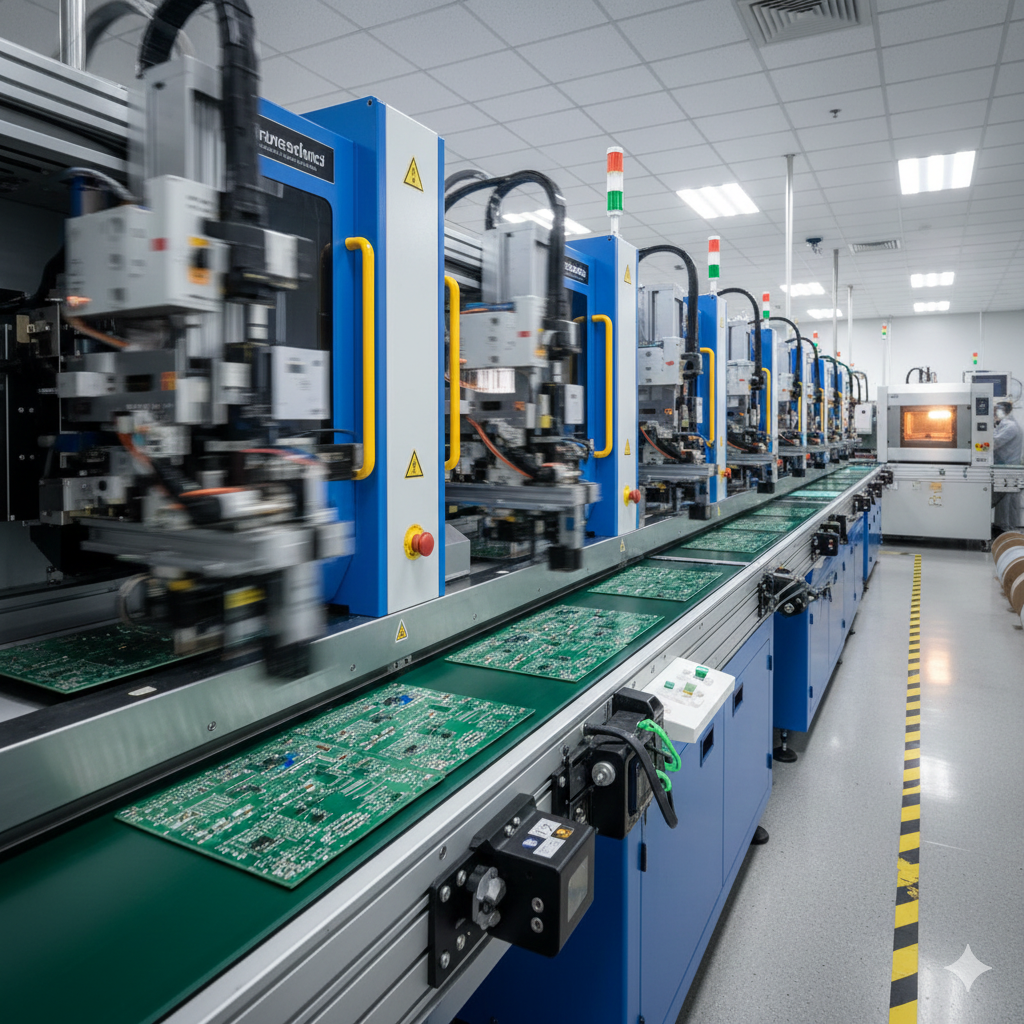
A high-speed line isn’t just a collection of machines. It’s a synchronized ecosystem where screen printers, placement units, conveyors, and reflow ovens operate within milliseconds of each other.
| Line Element | Key Function | Impact on Yield |
|---|---|---|
| Stencil Printer | Applies solder paste within ±10 μm thickness tolerance. | Consistent solder volume prevents bridging and opens. |
| Automated Pick and Place | Places 60,000–100,000 components per hour. | Micron precision ensures alignment for 0201/01005 packages. |
| Reflow Oven | Maintains 7–9 temperature zones with ±1°C control. | Proper wetting avoids voids and cold joints. |
| AOI + SPI Systems | Provide real-time correction feedback. | Detects deviations before cumulative defects occur. |
| Conveyor Synchronization | Optimizes board handoff and cycle time. | Prevents warping, scratching, or vibration misplacement. |
An effective SMT production line achieves balance—not just raw speed.
Fine-Pitch Placement and Micro-Component Handling
Modern PCBs are shrinking while I/O counts are rising.
To handle fine-pitch PCB assembly, factories must maintain sub-30 µm placement accuracy, especially for BGAs, QFNs, and 01005 passives.
Advanced equipment features include:
-
Laser-guided positioning systems to compensate for board expansion.
-
Vacuum-controlled nozzles that adjust pressure dynamically by component type.
-
AI-based vision algorithms to verify pad alignment in real time.
-
Dynamic feeder calibration for uninterrupted operation at full throughput.
This level of automation converts mechanical speed into measurable reliability.
Reflow and Process Stability in High-Volume Manufacturing
Even the best placement is meaningless without the right soldering curve.
In high-volume PCB manufacturing, the reflow process is where defects either multiply or disappear.
Professional surface mount technology service providers maintain precise control across multiple production lines by:
-
Profiling every new PCB batch for temperature delta <2°C.
-
Using nitrogen reflow to minimize oxidation on fine-pitch joints.
-
Monitoring conveyor speed and airflow to maintain heating uniformity.
-
Logging all process data for IPC-A-610 compliance.
A well-tuned reflow process doesn’t just ensure quality—it enables consistent throughput over millions of boards.
Inline Inspection and PCBA Yield Optimization
At production speeds exceeding 80,000 CPH, even minor deviations can create exponential defect chains.
Therefore, yield optimization must be embedded, not reactive.
| Inspection Type | Purpose | Frequency |
|---|---|---|
| SPI (Solder Paste Inspection) | Monitors paste volume and stencil alignment. | 100% inline |
| AOI (Automated Optical Inspection) | Detects placement offset, tombstoning, or bridging. | Every board |
| X-Ray Inspection | Validates hidden joints under BGAs and CSPs. | Sample-based or critical zones |
| Functional Testing (FCT) | Confirms assembled circuit performance. | Batch or full coverage based on project type |
Data from these systems is analyzed in real time, feeding corrections back to printers and placement units—creating a closed-loop PCBA yield optimization cycle.
Engineering and Supplier Selection: Matching Speed With Control
Choosing a high-speed SMT assembly supplier isn’t about the number of machines—it’s about how the factory synchronizes them.
Before selecting a partner, evaluate these engineering factors:
-
CPK and SPC Data Availability: Can the supplier show process capability, not just machine specs?
-
Multi-Line Synchronization: Are different lines controlled under a unified MES system?
-
Feeder Changeover Time: Shorter changeovers mean higher flexibility in production scheduling.
-
Temperature and Humidity Control: Stability determines long-term solder joint reliability.
-
AOI-to-Reflow Feedback: Ensures defects are corrected before volume scaling.
True speed isn’t in cycle time—it’s in how fast a factory can detect, correct, and recover.
Scaling Precision Into Productivity
In high-speed SMT, every micron and every millisecond count.
A professional supplier blends automation with human oversight to ensure both speed and stability—turning high throughput into predictable quality.
If your project demands fine-pitch assembly, scalable production, or data-driven process control, explore our manufacturing capabilities at our homepage.
For direct engineering consultation or project evaluation, reach our team via the contact page.
Let’s transform precision into productivity—board after board.