Why Classroom Projector Module Selection Matters for Education Products
The education industry is moving toward smarter classrooms that combine digital content, interactive learning, and connected teaching equipment.
For projector brands and education technology companies, choosing the right classroom projector module manufacturer is not only about selecting an optical component. A projector module directly influences:
- image quality
- brightness performance
- reliability
- power consumption
- thermal behavior
- product lifetime
- manufacturing consistency
Classroom environments create different requirements compared with home entertainment products.
A classroom projector may need to operate:
- for several hours every day
- in different lighting conditions
- with frequent connection switching
- under continuous thermal load
- across thousands of education sites
Therefore, OEM buyers need a manufacturing partner that understands both projector technology and electronics manufacturing.
HCDPCBA provides PCB prototyping, PCBA manufacturing, SMT assembly, component sourcing, DFMA, testing, and OEM/ODM support. The company also maintains a dedicated Projector Series covering projector-related products and applications. (hcdpcba.com)
Who Needs a Classroom Projector Module Manufacturer?
Different education-related businesses have different requirements when selecting projector module suppliers.
Education Technology Companies
EdTech companies often develop complete classroom solutions that combine:
- interactive displays
- digital teaching platforms
- projection systems
- network connectivity
- learning software
They usually need hardware suppliers that can support customized product development instead of only providing standard components.
Projector Brands
Existing projector brands may require:
- new product platforms
- customized projector modules
- improved optical performance
- optimized production costs
A reliable manufacturing partner can help brands develop new models faster while reducing internal engineering pressure.
Classroom Equipment Suppliers
Distributors and education equipment suppliers often need:
- stable product availability
- customized configurations
- private-label production
- consistent quality
Manufacturing capability becomes important because classroom equipment buyers usually expect long-term product support.
AV System Integrators
Professional AV companies may integrate projectors into:
- conference rooms
- training facilities
- universities
- government education projects
These applications require stable performance and compatibility with different installation environments.
Hardware Startups
For startups developing new smart education devices, working with a projector module manufacturer can reduce the complexity of managing:
- optical suppliers
- PCB manufacturers
- component vendors
- testing partners
An experienced partner can help move from prototype validation to commercial production.
What Is a Classroom Projector Module?
A classroom projector module is the core projection subsystem responsible for generating and projecting images.
Depending on the product architecture, it may include:
- optical engine
- projection lens
- light source system
- display chipset
- driver electronics
- control interface
However, the exact module configuration depends on the projector technology and product requirements.
A module should not be evaluated only by one specification.
A complete evaluation should consider:
| Evaluation Area | Why It Matters |
|---|---|
| Resolution | Determines image detail and clarity |
| Brightness | Affects visibility in classroom environments |
| Throw Ratio | Determines installation distance |
| Contrast | Influences image quality |
| Focus Performance | Affects text readability |
| Power Consumption | Impacts operating cost |
| Thermal Design | Influences reliability |
| Size | Determines product integration |
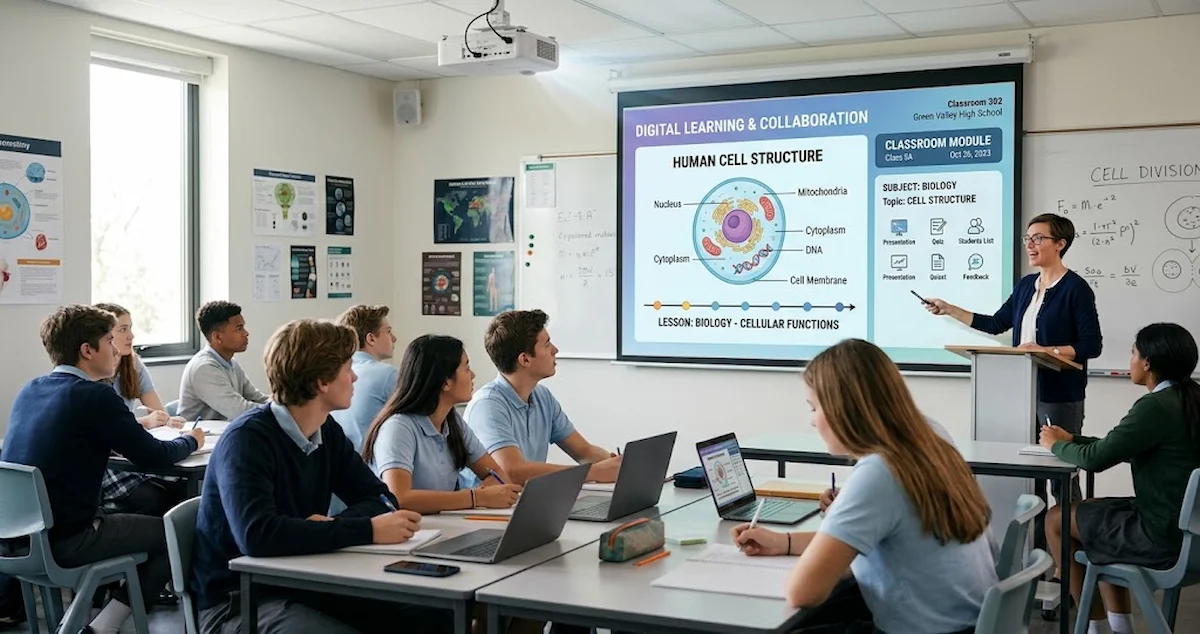
For classroom applications, image readability is especially important because projected content often includes:
- text
- diagrams
- educational videos
- presentations
- interactive content
Key Requirements for Classroom Projector Modules
Brightness Performance for Classroom Environments
Classrooms are different from dark home theater environments.
A classroom projector often needs to maintain image visibility under:
- daylight
- overhead lighting
- larger projection distances
- frequent student viewing
When evaluating a projector module, buyers should define:
- required image size
- room brightness
- projection distance
- screen type
- expected usage environment
A higher brightness specification is not always the only solution.
The complete optical system, image processing, contrast performance, and thermal management all affect the final classroom experience.
Resolution and Image Clarity
Education content often contains detailed information such as:
- text documents
- charts
- technical drawings
- digital learning materials
Therefore, resolution selection should match the application.
Examples:
Basic Classroom Presentation
May prioritize:
- cost efficiency
- reliability
- easy maintenance
University or Professional Training
May require:
- higher resolution
- better text clarity
- stronger image performance
Interactive Learning Systems
May require:
- accurate image processing
- integration with sensors or cameras
- responsive system performance
The correct specification depends on the product positioning rather than simply selecting the highest available resolution.
Throw Ratio and Classroom Installation Requirements
Throw ratio determines how far the projector needs to be placed from the projection surface.
For classroom applications, this affects:
- classroom layout
- installation position
- mounting structure
- screen size
A suitable projector module should match the actual environment.
OEM buyers should define:
- projection distance
- image size
- installation method
- ceiling or wall mounting requirements
Short-throw and ultra-short-throw modules are often considered for classrooms where space is limited.
However, shorter throw distances usually require more complex optical design and tighter manufacturing control.
Thermal Design for Long Classroom Operation
Education projectors often operate for extended periods.
Thermal performance affects:
- component lifetime
- brightness stability
- system reliability
- maintenance requirements
A classroom projector module needs consideration of:
- heat generation
- airflow design
- fan control
- component temperature
- enclosure structure
Thermal design should be evaluated together with:
- optical system
- electronics
- mechanical design
A projector module that performs well in laboratory conditions may require additional validation inside the final product enclosure.
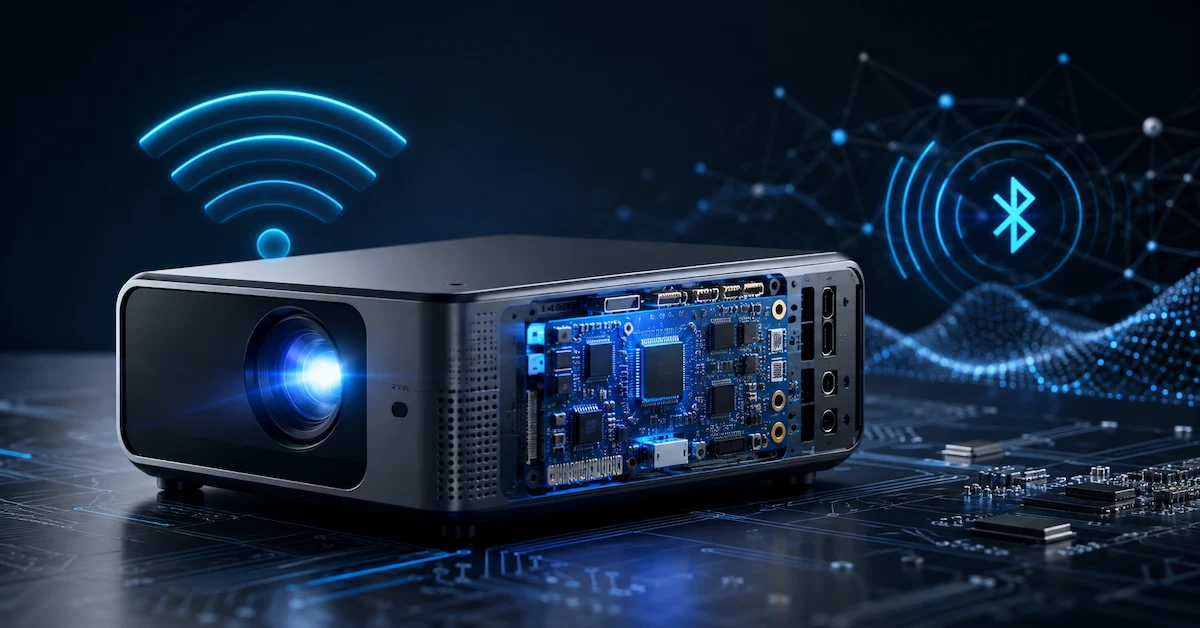
PCBA Integration in Classroom Projector Systems
A projector module does not operate independently.
The complete product requires cooperation between:
- projection module
- mainboard
- power system
- control electronics
- communication interfaces
- firmware
The PCBA connects these systems together.
A classroom projector PCBA may manage:
- video input
- display control
- power conversion
- fan control
- wireless communication
- external interfaces
For OEM brands, choosing a supplier with PCBA manufacturing capability can simplify the integration process.
HCDPCBA provides PCBA manufacturing services, including PCB prototyping, SMT assembly, component sourcing, testing, and OEM/ODM support. (hcdpcba.com)
Projector Module OEM Development Process From Prototype to Mass Production
Selecting a classroom projector module manufacturer is only the first step.For education projector brands, the ability to move from product concept to stable production is equally important.
A reliable manufacturing partner should support multiple development stages:
- Requirement analysis
- Optical and electronic evaluation
- Prototype production
- Functional validation
- Pilot production
- Quality verification
- Mass production
This staged approach helps reduce risks related to:
- optical performance
- electronic compatibility
- thermal problems
- manufacturing consistency
- production cost
Stage 1: Requirement Analysis
Before selecting a projector module, OEM buyers should define the product requirements clearly.
Important information includes:
Projection Requirements
- Target resolution
- Brightness requirement
- Throw ratio
- Projection distance
- Screen size
- Installation environment
Classroom Environment
- Classroom size
- Ambient lighting conditions
- Daily operating hours
- Mounting method
- Maintenance requirements
Electronics Requirements
- Mainboard architecture
- Input interfaces
- Power requirements
- Control communication
- Firmware requirements
Production Requirements
- Prototype quantity
- Expected production volume
- Target market
- Certification requirements
- Delivery schedule
A clear requirement document allows the supplier to evaluate whether the selected module can meet the final product goals.
Stage 2: Engineering Review and System Integration
A classroom projector is a complete system, not only an optical module.
Engineering teams should evaluate the interaction between:
- projector module
- PCBA
- power system
- cooling system
- enclosure
- firmware
A professional projector module manufacturer should review:
Optical Integration
- module dimensions
- lens position
- image alignment
- focus adjustment
- projection angle
Electronic Integration
- interface compatibility
- power supply requirements
- communication protocol
- controller compatibility
Mechanical Integration
- mounting structure
- heat dissipation space
- cable routing
- enclosure limitations
Early engineering review helps avoid problems discovered after tooling or mass production.
Stage 3: Prototype Development
Prototype production allows education brands to verify product performance before larger investment.
Prototype validation should include:
Image Performance Testing
Check:
- brightness
- resolution
- focus quality
- image uniformity
- color performance
Classroom Simulation Testing
Evaluate performance under:
- normal classroom lighting
- different projection distances
- extended operation periods
Electronics Testing
Verify:
- power stability
- video input
- system communication
- interface functions
Mechanical Testing
Confirm:
- module installation
- enclosure compatibility
- thermal behavior
A successful prototype should not only display an image but also demonstrate production feasibility.
Stage 4: Pilot Production Validation
Pilot production verifies whether the product can be manufactured consistently.
During this stage, manufacturers evaluate:
- assembly process
- supplier stability
- testing procedures
- production yield
- quality standards
Pilot production can identify issues such as:
- component availability problems
- assembly variation
- optical alignment errors
- thermal performance differences
Solving these problems before mass production reduces future production risks.
Stage 5: Mass Production Management
Before mass production, the project should have:
- approved product specifications
- finalized BOM
- validated prototype
- confirmed testing standards
- approved production process
A professional supplier should control:
- incoming materials
- manufacturing processes
- inspection procedures
- production consistency
- product traceability
For classroom products, reliability is especially important because projectors are often deployed in large quantities across schools and training facilities.
Classroom Projector Module Technical Evaluation Checklist
When comparing different projector module suppliers, buyers should evaluate the following factors.
| Specification | Buyer Consideration |
|---|---|
| Resolution | Does it meet classroom content requirements? |
| Brightness | Can students clearly view projected content? |
| Throw Ratio | Does it fit classroom installation distance? |
| Focus Performance | Is text clear across the screen? |
| Contrast | Does it improve image readability? |
| Power Consumption | Does it meet product efficiency goals? |
| Thermal Performance | Can it operate for long periods? |
| Module Size | Does it fit the product structure? |
| Interface | Is it compatible with the mainboard? |
| Reliability | Can it support long-term operation? |
Classroom Projector Module Supplier Comparison
Choosing a supplier should focus on technical capability rather than only price.
| Evaluation Area | Basic Module Supplier | Professional OEM Partner |
|---|---|---|
| Standard modules | Available | Available |
| Custom requirements | Limited | Supported |
| Optical evaluation | Basic | Detailed review |
| PCBA integration | May require external supplier | Integrated support |
| Prototype support | Depends | Structured process |
| DFMA review | Limited | Available |
| Testing support | Basic | Customized testing |
| Mass production | Depends | Production planning |
| Supply chain management | Limited | Stronger coordination |
For education technology brands, a supplier that understands both projector technology and electronics manufacturing can reduce integration complexity.
Quality Control Requirements for Classroom Projector Modules
Education products require stable operation because failures can directly affect teaching environments.
A quality control process may include:
Incoming Material Inspection
Verify:
- optical components
- electronic components
- PCB materials
- mechanical parts
This helps prevent material-related production problems.
PCBA Quality Inspection
For projector electronics, inspection may include:
- component placement inspection
- solder quality inspection
- electrical testing
AOI Inspection
AOI can identify visible assembly issues including:
- missing components
- incorrect placement
- solder appearance problems
X-Ray Inspection
For hidden solder connections, X-Ray inspection can provide additional verification.
This can be useful for assemblies containing:
- BGA packages
- hidden solder joints
- high-density components
HCDPCBA lists AOI and X-Ray inspection as part of its quality-control capabilities. (hcdpcba.com)
Functional Testing
Functional testing should verify the actual product requirements.
Possible tests include:
| Test | Purpose |
|---|---|
| Power test | Confirm stable startup |
| Display test | Verify image output |
| Interface test | Check communication ports |
| Thermal test | Evaluate operating temperature |
| Long operation test | Verify reliability |
| System test | Confirm complete functionality |
The final test plan should be customized according to the projector product design.
Cost Factors of Classroom Projector Module Manufacturing
The cost of a classroom projector module depends on several factors.
Optical Configuration
Affected by:
- resolution
- brightness
- throw ratio
- optical complexity
Higher optical requirements usually require more precise components and manufacturing processes.
Electronic Integration
Cost may increase due to:
- controller requirements
- PCB complexity
- component selection
- interface customization
Manufacturing Volume
Prototype and mass-production pricing are different.
Large-volume production can reduce:
- setup cost per unit
- purchasing cost
- manufacturing overhead
Testing Requirements
Additional validation may increase initial cost but helps reduce product failures.
Examples:
- optical calibration
- functional testing
- reliability testing
Customization Level
Customized products may require additional engineering work for:
- module adaptation
- PCBA integration
- mechanical changes
- testing fixtures
How to Choose a Classroom Projector Module Manufacturer in 2026
Education brands should evaluate suppliers based on several areas.
1.Projector Technology Understanding
The supplier should understand:
- optical requirements
- projector architecture
- integration challenges
2. Electronics Manufacturing Capability
Important capabilities include:
- PCB manufacturing
- SMT assembly
- component sourcing
- testing
3. Engineering Support
A good partner should help identify:
- design problems
- manufacturing risks
- optimization opportunities
4.Production Scalability
The supplier should support:
- prototypes
- pilot runs
- mass production
5. Quality Management
Evaluate:
- inspection process
- testing capability
- production control
6. Communication and Project Management
Complex projector projects require coordination between:
- engineering teams
- suppliers
- production teams
- quality teams
Clear communication reduces development delays.
HCDPCBA Support for Classroom Projector Electronics Projects
HCDPCBA provides electronics manufacturing services including:
- PCB prototyping
- PCBA manufacturing
- SMT assembly
- component sourcing
- DFMA
- inspection
- testing
- OEM/ODM support
The company also provides projector-related products through its Projector Series and supports broader PCBA Manufacturing Services.
For classroom projector projects, HCDPCBA can support the electronics manufacturing side, including:
- projector control boards
- customized PCB assembly
- component management
- prototype production
- manufacturing preparation
The exact projector module specifications, optical system, brightness requirements, resolution, and final product architecture should be confirmed according to each customer's project requirements.
Frequently Asked Questions
What does a classroom projector module manufacturer provide?
A classroom projector module manufacturer provides projection-related hardware solutions, including optical modules, electronic integration support, customization, and manufacturing assistance depending on the supplier's capabilities.
What is the difference between a projector module and a complete projector?
A projector module is a core projection subsystem, while a complete projector includes the module together with electronics, enclosure, power system, software, and additional functions.
What specifications should schools consider for classroom projectors?
Important factors include brightness, resolution, throw ratio, focus performance, reliability, operating time, and maintenance requirements.
Can projector modules be customized for education products?
Yes. Customization may include optical requirements, mechanical integration, electronic interfaces, and product-specific configurations.
Why is thermal design important for classroom projectors?
Classroom projectors often operate for long periods. Proper thermal design helps maintain brightness stability, component lifetime, and system reliability.
Can HCDPCBA support projector electronics manufacturing?
HCDPCBA provides PCB, PCBA, SMT assembly, component sourcing, testing, DFMA, and OEM/ODM manufacturing support for electronics projects.
What files are needed for projector PCBA quotation?
Typical requirements include:
- Gerber files
- BOM
- assembly drawings
- technical specifications
- testing requirements
- production quantity
How can brands reduce projector development risks?
Brands can reduce risks through early engineering review, prototype validation, DFMA analysis, pilot production, and defined quality standards.
What industries use classroom projector modules?
Applications include:
- schools
- universities
- training centers
- education technology platforms
- conference and collaboration systems
How long does projector module development take?
Development time depends on customization requirements, prototype cycles, testing requirements, and production preparation.
Conclusion
Choosing the right classroom projector module manufacturer is a strategic decision for education technology companies.
A successful classroom projector product requires coordination between:
- optical performance
- electronics integration
- PCBA manufacturing
- thermal management
- testing
- production scalability
The best supplier is not only able to provide a projector module but also understands how to support the transition from concept development to reliable mass production.
HCDPCBA combines PCB manufacturing, PCBA assembly, SMT production, component sourcing, DFMA, testing, and OEM/ODM support to help companies develop customized electronics products.
For brands developing classroom projectors, smart education devices, or projection-related electronics, preparing product specifications, technical requirements, and production goals early can help create a more efficient development process.