Volume PCBA Manufacturing for Stable Output and Long-Term Production Consistency
Scaling electronics production is not simply a matter of increasing quantity.
Many projects that perform well during pilot runs begin to encounter instability once manufacturing volume rises. Yield drift, sourcing inconsistency, process variation, and delivery delays often appear only when production reaches larger scales.
These problems rarely originate from circuit design. In most cases, they result from manufacturing systems that were never structured for long-term scalable production.
A reliable volume PCBA manufacturing process addresses these challenges through standardized workflows, stable sourcing systems, and tightly controlled production parameters. Our engineering and manufacturing teams focus on ensuring that products maintain the same electrical and mechanical consistency whether producing hundreds of boards or hundreds of thousands.
Why High-Volume Production Requires Different Manufacturing Systems
Low-volume production prioritizes flexibility. High-volume manufacturing prioritizes repeatability.
As production quantity increases, even small process deviations become amplified. A defect that affects only a few units in a prototype run may impact thousands of boards during mass production.
For example:
- Minor solder paste inconsistency can create widespread yield loss
- Uncontrolled feeder setup may affect multiple production lines
- Material variation becomes more difficult to detect across large batches
A structured volume PCBA manufacturing workflow therefore focuses on:
- Standardized production parameters across all lines
- Strict material validation before scaling
- Real-time monitoring of yield and defect trends
Factories implementing these systems often reduce large-scale defect escalation by 20–35%.
Process Stability as the Core of Volume Manufacturing
In large-scale production, process stability matters more than short-term output speed.
Stable manufacturing requires:
- Fixed SMT placement parameters
- Controlled reflow profiles across all batches
- Standardized inspection procedures
Without these controls, yield variation increases as production expands.
For instance, inconsistent thermal profiles between shifts may create solder reliability differences that only become visible after field deployment.
A disciplined volume PCBA manufacturing process typically improves:
- Long-term yield stability
- Cross-batch electrical consistency
- Reduced field failure rates
Manufacturers with mature process control often reduce recurring assembly defects by 25–40%.
Supply Chain Coordination at Production Scale
Material sourcing becomes significantly more complex during high-volume production. A single unstable supplier can disrupt entire manufacturing schedules.
In scalable production systems:
- Long lead-time components are planned months in advance
- Approved alternate components are validated before shortages occur
- Supplier consistency is monitored continuously
This prevents emergency substitutions that can introduce electrical or thermal variation.
A mature volume PCBA manufacturing system often achieves:
- 5–15% reduction in sourcing-related instability
- Improved delivery predictability across repeat orders
This level of coordination is especially important for OEM and industrial projects with long production cycles.
Yield Management and Production Efficiency
High-volume manufacturing cannot rely solely on inspection to maintain quality. Defects must be prevented through process optimization before assembly begins.
For example:
- Stencil optimization improves solder consistency
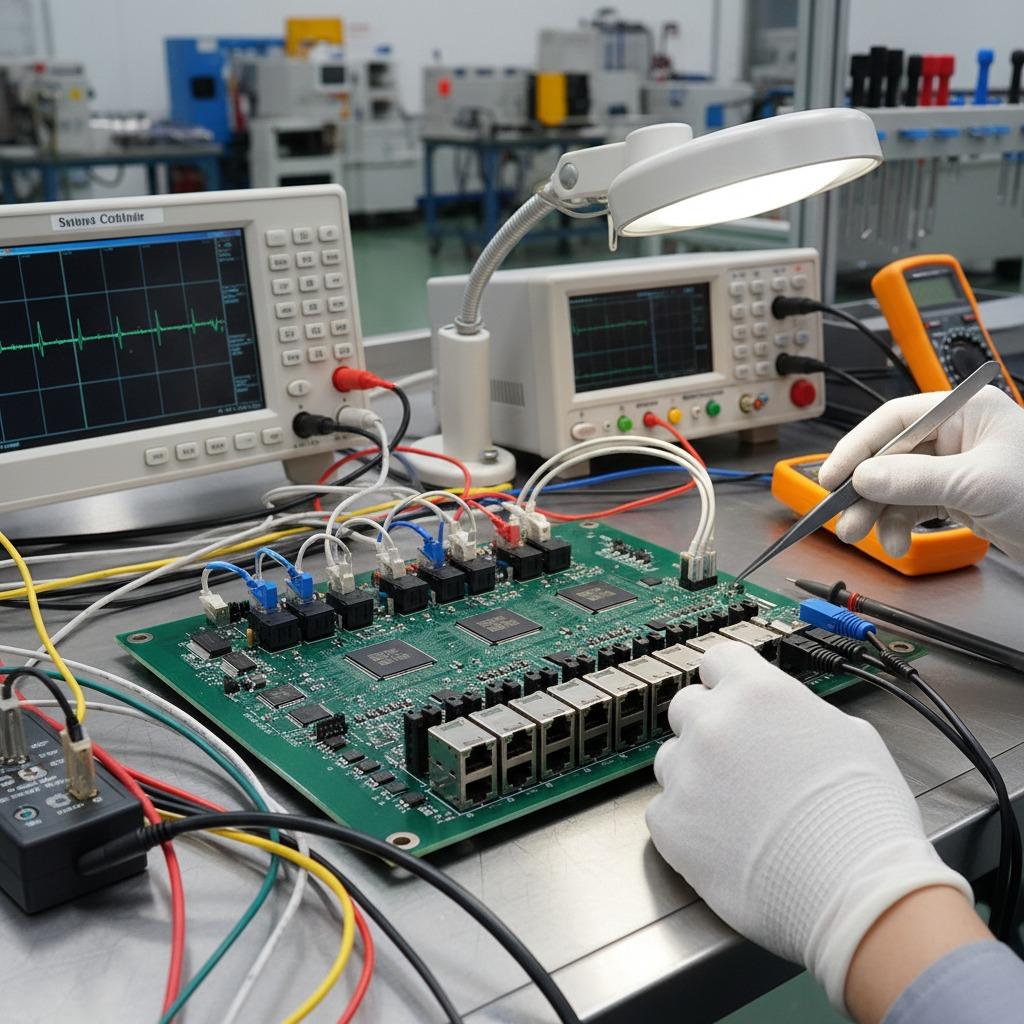
- Automated SPI and AOI systems detect process drift early
- Real-time production monitoring identifies recurring patterns before yield drops significantly
A structured volume PCBA manufacturing workflow balances:
- High throughput efficiency
- Stable assembly quality
- Reduced rework and production waste
Factories using integrated yield management systems commonly improve overall production efficiency by 10–20%.
Key Production Factors and Their Impact
| Manufacturing Factor | Control Method | Typical Result |
|---|---|---|
| SMT process stability | Fixed machine parameters | Reduced yield drift |
| Material sourcing | Long-term supplier validation | Improved consistency |
| Thermal profile control | Standardized reflow settings | Lower solder failure |
| AOI / SPI integration | Real-time defect monitoring | Faster issue detection |
| Production analytics | Data-driven process tracking | Reduced recurring defects |
These controls determine whether large-scale production remains stable or becomes increasingly unpredictable.
Long-Term Manufacturing Consistency
Many electronics products remain in production for years. Maintaining consistency over long manufacturing cycles requires more than stable equipment—it requires structured documentation and repeatable workflows.
A professional volume PCBA manufacturing system therefore includes:
- Batch traceability across all production runs
- Locked engineering revisions for repeat orders
- Standardized production records and testing data
Projects using these systems typically achieve:
- Better repeat-order consistency
- Faster troubleshooting capability
- Lower long-term production risk
Compliance and Quality Assurance
High-volume production must also maintain strict compliance standards, especially for export-oriented and industrial products.
Key requirements include:
- RoHS material compliance
- ISO-based quality systems
- Traceability for long-term support
- EMC-related manufacturing controls
Integrating compliance directly into production workflows reduces certification risk and delivery delays.
Frequently Asked Questions
Q1: Why do production issues appear only after scaling?
Because small process deviations become amplified at larger production volumes.
Q2: Can large-scale manufacturing maintain stable quality?
Yes. Stable process control is the foundation of scalable production.
Q3: Is inspection enough to maintain high-volume yield?
No. Preventing defects through process control is more effective than detecting them afterward.
Why Scalable Manufacturing Depends on Process Discipline
A reliable volume PCBA manufacturing system ensures that sourcing, assembly, inspection, and production control remain stable as manufacturing scales. When these systems are aligned, products maintain consistent quality, predictable delivery, and long-term manufacturing reliability.
If you want to evaluate how scalable manufacturing capability affects your product quality and production efficiency, reviewing real factory systems and process controls is the best starting point. You can learn more about our PCB and PCBA expertise here:
👉 https://www.hcdpcba.com
For projects involving OEM production, long-term manufacturing programs, or large-scale electronics assembly, early technical discussion can significantly improve production stability and delivery performance. You are welcome to contact our engineering team here:
👉 https://www.hcdpcba.com/en/contact-us