Projector Light Engine OEM: The Short Answer for OEM Buyers
A projector light engine OEM partner should be qualified as a system-integration and production partner, not selected only from a catalog of optical modules. The light engine has to work with the projector's power architecture, driver electronics, mainboard, thermal path, lens position, enclosure, firmware, and final image-quality requirements. A module that produces an image on a bench can still fail after it is installed in a compact housing, connected to a different power board, exposed to heat, or manufactured at a larger volume.
For most projector brands, the correct buying question is therefore: Can this manufacturer control the complete handoff from optical engine definition to repeatable production? This guide gives a practical qualification method for a projector light engine OEM program. It is written for product managers, sourcing teams, optical engineers, electronics engineers, and private-label brands that need a clear RFQ path before committing to samples or mass production.
What a Projector Light Engine OEM Program Actually Includes
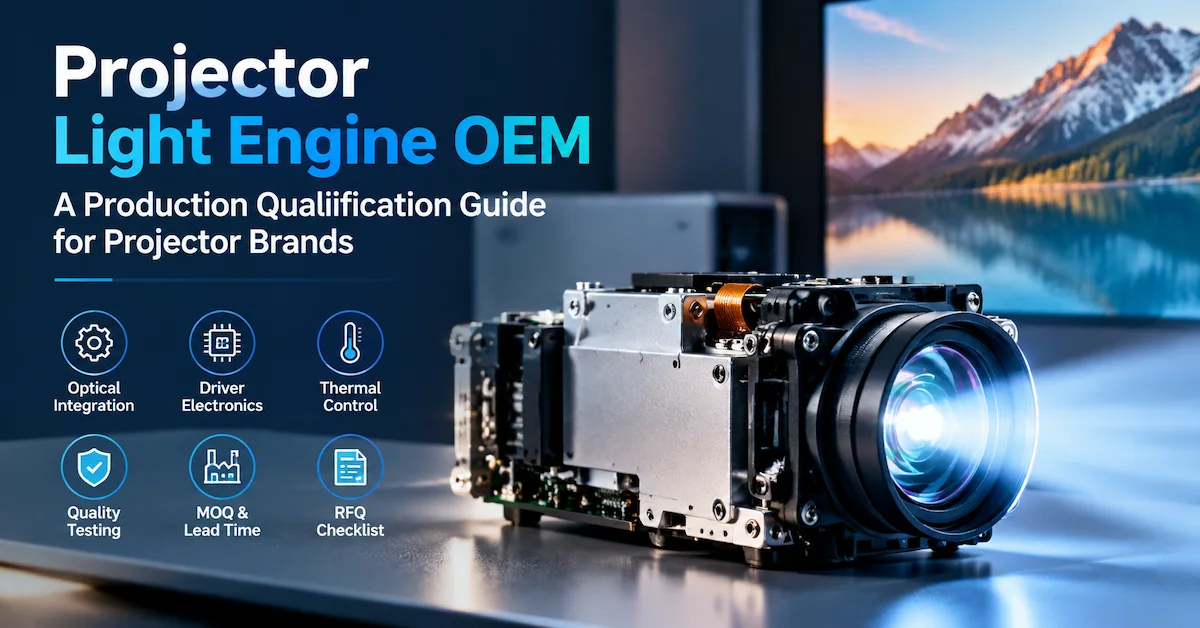
The phrase projector light engine can describe different hardware boundaries. In one project it may mean an optical module that contains the light source, concentrator, illumination path, imaging device, lens path, and mechanical mounts. In another project it may include the driver board, heat sink, fan control, focus mechanism, interface cable, or a complete projection subassembly. If a buyer and supplier use the same phrase for different boundaries, the RFQ will produce misleading prices and an unstable development plan.
A projector light engine OEM program normally includes five linked decisions:
- Optical boundary: define the light source type, imaging technology, lens path, throw relationship, focus method, and alignment references.
- Electrical boundary: define input rails, LED or laser drive requirements, control signals, connectors, protection circuits, and communication interfaces.
- Mechanical boundary: define mounting points, datum surfaces, tolerance stack-up, airflow openings, service access, and enclosure constraints.
- Manufacturing boundary: define which boards, cables, optics, thermal parts, and mechanical parts are sourced, assembled, tested, and packed by the OEM partner.
- Acceptance boundary: define the test conditions and pass criteria for brightness, uniformity, focus, color, noise, temperature, power, start-up, and final image quality.
These boundaries matter because an OEM request for “a 1080p projector light engine” is not enough to produce a reliable quotation. Resolution alone does not specify the optical path, screen size, throw distance, light-source power, thermal environment, image-processing requirements, or the mechanical envelope. A responsible supplier should ask for the missing conditions instead of filling them with assumptions.
Who Should Use a Projector Light Engine OEM Route?
Best fit for branded projector development
A projector light engine OEM route is most useful when the buyer has a defined product market but needs manufacturing support to turn a module concept into a repeatable product. Typical buyers include a projector brand launching a new portable model, an education-equipment company developing a classroom unit, an optical equipment integrator building a special-purpose display, and a consumer-electronics company adding projection to an existing product family.
It is also a fit for teams that own part of the design but need a partner for PCBA, component sourcing, DFMA, assembly, testing, or production scale-up. HCDPCBA describes services that are relevant when the light engine has to be coordinated with the rest of the projector electronics.
When a light engine OEM is not the right first step
If the project has no target image size, enclosure concept, interface definition, or intended market, start with a requirements workshop rather than a volume RFQ. A standard distributor may be more efficient when no customization or integration control is required.
Define the System Boundary Before Requesting a Quote
The following table can be used as the first page of an RFQ. It makes the commercial comparison more meaningful because every shortlisted supplier is quoting the same scope.
| RFQ area | Information the buyer should provide | Evidence expected from the OEM partner |
|---|---|---|
| Optical output | Target resolution, brightness measurement method, screen size, throw distance, uniformity, focus range, color target, and intended ambient light. | Optical specification sheet, sample measurement report, test conditions, and an explanation of what is typical versus guaranteed. |
| Light source | LED or laser preference, target power, operating duty cycle, lifetime expectation, dimming behavior, and safety requirements. | Light-source part information, driver compatibility, thermal assumptions, and replacement or obsolescence plan. |
| Electronics | Input voltage, power budget, control protocol, connector location, board stack, firmware ownership, and required interfaces. | Block diagram, interface definition, PCBA capability, BOM control process, and functional-test coverage. |
| Mechanical fit | Envelope, mounting datum, lens opening, airflow path, focus adjustment, fan position, and housing material. | 2D or 3D interface drawing, tolerance assumptions, DFMA feedback, and sample fit-check plan. |
| Production | Prototype quantity, pilot quantity, annual volume, target market, packaging, labeling, and required delivery window. | MOQ, sample lead time, pilot lead time, mass-production lead time, capacity assumptions, packaging proposal, and change-control rules. |
Do not compare supplier quotations until these fields are aligned. One company may quote only the optical module, while another includes the driver PCBA, cables, heat sink, alignment, and final functional testing. The lower number may simply represent a smaller scope.
Five Engineering Areas That Decide Light Engine OEM Success
1. Optical performance must be defined by measurement conditions
Brightness and image quality are not meaningful without test conditions. The RFQ should state the measurement position, operating mode, input signal, warm-up time, screen or integrating method, and whether the result is a typical value or a contractual minimum. The same module can show different results depending on the drive mode, temperature, optical alignment, test instrument, and image-processing configuration.
For an OEM buyer, the important question is not simply “How many lumens can the light engine produce?” It is “What repeatable output will the finished projector deliver under the target conditions?” Connect light-engine measurements to final projector checks for focus stability, sharpness, uniformity, color consistency, geometry, start-up time, and thermal-soak behavior.
Optical alignment should be treated as a manufacturing process. Ask for datum references, adjustment method, adhesive or fastener rules, curing requirements where applicable, and the post-assembly inspection method. A bright sample without alignment repeatability is a scale-up risk.
2. The driver and PCBA must match the optical load
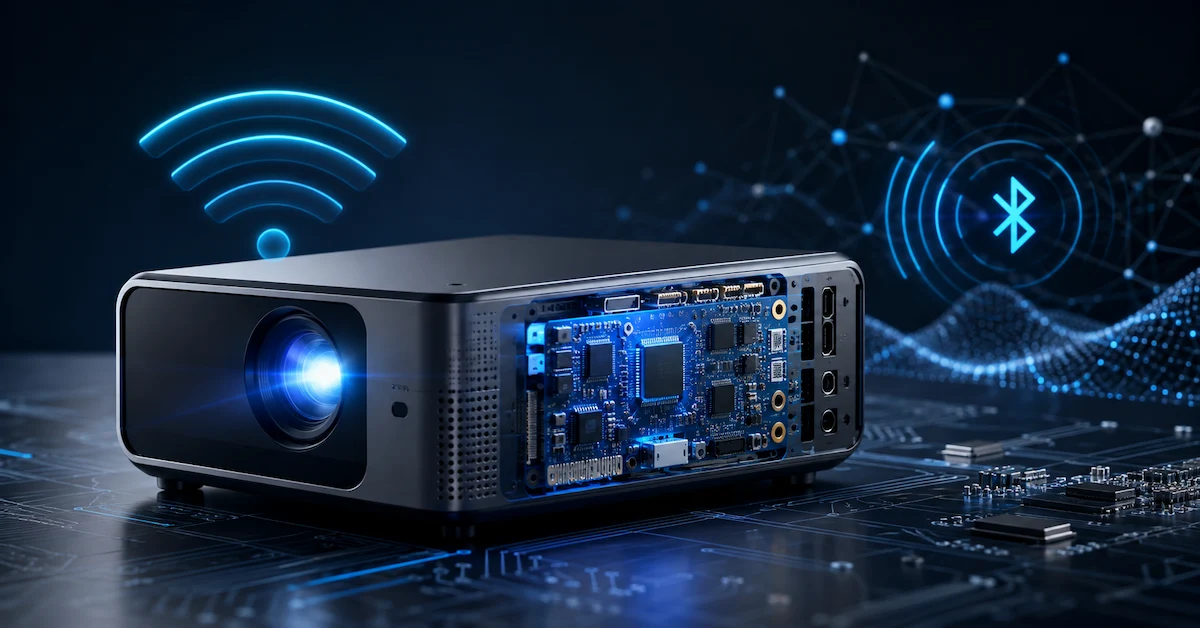
The light engine is an electrical load as well as an optical subsystem. The driver board must support the required current profile, control resolution, start-up sequence, protection functions, and communication method. A projector mainboard may also need to coordinate the light source with image processing, fan speed, standby mode, firmware updates, and fault reporting.
Ask the OEM partner to show how it controls component sourcing, PCB assembly, solder quality, connector insertion, cable routing, and functional testing. HCDPCBA's public manufacturing information highlights SMT assembly, PCBA fabrication, component sourcing, DFMA, AOI, X-Ray, and ICT-related quality control. These are useful capabilities, but the buyer should still request a project-specific control plan for the light engine driver and related boards.
For high-mix or customized projector programs, the BOM should identify critical components, approved alternates, last-time-buy risks, firmware dependencies, and revision-control rules. A component substitution that looks electrically equivalent may change heat generation, switching noise, optical output, or long-term stability. The supplier should not make such a change without documented approval.
3. Thermal design must cover the light source, board, and enclosure
Compact projectors have limited thermal margin. The light source, driver components, processor, memory, power conversion stage, and fan can all compete for airflow and heat-sink area. A light engine that performs well on an open test bench may show brightness drift, focus movement, color shift, fan noise, or protection shutdown after enclosure integration.
Thermal qualification should include the intended enclosure, operating orientation, ambient temperature range, fan control, dust-management assumptions, and continuous operating duration. Measure the temperature of the light source interface, driver power components, heat sink, optical housing, mainboard hot spots, and nearby plastic parts. The test report should state where the thermocouples or sensors were placed and which operating mode was used.
Thermal design is also a mechanical issue. The light engine mounting points must not distort under heat. The fan and duct should not transfer excessive vibration into optical components. The housing should not block the intake or exhaust path after cosmetic parts, filters, cables, and brackets are installed. These details should be reviewed during DFMA and sample fit checks rather than discovered during pilot production.
4. Mechanical interfaces determine whether the module is truly OEM-ready
A usable OEM light engine needs more than an outline drawing. The supplier should provide the lens axis, mounting datum, adjustment range, connector keep-out areas, heat-sink envelope, cable bend radius, service access, and tolerance assumptions. If the engine is installed at an angle or in a compact portable housing, gravity, vibration, and repeated handling may influence alignment.
During the first sample review, check the light engine against the real enclosure or a dimensionally accurate mock-up. Confirm lens opening, focus access, screw reach, adhesive clearance, cable routing, ventilation, and the sequence used to assemble the housing. A design that can be assembled only by forcing parts into position will create inconsistent focus and cosmetic defects at volume.
5. Firmware and control ownership should be explicit
Many light-engine problems appear to be optical but are caused by control logic. The firmware may set the wrong drive level, start the fan too late, misread a temperature sensor, fail to handle a fault state, or apply a different mode after an update. The RFQ should state who owns the firmware, who controls the interface specification, how revisions are approved, and how the buyer receives test logs.
If the light engine is integrated with a smart projector mainboard, the supplier should define the handshake during power-on, standby, brightness control, thermal protection, fan feedback, error reporting, and recovery after a power interruption. This is where a separate light-engine supplier and a separate electronics factory can create integration gaps. A coordinated OEM partner reduces that handoff risk only when responsibilities are documented.
How to Compare Projector Light Engine OEM Partners
Use a weighted comparison rather than choosing the lowest initial quotation. The right partner should be able to explain how its process protects the buyer's performance, supply, and launch risks. The scorecard below can be adapted for a commercial investigation or RFQ review.
| Qualification category | Questions to ask | Strong evidence | Red flag |
|---|---|---|---|
| Optical definition | Can the supplier define the measured output and acceptance conditions? | Specification sheet, sample report, alignment process, and clear exclusions. | Only a brightness headline with no test method. |
| Electronics integration | Can the driver, mainboard, power supply, and control interfaces be reviewed together? | Block diagram, interface table, PCBA process, and revision control. | Each board is quoted separately with no integration owner. |
| Thermal control | How is the engine qualified inside the final enclosure? | Thermal test plan, sensor locations, operating duration, and failure response. | Open-bench testing is presented as final-product validation. |
| Manufacturing evidence | Can the factory show its real production and inspection controls? | Production photos, equipment list, AOI/X-Ray/ICT records, and process ownership. | Generic marketing images and no project-specific control plan. |
| Commercial readiness | Can the supplier state MOQ, lead time, capacity, packaging, and change rules? | Written assumptions, pilot gates, approved BOM, and escalation path. | Price is given without quantity, test, packaging, or delivery conditions. |
HCDPCBA's existing content on projector PCB assembly factory qualification and projector mainboard manufacturing can be used as supporting reading, but this article's decision point remains narrower: whether the chosen OEM partner can carry the light engine from interface definition through production acceptance.
Original Factory Evidence Required Before Publication or RFQ Approval
Projector buyers should not award an OEM project from generic claims such as “high quality,” “advanced technology,” or “one-stop solution.” The buyer needs evidence connected to the actual project. HCDPCBA's website provides a useful starting capability profile, including one-stop electronics manufacturing, 50+ employees, a 5,000 square meter plant, SMT and PCBA services, DFMA support, and ISO 9001, ISO 14001, ISO 45001, and RoHS information on the company page. These facts explain who the manufacturer is, but they do not replace a projector-specific qualification package.
Recommended OEM Development Process From Sample to Mass Production
Stage 1: Requirements and feasibility review
Begin with a one-page product brief. It should state target market, projector type, projection size, intended viewing distance, brightness target, resolution, light-source preference, operating hours, ambient temperature, housing envelope, interfaces, annual volume, target launch date, and compliance requirements. The OEM partner should respond with assumptions, open questions, risks, and a proposed sample configuration.
At this stage, the supplier should identify which values require optical simulation, sample measurement, or customer-side confirmation instead of promising a final price from incomplete inputs.
Stage 2: Interface and architecture freeze
Once the concept is feasible, freeze the system boundary. Create an interface control document covering power rails, current range, control signals, connectors, mounting points, lens axis, heat-sink interface, fan control, sensor feedback, and firmware behavior. The document should assign an owner to each interface and define the approval process for changes.
This stage is where the buyer should connect the light engine plan with the projector power supply board, mainboard, and driver PCBA plans. A light engine quotation without these connections is incomplete.
Stage 3: Engineering sample and fit validation
The first sample should be evaluated in a fixture that represents the final projector. Check mechanical fit, lens access, cable routing, connector retention, fan clearance, heat-sink contact, focus adjustment, and image output. Record the sample revision, component lot, firmware version, equipment, and conditions. Test power cycles, input sources, brightness modes, fan transitions, image patterns, and intended operating duration before approval.
Stage 4: Design validation and pilot build
The pilot build should use production-intent materials, approved components, production tooling, and the intended assembly sequence. This is the point to confirm whether the light engine can be assembled consistently rather than individually adjusted by a senior engineer.
Review first-pass yield, alignment rework, solder defects, connector issues, thermal behavior, image-quality variation, and packaging damage. The supplier should provide a corrective-action list with owners and due dates. If the pilot requires manual rework that will not be available at mass-production volume, the process is not ready.
Stage 5: Production release and change control
Production release should include the approved drawings, BOM, firmware, test limits, inspection instructions, packaging, label information, and revision history. The change-control process should define what requires customer approval. This includes critical optical parts, light-source changes, driver components, PCB layout, firmware, heat sinks, fans, adhesives, connectors, and packaging that affects product protection.
After release, the buyer should continue monitoring field returns, brightness drift, focus complaints, thermal shutdown, fan noise, color consistency, and component availability. An OEM relationship is more valuable when it supports controlled updates instead of treating every order as a separate transaction.
Testing and Quality Plan for a Projector Light Engine OEM Program
The test plan should reflect the actual customer risk. A factory may perform many tests, but the buyer still needs to know whether those tests cover the failure modes that matter for the finished projector.
| Test layer | Typical purpose | Result the buyer should request |
|---|---|---|
| Incoming inspection | Verify critical optical, electronic, mechanical, and thermal components before assembly. | Inspection criteria, sampling plan, lot traceability, and nonconformance process. |
| PCBA inspection | Check placement, solder joints, hidden connections, polarity, and assembly defects. | AOI, X-Ray or other applicable inspection records, plus rework rules. |
| Electrical test | Verify power rails, current behavior, control signals, protection, and communication. | Functional test limits, test fixture revision, and failure log format. |
| Optical test | Verify brightness, focus, uniformity, color behavior, geometry, and image artifacts. | Test method, instrument, warm-up time, operating mode, and pass/fail limits. |
| Thermal and endurance test | Reveal drift, shutdown, fan-control, heat-sink, and enclosure problems. | Ambient condition, duration, sensor locations, operating mode, and before/after output. |
| Final system test | Confirm the light engine works with the buyer's mainboard, firmware, housing, and power supply. | Golden-sample comparison, final checklist, serial traceability, and release sign-off. |
For the PCBA portion of the program, HCDPCBA's public quality messaging references DFM review and AOI, X-Ray, and ICT capabilities. The buyer should ask which of these controls apply to the actual driver or control board, what the test coverage is, and whether records can be linked to a serial number or production lot.
Quality data should be actionable. A useful report identifies the sample revision, test condition, instrument, limit, and result so the buyer can evaluate changes, hold a lot when needed, and trace a field failure to a component or process change.
MOQ, Lead Time, Cost, and Packaging: What to Clarify
There is no reliable universal MOQ or lead time for projector light engine OEM work. The answer depends on whether the project uses an existing module, a customized optical path, a new driver board, special tooling, selected components, custom packaging, and a new test fixture. The RFQ should therefore ask for separate quantities and dates for engineering samples, pilot units, first production, and repeat orders.
Ask the supplier to separate one-time engineering charges from recurring unit cost. Typical cost drivers may include optical parts, light-source power, driver electronics, heat sinks, fans, mechanical tooling, alignment labor, test fixtures, packaging, certification support, firmware work, and component inventory. A low unit price can become expensive if it excludes alignment, final testing, special packaging, or the engineering changes required to fit the enclosure.
Packaging also needs review because a light engine may be sensitive to lens scratches, dust, vibration, connector damage, and movement of adjustment components. Request packaging photos or a concept, protection details, and validation assumptions for the logistics route.
Ask for these commercial fields in writing: sample MOQ, pilot MOQ, mass-production MOQ, sample lead time, pilot lead time, repeat-order lead time, tooling ownership, fixture charges, packaging method, payment terms, warranty scope, approved component policy, engineering-change notice period, and the assumptions behind the quotation.
Common Projector Light Engine OEM Failure Modes
Failure mode 1: The module is qualified outside the final enclosure
This creates a false pass. Airflow, temperature, vibration, and cable routing change after integration. The fix is to use an enclosure representative of production during fit and thermal validation.
Failure mode 2: Brightness is quoted without a measurement method
The buyer receives a number that cannot be compared with another supplier or reproduced in the factory. The fix is to define the instrument, operating mode, warm-up time, input pattern, and acceptance condition in the RFQ.
Failure mode 3: The driver board and light source are sourced from different owners
Each part may pass its own test while the combined system shows flicker, unstable brightness, startup faults, or thermal stress. The fix is to assign one integration owner and test the complete interface.
Failure mode 4: Optical alignment is treated as final inspection only
When alignment depends on individual technician skill, variation grows with production volume. The fix is to define datums, fixtures, adjustment limits, curing or fastening rules, and a repeatable inspection method.
Failure mode 5: Component substitutions are approved informally
A replacement component can change current, heat, switching noise, optical output, or firmware behavior. The fix is to classify critical components and require documented approval for changes.
Failure mode 6: The buyer asks for an OEM price before defining the product
This creates a quote that cannot be compared. The fix is to provide a product brief, interface table, target quantity, test plan, packaging expectation, and desired delivery window before commercial evaluation.
How HCDPCBA Can Fit Into a Projector Light Engine OEM Workflow
HCDPCBA's public company information positions Jiangxi Hechengda Technology Industrial Co., Ltd. as a one-stop electronics manufacturing partner. Its stated scope includes SMT assembly, PCBA fabrication, rapid prototyping, DFMA consulting, component sourcing, testing, and OEM/ODM support. The company page also presents a 5,000 square meter plant, 50+ employees, and ISO 9001, ISO 14001, ISO 45001, and RoHS information. These facts are useful when a projector brand is looking for an electronics manufacturing partner that can participate in more than board assembly.
For a light engine project, confirm how those capabilities will be assigned to the buyer's actual scope. HCDPCBA may be a fit when the project requires coordinated review of the driver PCBA, power supply, mainboard, component sourcing, assembly, and testing. Confirm the optical boundary, alignment process, MOQ, lead time, and project-specific test capability before a production decision.
Related HCDPCBA resources include the projector driver PCBA manufacturing guide, the portable projector electronics OEM guide, and the short-throw projector module guide. These pages support different stages of the projector topic cluster. This page should remain the commercial qualification page for the broader light-engine OEM program.
RFQ Checklist for Projector Light Engine OEM Buyers
Before sending an RFQ, prepare the following information. The more complete the package, the less likely the quotation will be based on hidden assumptions.
- Product type: portable, classroom, home, business, automotive, industrial, or special-purpose projector.
- Target market and operating environment, including ambient temperature, duty cycle, installation angle, and expected service life.
- Target resolution, image size, throw distance, brightness target, uniformity expectation, focus method, and color requirements.
- Light-source preference, power budget, input rails, control protocol, connector definition, and fault behavior.
- Mechanical envelope, mounting datums, lens opening, heat-sink interface, fan path, cable bend radius, and service access.
- Mainboard, driver-board, power-board, firmware, and enclosure ownership.
- Prototype quantity, pilot quantity, annual forecast, target launch date, MOQ expectation, and repeat-order plan.
- Required inspection, optical test, thermal test, endurance test, packaging, labeling, and traceability.
- Current drawings, Gerber files, BOM, 3D files, sample photos, or a short video of the intended product where available.
- Which specifications are fixed, which are targets, and which can be optimized by the OEM partner.
Attach this checklist to the quotation request and ask the supplier to return confirmed items, assumptions, exclusions, risks, and information still needed. That response is more useful than a one-page price sheet.
Frequently Asked Questions
What is a projector light engine?
A projector light engine is the optical and light-source subsystem that creates and directs the projected image. Its exact boundary varies by project and may include the light source, imaging path, lens path, driver electronics, thermal parts, control interface, and mounting hardware.
Is a projector light engine the same as a projector mainboard?
No. The mainboard usually manages input processing, software, user functions, and system control. The light engine creates the optical output. They must be compatible, but they are separate functional boundaries unless an OEM project combines them.
What should I send to a projector light engine OEM manufacturer?
Send the product brief, target resolution and brightness, projection size, throw distance, light-source preference, power budget, interface requirements, mechanical envelope, annual volume, test requirements, packaging expectations, and available drawings or samples.
Can a PCBA factory also support a projector light engine project?
It can support the electronic and manufacturing portion when it has the required PCBA, sourcing, DFMA, testing, and integration capabilities. The buyer must confirm whether the factory also owns or can coordinate the optical alignment and final image-quality requirements.
How do I compare light engine OEM quotations?
Compare the same scope and test conditions. Check whether each quotation includes the optical module, driver board, heat sink, fan, cables, alignment, firmware support, packaging, inspection, tooling, and final system test. Separate one-time engineering charges from recurring unit cost.
What is a reasonable MOQ for a customized projector light engine?
There is no universal MOQ. It depends on existing module availability, customization depth, tooling, component commitments, test fixtures, packaging, and forecast volume. Request separate MOQ values for engineering samples, pilot builds, first production, and repeat orders.
Which tests should be required before mass production?
At minimum, define electrical functional testing, optical output measurement, focus and uniformity checks, thermal and endurance testing, mechanical fit validation, power-cycle testing, and final system testing with the intended mainboard, enclosure, firmware, and power supply.
Why is thermal testing important for a compact projector?
Compact housings have limited airflow and heat-sink area. Temperature can affect brightness, focus, color, fan noise, component life, and protection behavior. The engine should be tested inside a production-intent enclosure under the intended duty cycle.
Can HCDPCBA provide an OEM or ODM projector solution?
HCDPCBA publicly describes OEM/ODM, SMT, PCBA, component sourcing, testing, prototyping, and DFMA services. The buyer should contact the team with the project boundary and confirm the exact optical, mechanical, electronic, MOQ, lead-time, and testing scope.
How should I start an RFQ with HCDPCBA?
Send the product brief, drawings or sample images, target quantity, application environment, required interfaces, test expectations, and delivery target through the HCDPCBA contact page. Ask for a marked-up feasibility response before approving a sample or production quotation.
Conclusion
A projector light engine OEM project succeeds when optical performance, electronics, thermal design, mechanical fit, firmware, production control, and acceptance testing are treated as one connected system. The most important sourcing decision is not the lowest module price. It is whether the partner can define the scope, expose its assumptions, prove its process, protect critical components, and deliver repeatable performance inside the final projector.
For HCDPCBA, the strongest commercial opportunity is to present the company as an accountable electronics and OEM/ODM integration partner, supported by SMT, PCBA, DFMA, sourcing, testing, and projector-related manufacturing knowledge. Before publishing this article, add the verified projector-specific photos, MOQ, lead time, measurement report, packaging evidence, case details, and named technical review. That evidence will convert a technically sound article into a credible RFQ asset.