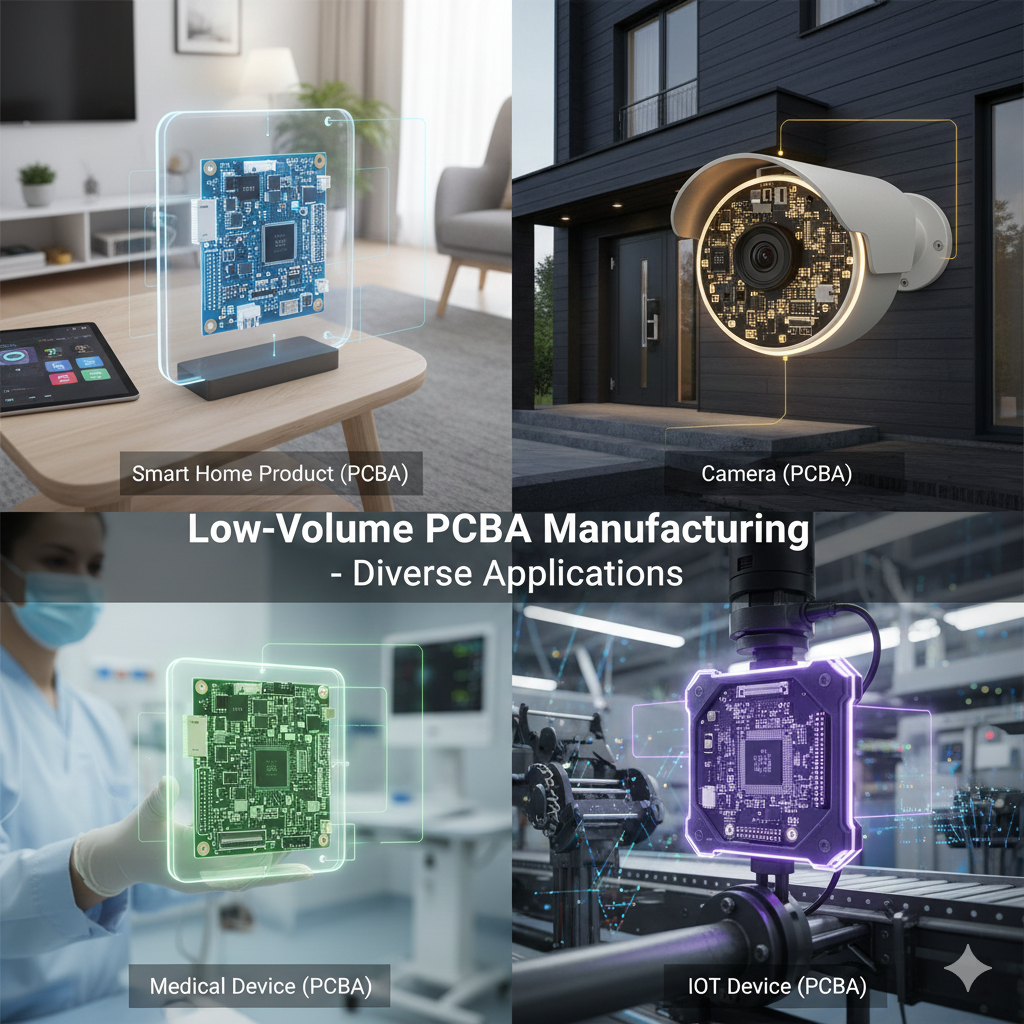
Low-Volume PCBA Manufacturing with Quick Changeover and Full Traceability
In modern electronics production, speed and stability are no longer opposites—they must coexist.
From IoT controllers to wearable modules, new designs evolve monthly, yet customers still expect consistent quality and documentation accuracy.
That’s why low-volume PCBA manufacturing has become the silent infrastructure of modern innovation.
It’s where agility meets control, where small-batch customization doesn’t come at the cost of reliability, and where traceability ensures accountability at every step.
Why Quick Changeover Defines Competitive Manufacturing
The value of quick changeover isn’t just about saving minutes—it’s about enabling manufacturing fluidity.
When product variations shift daily, downtime between builds can destroy productivity.
| Production Parameter | Traditional Setup | Quick Changeover Workflow | Efficiency Gain |
|---|---|---|---|
| Feeder Reassignment | Manual reel removal and relabeling | Modular feeder racks preconfigured per BOM | 75% faster line readiness |
| Stencil Exchange | Manual alignment and verification | Auto-lock stencil frame system | ±10μm repeat accuracy |
| Reflow Profile Adjustment | Full reheat calibration | Stored thermal recipes by board ID | <3°C delta per board |
| Program Loading | Manual code input | Digital job recall via MES barcode | 0 operator input errors |
| Inspection Reset | Full AOI reprogramming | Template reuse + parameter inheritance | 60% faster validation |
In low-volume PCBA, the shift from manual changeovers to digital scheduling directly boosts output capacity—even without adding machines.
A single line can now run three product types per day instead of one, maintaining yield rates above 98.7%.
Flexible PCB Assembly for Multiple Product Types
Flexibility is not improvisation—it’s pre-engineered adaptability.
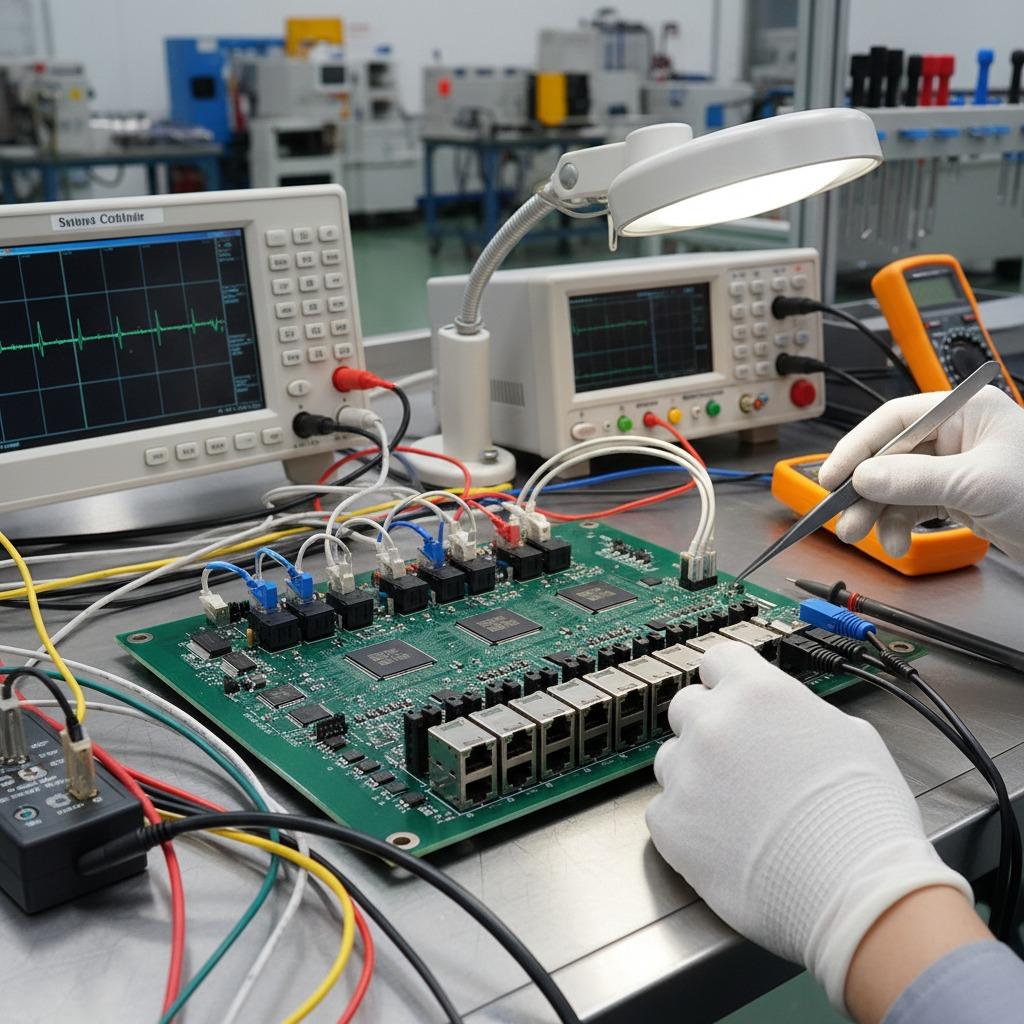
A flexible PCB assembly facility is designed to handle different layouts, component densities, and assembly technologies on the same production floor.
To achieve this, professional manufacturers employ:
-
Multi-zone reflow ovens capable of switching profiles without cooling downtime.
-
Universal placement heads for SMT components ranging from 01005 passives to 55mm BGAs.
-
Dual-head pick-and-place systems that can process two jobs simultaneously under MES supervision.
-
Inline AOI and SPI feedback loops that self-correct placement accuracy within 0.02mm.
The result: customers can push design diversity without worrying about scheduling penalties or yield fluctuations.
Traceability: The Core of Reliable Small-Batch Production
When batch size shrinks, the importance of traceable PCBA process grows exponentially.
Each board represents significant R&D cost, so tracking every detail—from component source to oven temperature—is mission-critical.
| Trace Level | Tracked Elements | Function in Quality Control |
|---|---|---|
| Material Traceability | Supplier, reel ID, incoming inspection data | Enables component-level defect isolation |
| Process Traceability | Solder paste lot, printer ID, placement offset logs | Provides process validation evidence |
| Environmental Traceability | Temperature, humidity, operator shifts | Ensures condition compliance per IPC-A-610 |
| Product Traceability | Serial ID, MAC, firmware version | Links manufacturing data to final device testing |
A complete traceability matrix allows instant backward and forward tracking—identifying the exact component lot if a fault occurs months later.
This data also supports RoHS, REACH, and ISO 9001 compliance audits without manual paperwork.
NPI and Rapid Iteration in Low-Volume Builds
For NPI PCBA builds (New Product Introduction), design stability often evolves mid-production.
A professional manufacturer treats each run not as a one-off order but as a learning loop.
Modern NPI systems include:
-
Real-time DFM feedback: Detects footprint or solder pad mismatch before soldering.
-
ECN integration within MES: Ensures new revisions are reflected instantly across the line.
-
Component alternates management: Pre-approved substitutes maintain supply continuity.
-
Batch-specific documentation: Each iteration generates a unique traveler and QA report.
This process ensures that even with five design updates in a month, data consistency and production repeatability remain uncompromised.
Technology Backbone of Quick Changeover PCBA Lines
Automation alone doesn’t guarantee flexibility—it’s the orchestration that matters.
High-performance custom PCB manufacturing lines combine smart scheduling, predictive logistics, and adaptive tooling.
Core enabling technologies include:
-
Feeder Recognition Cameras: Identify and calibrate feeders in seconds via QR labels.
-
Digital Twin Simulation: Predicts line bottlenecks before setup begins.
-
Adaptive Reflow Control: Adjusts temperature zones dynamically based on PCB thermal mass.
-
Cross-Line MES Integration: Syncs data from stencil printer to AOI for unified traceability.
Together, these technologies transform complexity into repeatable precision—even when no two batches are alike.
Quality Assurance Through Transparent Data
Every customer wants to know one thing: How do I trust your process?
The answer lies in visibility. A low-volume PCBA manufacturing partner with real-time dashboards and open data access creates measurable confidence.
Manufacturers committed to full traceability provide clients with:
-
Digital production reports including line parameters and test yields.
-
Component genealogy tracking for audit and warranty documentation.
-
Photo documentation for each completed assembly.
-
Post-build analytics highlighting process improvements for next runs.
Transparency is the bridge between precision and trust—and it’s what separates a supplier from a long-term partner.
Delivering Agility Without Sacrificing Quality
The future of small-batch manufacturing belongs to those who can adapt instantly without losing control.
Quick changeover ensures responsiveness; full traceability guarantees accountability.
Together, they redefine what low-volume PCBA manufacturing means in the age of constant innovation.
If your next electronics project demands short runs, rapid design updates, or version-controlled builds, visit homepage to learn more.
For personalized technical consultation or quotation, contact our team through the contact page.
Every build, every change, every board—delivered with traceable precision and flexible speed.