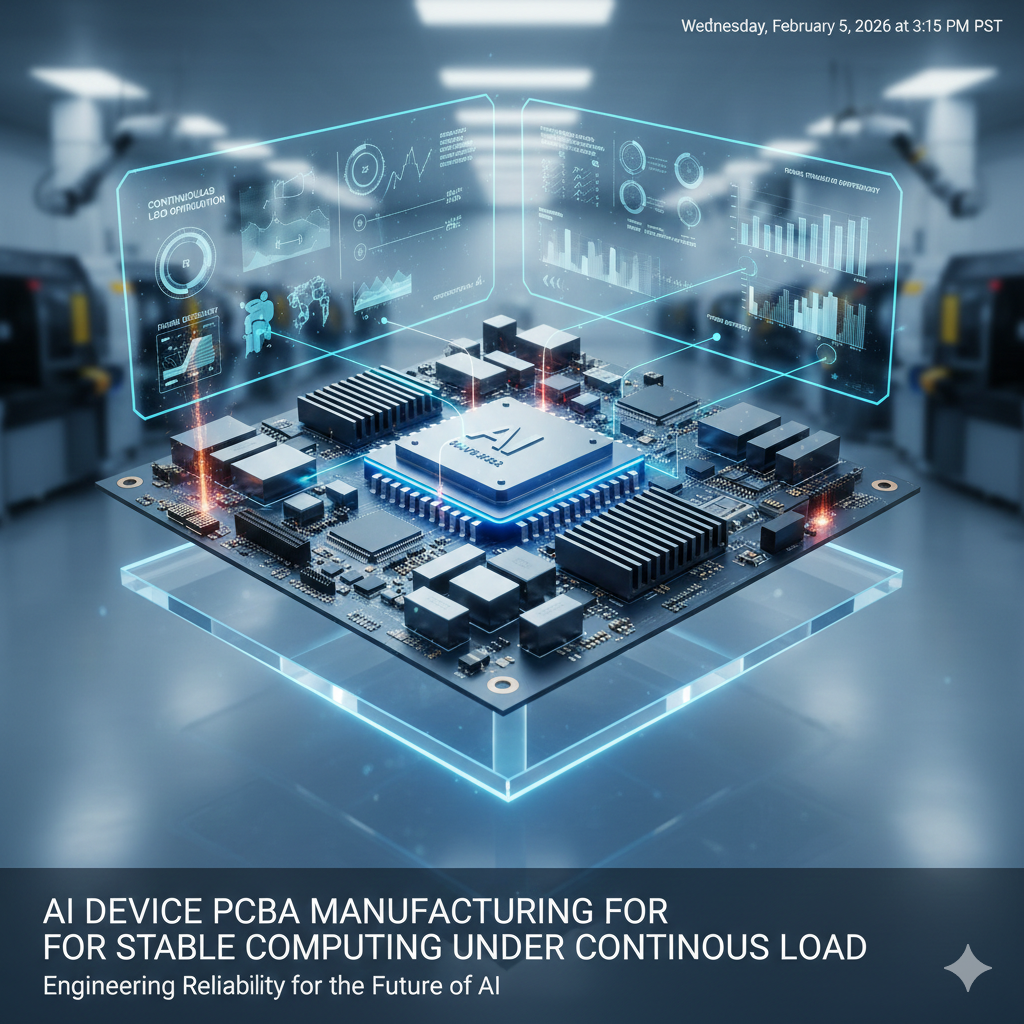
AI-enabled devices rarely fail in obvious ways.
Instead of complete shutdowns, problems surface as inconsistent inference results, unexplained processing slowdowns, or system resets that occur only after hours or days of operation.
These issues are often misattributed to software. In practice, many originate at the hardware level—specifically within the AI device PCBA, where power delivery, data movement, and heat dissipation intersect under real workloads.
Why AI Hardware Places Unique Demands on PCBA Manufacturing
Unlike traditional embedded systems, AI devices operate under fluctuating computational loads. Inference tasks arrive unpredictably, pushing processors from idle states to peak current draw within milliseconds.
From a manufacturing perspective, this creates three non-negotiable requirements:
-
Stable power delivery during rapid load transitions
-
Consistent high-speed data paths between processors and memory
-
Predictable thermal response under sustained computation
An experienced AI device PCBA manufacturing approach treats these as production constraints, not design assumptions.
Computing Stability Is a Manufacturing Outcome, Not a Specification
AI chipsets are validated in controlled environments, but production variability can quietly undermine their stability.
The most common manufacturing-level contributors include:
-
Marginal solder joints on power regulators and inductive components
-
Inconsistent grounding continuity across boards
-
Placement variation that alters heat dissipation efficiency
To mitigate these risks, manufacturers lock assembly parameters for compute-critical components and apply inspection emphasis beyond cosmetic criteria. Programs implementing these controls typically achieve:
-
20–30% reduction in intermittent processing errors
-
Measurable improvement in runtime consistency during burn-in tests
These results directly reflect disciplined AI device PCBA manufacturing rather than post-assembly correction.
Managing Power Behavior Under Dynamic AI Workloads
AI workloads stress power systems differently from static electronics. Rapid current spikes expose weaknesses that basic power-on testing cannot detect.
Effective manufacturing controls include:
-
Validating voltage stability during simulated inference cycles
-
Ensuring consistent solder integrity on power MOSFETs and inductors
-
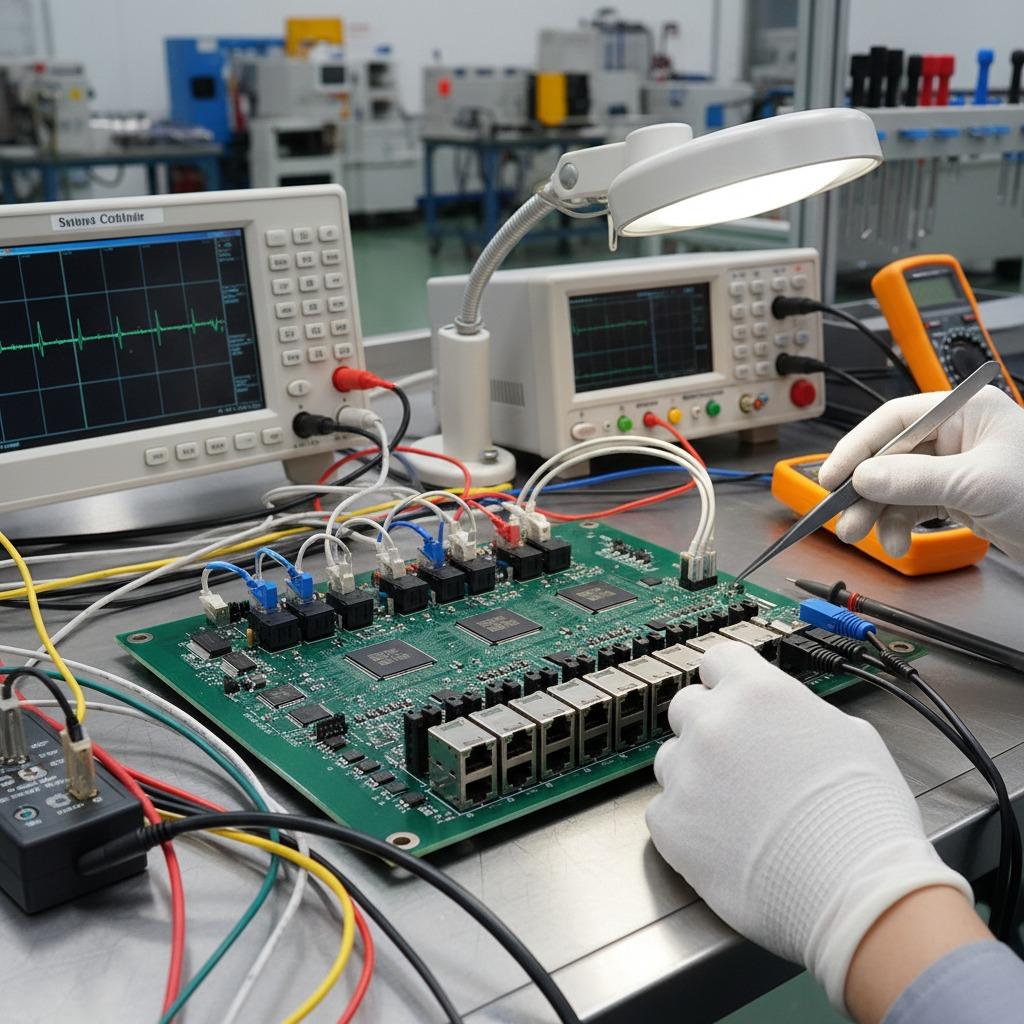
Monitoring transient response during production-level stress checks
Manufacturers applying these methods report 15–25% fewer unexplained resets in deployed AI devices, especially in edge computing scenarios.
Data Path Consistency and Assembly Discipline
High-speed data transfer between processors, memory, and accelerators is sensitive to subtle assembly variation. Even small inconsistencies can affect timing margins and long-term reliability.
A structured AI device PCBA approach emphasizes:
-
Controlled placement accuracy for memory and interface components
-
Focused inspection on data-critical solder joints
-
Consistent handling of thermally sensitive components
This discipline reduces batch-to-batch performance variance and minimizes the need for software-level compensation.
Inspection and Validation Aligned With Real AI Usage
Testing must reflect how AI hardware actually operates—not idealized lab conditions.
AI Device–Focused Inspection and Validation Structure
| Validation Stage | Applied Scope | Reference Impact |
|---|---|---|
| In-line inspection | Power & data-critical areas | 25–40% reduction in latent defects |
| Electrical testing | Voltage stability & signal paths | Eliminates early functional escapes |
| Load simulation | Sustained inference workload | 20–30% fewer runtime faults |
| Thermal observation | Heat response over time | Reduces thermal-related throttling |
| Trend analysis | Batch-level data comparison | Prevents gradual performance drift |
These figures reflect typical results observed in controlled production environments rather than marketing claims.
Scaling AI Hardware Without Introducing Instability
AI products often move from pilot deployments to broader rollout once models prove effective. Scaling at this stage introduces risk if early manufacturing assumptions are not preserved.
In disciplined AI device PCBA manufacturing:
-
Assembly parameters validated during pilots are locked before scale-up
-
Approved component alternates are qualified in advance
-
Process changes are introduced deliberately, not reactively
Manufacturers following this model experience 10–20% fewer production-related issues during expansion compared to fragmented manufacturing approaches.
Where This Manufacturing Approach Adds the Most Value
This production strategy is especially relevant for:
-
Edge AI gateways and processors
-
AI-enabled imaging and vision systems
-
Intelligent industrial controllers
-
Embedded AI analytics hardware
In these applications, stable computing behavior is often more valuable than peak benchmark performance.
Frequently Asked Questions
Q1: Is AI PCBA production suitable for medium volumes?
Yes. Many AI products scale gradually, making stability and repeatability more critical than sheer capacity.
Q2: Why is basic electrical testing insufficient for AI hardware?
Because it does not capture dynamic load behavior or sustained processing conditions.
Q3: Can manufacturing variability affect AI inference accuracy?
Yes. Power and data instability can subtly degrade inference consistency over time.
Why Manufacturing Discipline Defines AI Hardware Reliability
A robust AI device PCBA strategy ensures that computing performance remains stable as workloads fluctuate and deployment scales. When power behavior, data integrity, and validation depth are aligned with real AI usage patterns, hardware reliability becomes predictable rather than fragile.
If you are assessing whether a manufacturer’s production structure can support AI hardware under continuous load, reviewing real assembly controls and validation practices is a logical first step. You can learn more about our PCBA manufacturing capabilities and technical scope by visiting:
👉 https://www.hcdpcba.com
For projects that require a deeper evaluation—such as power behavior under inference load, data stability, or scaling AI hardware from pilot to deployment—you are welcome to discuss your specific AI device PCBA requirements with our team here:
👉 https://www.hcdpcba.com/en/contact-us