AI Camera PCBA for Edge Vision Systems
An AI Camera PCBA is used when a smart camera needs more than simple image capture. It solves a common buyer problem: moving processing closer to the camera so the device can analyze video locally, reduce latency, and avoid sending every frame to a remote server. In practical terms, this kind of board supports on-board AI inference for smart cameras, industrial inspection tools, security devices, and other embedded vision products.
Product Overview
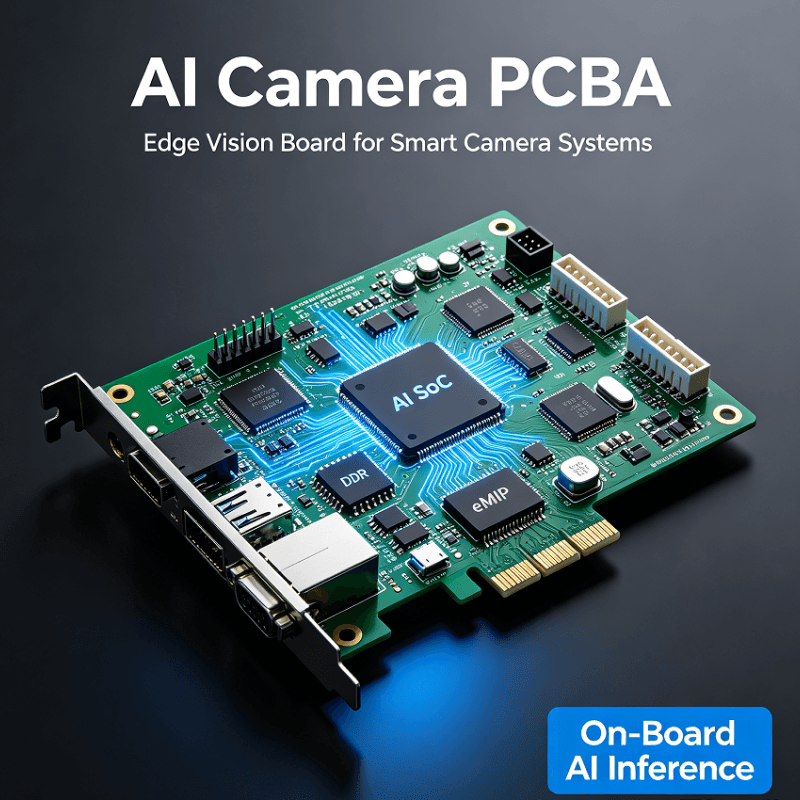
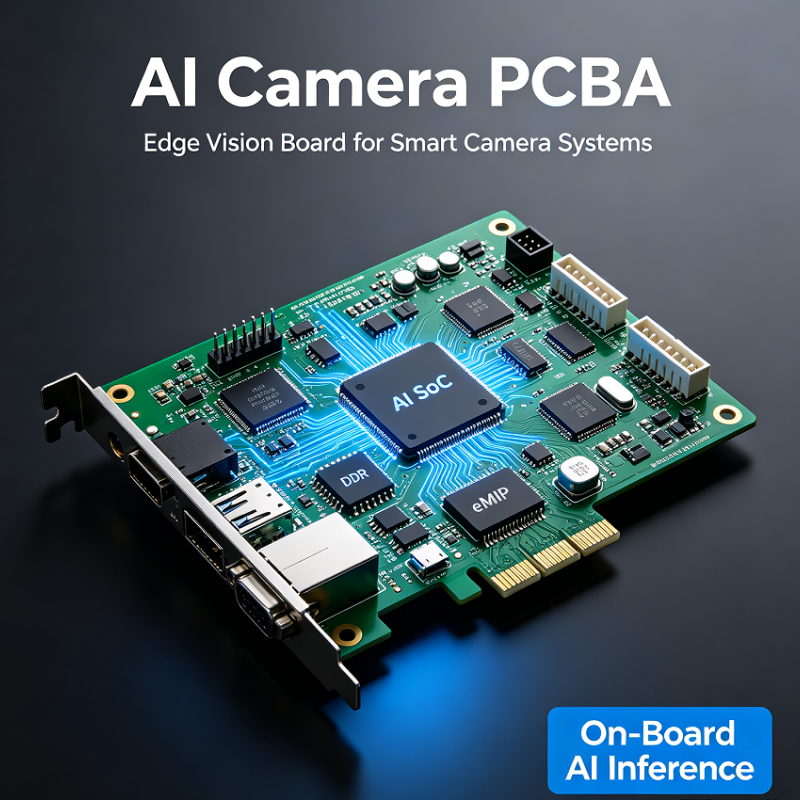
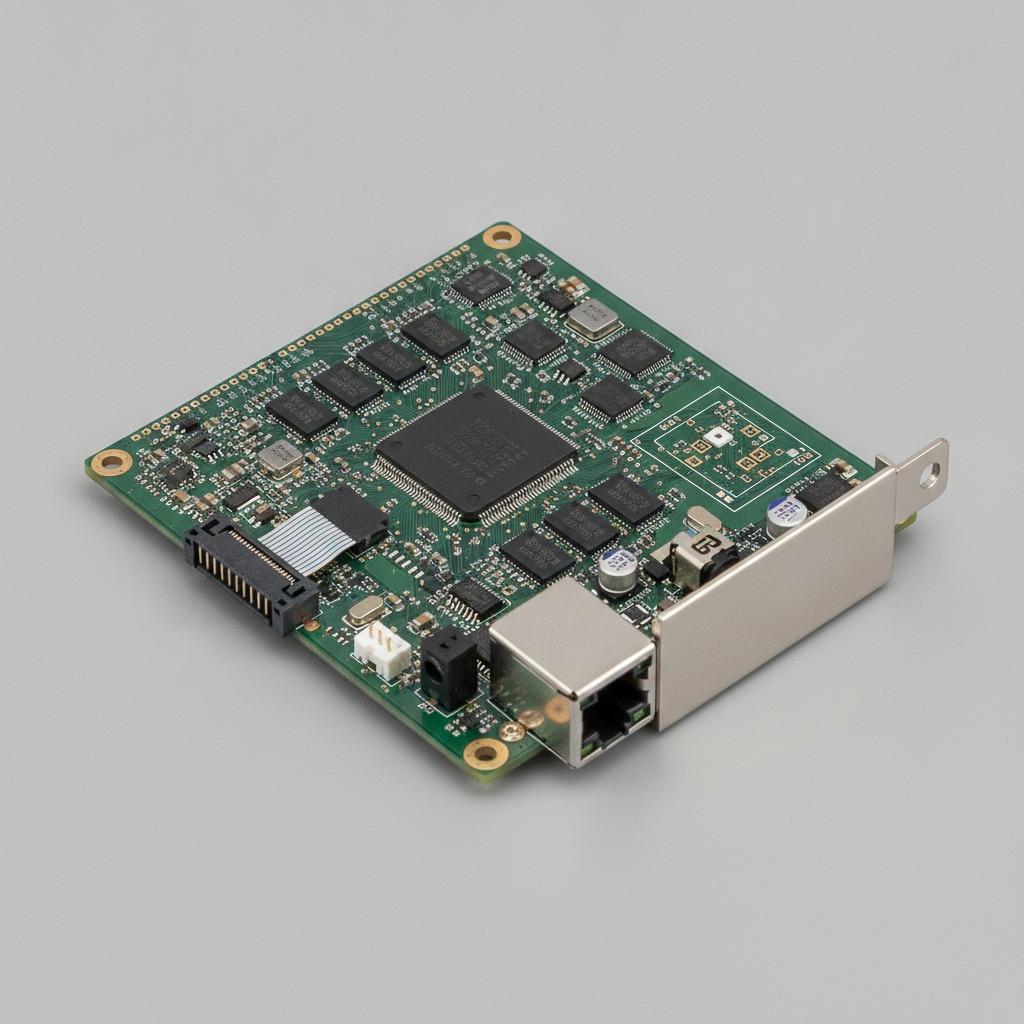
This product category is an embedded vision control board built on a rigid printed circuit board assembly. The visible structure includes a central AI SoC, supporting memory devices, connectors, headers, and a metal I/O bracket. The board layout suggests a compact control platform for camera input, local inference, and external device connection. In the supplied material, the board is also associated with terms such as AI IPC Board, Edge AI Board, AI Camera Motherboard, and Security Camera PCBA, which all point to the same general class of embedded camera electronics.
One of the clearest visible functions is on-board AI inference. The board is intended to handle local detection or analysis tasks directly at the edge, which is useful when network bandwidth is limited or when response time matters. This makes it suitable for vision endpoints that must react quickly to moving objects, events, or process anomalies.
Key Specifications and Visible Capabilities
Board-Level Structure
The image shows a green solder-mask PCB with surface-mounted ICs, passive components, exposed gold-finish edge contacts, and a metal bracket for external ports. A large central chip labeled AI SoC is visible, along with nearby devices labeled DDR and eMIP in one version of the product data. Another image reference shows labels such as eMMC and AI NPU Powered, indicating local processing and onboard storage support.
Interface and Connectivity
Visible interface markings include MIPI CSI, IR-CUT, RJ45, WiFi, and Audio. The board also appears to include an Ethernet port, a USB-style connector, a serial or D-sub-style connector, and a microSD/SD-style slot. These features suggest the board can serve as a camera integration platform with multiple peripheral options. Exact protocol speeds, supported resolutions, and camera channel counts are not supplied, so they should be confirmed during engineering review.
Materials and Finish Options
The visible construction uses a standard rigid PCB substrate with solder mask finish. Connectors are a mix of black and white plastic housings, metal-shielded ports, and through-hole mechanical parts on the bracket side. The exposed gold contacts indicate a board-edge interface suitable for reliable mating with a host system or expansion slot. For buyer projects, similar PCBA builds can also be adapted with different board materials, layer counts, and surface finishes depending on signal integrity and assembly needs, although those details must be defined per project.
Manufacturing and Assembly Process
Boards in this class are typically produced through SMT placement, reflow soldering, through-hole assembly for connectors, and final inspection. Because the product belongs to embedded electronics and PCBA manufacturing, assembly quality matters at both the fine-pitch IC level and the mechanical connector level. hcdpcba supports SMT贴片, PCB打样, 元器件代采, 组装, 测试, and DFMA services, which is relevant for customers who need a complete build path from prototype to production.
For an AI camera motherboard or security camera PCBA, process control usually focuses on component placement accuracy, solder joint consistency, connector alignment, and functional testing of key I/O paths. When the design includes multiple interfaces such as MIPI CSI, Ethernet, audio, or WiFi modules, assembly planning should also consider mechanical clearance and signal routing.
Application Scenarios
Typical uses include smart cameras, edge video analytics, industrial inspection, robotics vision, access control, IoT vision endpoints, and surveillance hardware. In these systems, an Edge AI Board can help classify objects, detect motion, or run local inference without relying entirely on a cloud connection. That is especially valuable where privacy, speed, or network stability is a concern.
The platform references RV1126, GK7206, and RK3588 in the provided material suggest the general family of embedded processing environments this board may align with. Those names indicate the type of market segment rather than a confirmed exact chip choice, so they should be treated as compatibility or reference points only.
Quality Control and Buyer Decision Factors
When selecting an AI IPC Board, buyers usually compare interface count, memory support, thermal design, connector reliability, and software integration needs. For a Security Camera PCBA, it is also important to confirm IR-CUT control, network connectivity, power architecture, and how the board fits into the enclosure. Because the supplied data does not list exact electrical ratings or performance figures, engineering validation is essential before volume purchase.
Quality control for this type of PCBA should include incoming inspection, assembly inspection, solder joint review, functional test, and interface verification. hcdpcba emphasizes quality control, fast response, confidentiality, and OEM/ODM service, which can help teams move from concept to pilot build with fewer manufacturing gaps.
Customization Guidance
If you are developing a new embedded camera product, define the camera interface, storage needs, power budget, wireless requirements, and I/O list first. That information determines whether the board should prioritize MIPI CSI input, RJ45 networking, audio support, or bracket-mounted external ports. For custom PCBA work, DFMA review can reduce rework and improve manufacturability before the design is released.
Customers planning a smart camera motherboard, industrial vision endpoint, or AI inference controller should also decide early whether the project needs prototype quantity, small-batch assembly, or mass production. Clear documentation for BOM, placement drawings, and test requirements will improve results and shorten the iteration cycle.
Contact for Custom AI Camera PCBA
For custom PCB assembly, embedded vision hardware, or a tailored AI Camera PCBA build, hcdpcba offers PCB打样, SMT贴片, 元器件代采, 组装, 测试, OEM, and ODM support. If you need a board for smart cameras, edge analytics, or security monitoring equipment, share your interface list and target application so the assembly path can be defined correctly.