Choosing the right mass production camera module OEM partner is a critical decision for brands developing security cameras, smart locks, baby monitors, USB camera modules, industrial vision devices, IoT cameras, and smart home monitoring products. A sample that works well does not always guarantee stable mass production. The real challenge is whether the supplier can control PCBA quality, SMT assembly, component sourcing, testing, yield rate, packaging, and delivery consistency across every batch.
For B2B buyers, camera module mass production is not only about producing more units. It is about making sure every unit performs close to the approved sample. If image quality changes, connectors fail, power consumption varies, or the sensor supply becomes unstable, the project may face returns, delayed shipments, and customer complaints.
HCDPCBA supports camera-related electronic projects through one-stop electronics manufacturing services, including PCB prototyping, SMT assembly, PCBA manufacturing, component sourcing, DFMA review, testing, and OEM/ODM production.
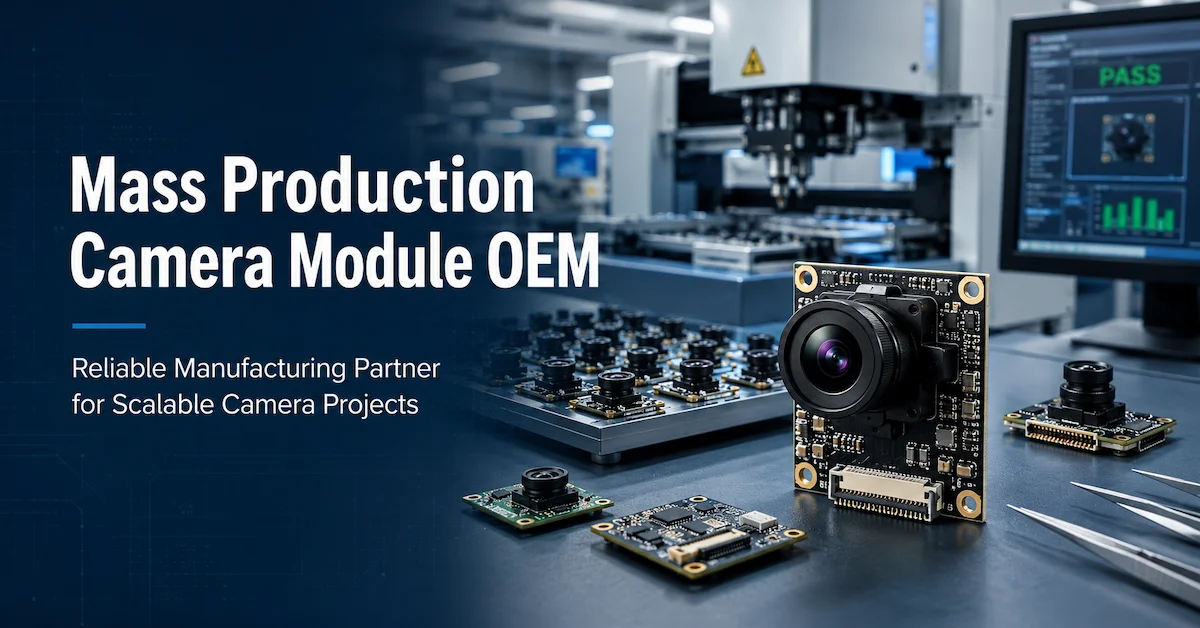
What Is Mass Production Camera Module OEM?
Mass production camera module OEM refers to the process of producing customized camera modules or camera-related electronic assemblies in larger quantities based on the buyer’s approved specifications, samples, drawings, BOM, or functional requirements.
A mass production camera module project may include:
- Camera sensor module production
- Lens and sensor assembly
- Camera module PCB assembly
- SMT assembly
- FPC or connector assembly
- USB, MIPI, DVP, or custom interface support
- Power management circuit assembly
- Night vision or IR circuit integration
- Image function testing
- OEM logo or packaging customization
- Batch production and shipment control
For buyers, the goal is to scale from prototype to stable production without losing quality consistency.
Why Camera Module Mass Production Is Different from Sampling
Many buyers successfully approve a camera module sample, but problems appear after the first batch order. This happens because mass production requires stronger process control than sample development.
During sampling, the supplier may manually check each unit carefully. During mass production, the supplier must rely on a repeatable manufacturing process, stable components, clear testing standards, and production records.
Common mass production risks include:
- Sensor or lens changes after sample approval
- Inconsistent image quality between batches
- Weak FPC or connector soldering
- Poor SMT assembly consistency
- PCBA power instability
- Interface compatibility issues
- Low yield rate
- Component shortage
- Delayed delivery
- Unclear testing standards
A reliable mass production camera module OEM partner should help buyers control these risks before the purchase order is scaled.
Main Applications for Mass Production Camera Modules
Camera modules are widely used in smart electronics and industrial devices.
| Application | Mass Production Requirement | Typical Buyer |
|---|---|---|
| Security cameras | Stable image, night vision, long-term PCBA reliability | Security camera brands |
| Smart locks | Compact module, low power, face capture consistency | Smart lock manufacturers |
| Baby monitors | Safe power design, low-light image, batch consistency | Smart nursery brands |
| USB camera modules | USB stability, plug-and-play testing, cable reliability | Embedded device developers |
| Industrial vision | Stable frame rate, long operation, strong connector quality | Automation equipment suppliers |
| Doorbell cameras | Wide-angle image, night mode, wireless compatibility | Smart home brands |
| IoT cameras | Compact PCBA, low power, custom interface | IoT hardware developers |
| AI vision devices | Clean image input, stable data transmission | AI hardware companies |
HCDPCBA’s Camera Series covers camera-related product directions, while its PCBA manufacturing services support customized electronic board production for camera modules and smart devices.
What Buyers Should Check Before Mass Production
1. Golden Sample Approval
Before mass production starts, buyers should confirm a golden sample. This sample becomes the quality reference for future production.
A golden sample should define:
- Image quality
- Lens angle
- Focus distance
- Night vision performance
- Power consumption
- Interface stability
- PCBA layout
- Connector position
- Housing fit
- Packaging standard
- Testing acceptance criteria
Without a golden sample, it becomes difficult to judge whether production quality is acceptable.
2. BOM and Component Stability
Component changes are one of the biggest risks in camera module mass production. Sensors, lenses, ICs, FPC connectors, power components, and USB or MIPI interface parts should be confirmed before production.
Buyers should ask:
- Are all key components available?
- Are sensors and lenses locked after approval?
- Are alternative parts approved in advance?
- Is the BOM version controlled?
- Can the supplier provide component sourcing support?
- Are genuine components used?
- What is the lead time for long-lead items?
HCDPCBA supports component sourcing and BOM-related manufacturing support, helping buyers reduce sourcing risk before scaling orders.
3. Camera Module PCBA Quality
The camera module PCBA affects signal stability, power control, image output, and long-term reliability. Poor PCBA quality may not appear immediately during sample testing, but it can cause field failures later.
Buyers should check:
- PCB quality
- SMT assembly accuracy
- Soldering reliability
- Sensor interface stability
- USB, MIPI, or DVP signal routing
- Power management circuit
- EMI control
- Connector soldering
- Heat behavior
- Test point design
For camera module OEM projects, PCBA quality is one of the most important factors behind stable mass production.
4. SMT Assembly Process Control
Mass production requires repeatable SMT assembly control. Camera modules often use compact boards, small components, fine-pitch ICs, and FPC connectors.
A good supplier should control:
- Solder paste printing
- Component placement
- Reflow soldering
- Connector soldering
- Fine-pitch IC assembly
- AOI inspection
- Defect recording
- Batch consistency
- Rework control
HCDPCBA’s SMT assembly and PCBA manufacturing capability are suitable for buyers who need stable camera module electronics production rather than simple product sourcing.
5. Testing Before Shipment
Camera module mass production should include both electronic testing and image function testing.
Important testing items include:
- AOI inspection
- Power-on test
- Image output test
- Focus and clarity test
- USB/MIPI/DVP interface test
- Low-light or night vision test
- Connector test
- Power consumption test
- Functional test in target conditions
- Final sampling inspection
Testing standards should be agreed before production begins. This reduces disputes and improves shipment quality.
Mass Production Camera Module OEM Checklist
Before placing a batch order, buyers should prepare a clear manufacturing checklist.
| Item | What to Confirm |
| Application | Security camera, smart lock, baby monitor, industrial vision, USB camera |
| Golden sample | Approved image, PCBA, lens, interface, packaging |
| Sensor | Model, resolution, frame rate, long-term availability |
| Lens | Viewing angle, focus distance, IR compatibility |
| Interface | USB, MIPI, DVP, FPC, board-to-board, custom connector |
| PCBA | Board size, connector position, power design, test points |
| Components | BOM version, alternatives, sourcing plan |
| SMT | Placement accuracy, soldering process, AOI inspection |
| Testing | Image test, interface test, power test, functional test |
| OEM needs | Logo, label, packaging, private label requirements |
| Quantity | Pilot batch, mass production batch, forecast |
| Delivery | Lead time, packaging, shipment schedule |
This checklist helps buyers avoid unclear communication and improves quotation accuracy.
Pilot Production Before Full Mass Production
For new camera module projects, buyers should not jump directly from sample approval to a large order. A pilot production run is often the safer step.
Pilot production helps verify:
- Whether the process is repeatable
- Whether component sourcing is stable
- Whether testing standards are practical
- Whether PCBA quality is consistent
- Whether packaging protects the product
- Whether the yield rate is acceptable
- Whether the supplier can meet delivery expectations
After pilot production is approved, buyers can scale to larger batch orders with lower risk.
OEM vs ODM for Camera Module Mass Production
Buyers should choose the cooperation model based on their project maturity.
| Project Type | Meaning | Best For |
| OEM mass production | Buyer provides design or requirements, supplier produces accordingly | Brands with approved samples |
| ODM camera module development | Supplier supports product development and manufacturing | Buyers needing a complete solution |
| Camera PCBA production | Supplier builds electronic boards inside the module | Hardware developers |
| Turnkey electronics manufacturing | PCB, SMT, BOM sourcing, testing, assembly, delivery | Buyers needing supply chain control |
| Private label production | Supplier supports branding and packaging | Distributors and product brands |
If buyers already have drawings, samples, Gerber files, or BOM, OEM mass production can be efficient. If the buyer still needs module development, ODM support may be more suitable.
Common Mistakes Buyers Should Avoid
Placing a large order without pilot production
Pilot production helps identify process risks before full-scale manufacturing.
Ignoring BOM version control
Changing sensors, lenses, ICs, or connectors after approval can affect image quality and reliability.
Focusing only on unit price
A lower price may hide weak testing, unstable components, or poor process control.
Not defining testing standards
Without clear inspection criteria, it is difficult to judge whether a batch meets requirements.
Overlooking packaging protection
Camera modules include lenses, FPCs, connectors, and sensitive electronics. Poor packaging can cause damage during shipment.
Not checking supplier communication
Mass production requires fast communication on schedule, defects, testing, and component changes.
How HCDPCBA Supports Mass Production Camera Module OEM Projects
HCDPCBA can support camera module buyers from prototype to batch production.
PCB prototyping
Prototype production helps buyers verify camera circuit design, PCBA layout, interface compatibility, and mechanical fit before scaling.
SMT assembly
SMT assembly supports camera module PCBA production with controlled soldering and component placement.
Component sourcing
HCDPCBA can support BOM sourcing, component availability checks, and alternative component communication.
DFMA review
DFMA review helps identify production risks before mass production, such as difficult assembly, poor connector placement, weak test point access, or unnecessary cost.
Testing support
Testing can include PCBA inspection, power-on testing, image function testing, interface testing, connector testing, and final functional verification.
OEM/ODM production
HCDPCBA can support customized camera module electronics, private label requirements, board-level changes, and long-term manufacturing cooperation.
Buyers can learn more about HCDPCBA’s company capabilities through the About Us page.
Quality Control Points for Mass Production
A complete quality control process should cover incoming materials, assembly, testing, and final shipment.
| QC Point | Purpose |
| BOM review | Confirm components match approved version |
| Incoming inspection | Check PCBs, sensors, lenses, ICs, FPCs, connectors |
| SMT inspection | Verify placement, soldering, and missing parts |
| AOI inspection | Detect visible PCBA defects |
| Power test | Confirm stable voltage and current |
| Interface test | Check USB, MIPI, DVP, or custom signal stability |
| Image output test | Check clarity, focus, color, frame rate, and noise |
| Functional test | Verify module performance in target conditions |
| Final inspection | Confirm appearance, packaging, labels, and quantity |
| Golden sample comparison | Ensure batch quality matches approved standard |
This process helps reduce returns and improve buyer confidence.
What Information Should Buyers Provide for a Fast Quote?
To receive a faster and more accurate quotation, buyers should prepare:
- Product application
- Target quantity
- Forecast quantity if available
- Approved sample or reference image
- Gerber files
- BOM
- Pick-and-place file
- Sensor and lens requirements
- Interface type
- PCBA size
- Connector or FPC details
- Testing standards
- Packaging requirements
- OEM or private label needs
- Target delivery schedule
If the buyer does not have complete files yet, functional requirements and product photos can still help the supplier provide an initial feasibility review.
Why Work with HCDPCBA?
HCDPCBA is suitable for buyers who need an engineering-focused mass production camera module OEM partner. For camera module projects, HCDPCBA can connect PCB prototyping, SMT assembly, PCBA manufacturing, component sourcing, testing, and OEM/ODM support into one production workflow.
This helps buyers reduce supplier coordination, improve project speed, and control quality risks before scaling production.
For brands developing security cameras, smart locks, baby monitors, industrial vision modules, USB camera modules, IoT cameras, and embedded vision hardware, HCDPCBA can support the project from sample validation to batch production.
FAQ
1. What is mass production camera module OEM?
It is the large-scale production of customized camera modules or camera-related electronics based on buyer specifications, approved samples, BOM, drawings, or functional requirements.
2. Why is a golden sample important?
A golden sample defines the approved image quality, PCBA structure, interface, packaging, and testing standard for mass production.
3. What is the difference between sample production and mass production?
Sample production verifies function, while mass production requires stable components, repeatable SMT process, quality control, testing, packaging, and delivery management.
4. What should I check before placing a mass production order?
Buyers should check BOM stability, PCBA quality, SMT process, testing standards, pilot production results, packaging, and delivery schedule.
5. Can camera modules be customized for OEM production?
Yes. Buyers can customize sensors, lenses, PCBA size, connectors, FPC length, interface, power design, testing standards, logo, and packaging.
6. What testing is needed for mass production camera modules?
Common tests include AOI inspection, power test, image output test, interface test, connector test, low-light test, and final functional verification.
7. Can HCDPCBA support mass production camera module projects?
Yes. HCDPCBA supports PCB prototyping, SMT assembly, PCBA manufacturing, component sourcing, testing, and OEM/ODM production for camera-related electronics.
8. What files are needed for quotation?
Useful files include Gerber, BOM, pick-and-place file, drawings, approved sample, testing requirements, quantity, and packaging details.
Conclusion
Choosing a mass production camera module OEM partner requires more than approving a working sample. Buyers need to evaluate BOM stability, PCBA quality, SMT assembly consistency, testing process, pilot production, packaging, delivery control, and OEM/ODM support.
For security camera brands, baby monitor companies, smart lock manufacturers, industrial vision equipment suppliers, USB camera module buyers, and IoT hardware developers, a reliable manufacturing partner can reduce production risk and improve batch consistency.
HCDPCBA supports mass production camera module OEM projects through PCB prototyping, SMT assembly, PCBA manufacturing, component sourcing, testing, and OEM/ODM electronics manufacturing. If you are preparing to scale a camera module project from sample to batch production, you can explore HCDPCBA’s Camera Series or PCBA manufacturing services to plan your next OEM project.