Auto-Focus Camera Module: Fast, Accurate Lens Positioning for High-Definition Imaging
Ensuring a sharp image is rarely about the sensor alone — it is largely determined by how quickly and accurately the lens moves.
The auto-focus camera module combines micro-actuator mechanics, sensing algorithms, and PCBA control to deliver crisp imaging from close-range objects to distant landscapes, even when lighting or motion changes unexpectedly.
This capability is now foundational for smartphones, smart home cameras, industrial inspection systems, automotive electronics, and AI vision devices that must adapt instantly to new visual conditions.
1. Core Focusing Mechanisms: How Lens Movement Achieves Sharpness
Auto-focus depends on the ability to move the lens stack along the optical axis with precision measured in microns. Different module architectures suit different devices and focusing needs.
Main Auto-Focus Mechanisms
| AF Mechanism | Working Principle | Advantages | Suitable Applications |
|---|---|---|---|
| Voice Coil Motor (VCM) | Electromagnetic coil moves lens in a linear direction | Fast response, low noise | Smartphones, smart cameras |
| PDAF (Phase Detection AF) | Dedicated pixels detect focus phase difference | Accurate tracking of moving subjects | AI cameras, drones, industrial |
| Contrast AF | ISP analyzes contrast changes frame by frame | High accuracy, best for static scenes | Smart home devices |
| Hybrid AF (PDAF + Contrast) | Combines both methods for reliability | Faster and more consistent | Automotive, surveillance |
High-performance AF modules rely on micro-adjustments of 1–3 μm per step, controlled through closed-loop algorithms that evaluate focus in real time.
2. Optical Stack Design: Built for Sharpness Across Distances
Every auto-focus module uses a carefully engineered optical assembly that responds effectively to actuator movements.
Key lens design features:
-
Multi-element glass lenses for stable refractive performance
-
Wide-aperture structures (F1.6–F2.0) allowing rapid focus under low light
-
Aspheric lens surfaces reducing edge distortion
-
Anti-reflective coatings limiting flare and ghosting
-
Precision optical alignment within ±5 µm
The synergy between optics and actuator movement determines how quickly the module locks focus and how consistent the sharpness remains during autofocus transitions.
3. PCBA Architecture That Stabilizes Focusing Performance
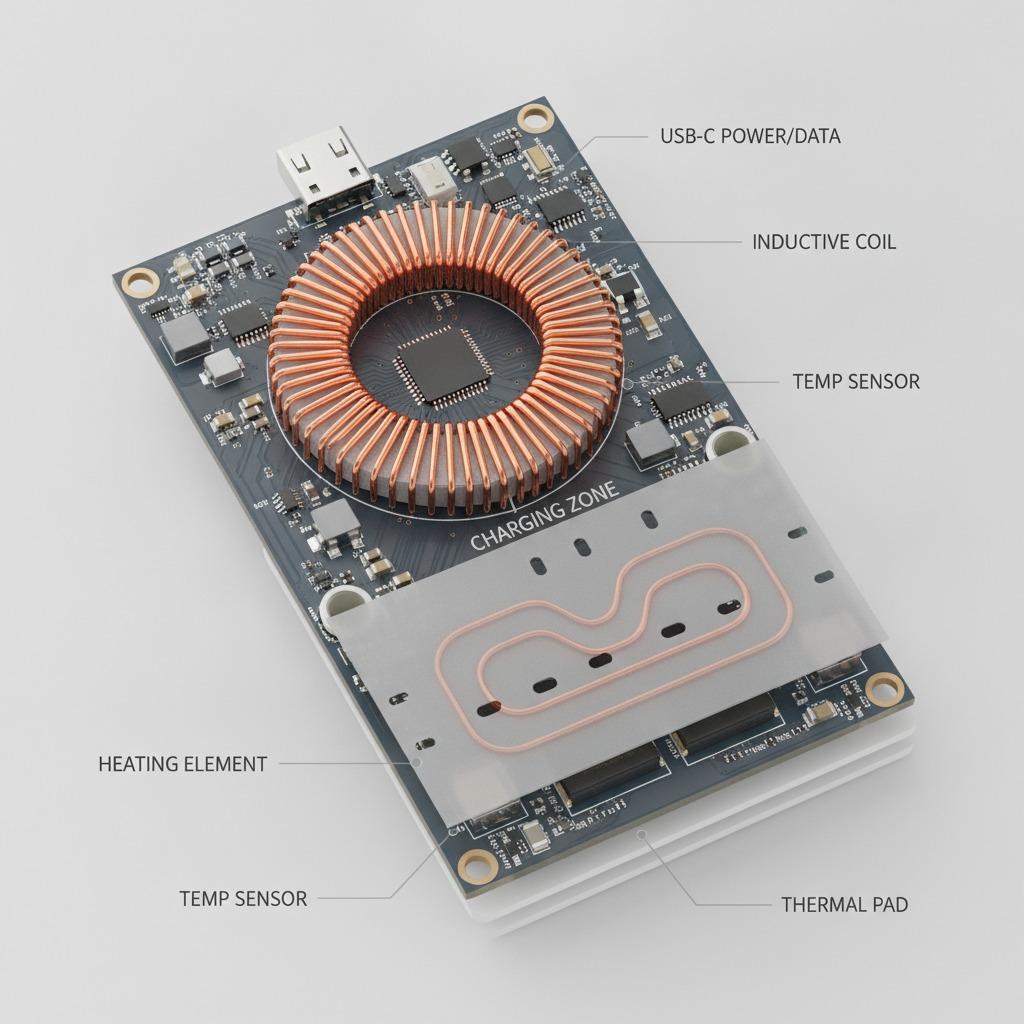
The PCBA is more than a connector — it is the real-time controller of all focusing operations.
A well-engineered camera PCBA delivers:
-
Stable driving current for VCM actuators (smooth lens movement)
-
Low-ripple power design for clean AF signal processing
-
High-speed communication lines for sensor-to-ISP data transfer
-
EMI shielding that prevents magnetic noise from disturbing autofocus
-
Thermal-balanced layout preserving actuator responsiveness
These elements ensure that focusing speed does not degrade even during long imaging cycles, heat buildup, or high-frame-rate operations.
4. ISP and Algorithm Optimization: Intelligent Focus Decisions
AF performance relies heavily on processing algorithms. A high-quality ISP interprets scene data and commands the actuator accordingly.
Key ISP functions supporting AF:
-
Scene Recognition — differentiates faces, objects, backgrounds
-
Motion Prediction — estimates subject trajectories
-
Contrast Curve Analysis — identifies peak clarity points
-
Low-Light Compensation — increases gain for focusing accuracy
-
Anti-Hunting Logic — prevents the lens from moving back and forth unnecessarily
Well-tuned algorithms are essential for avoiding focus hunting, a common challenge in low-light or high-movement environments.
5. Reliability Engineering for Auto-Focus Modules
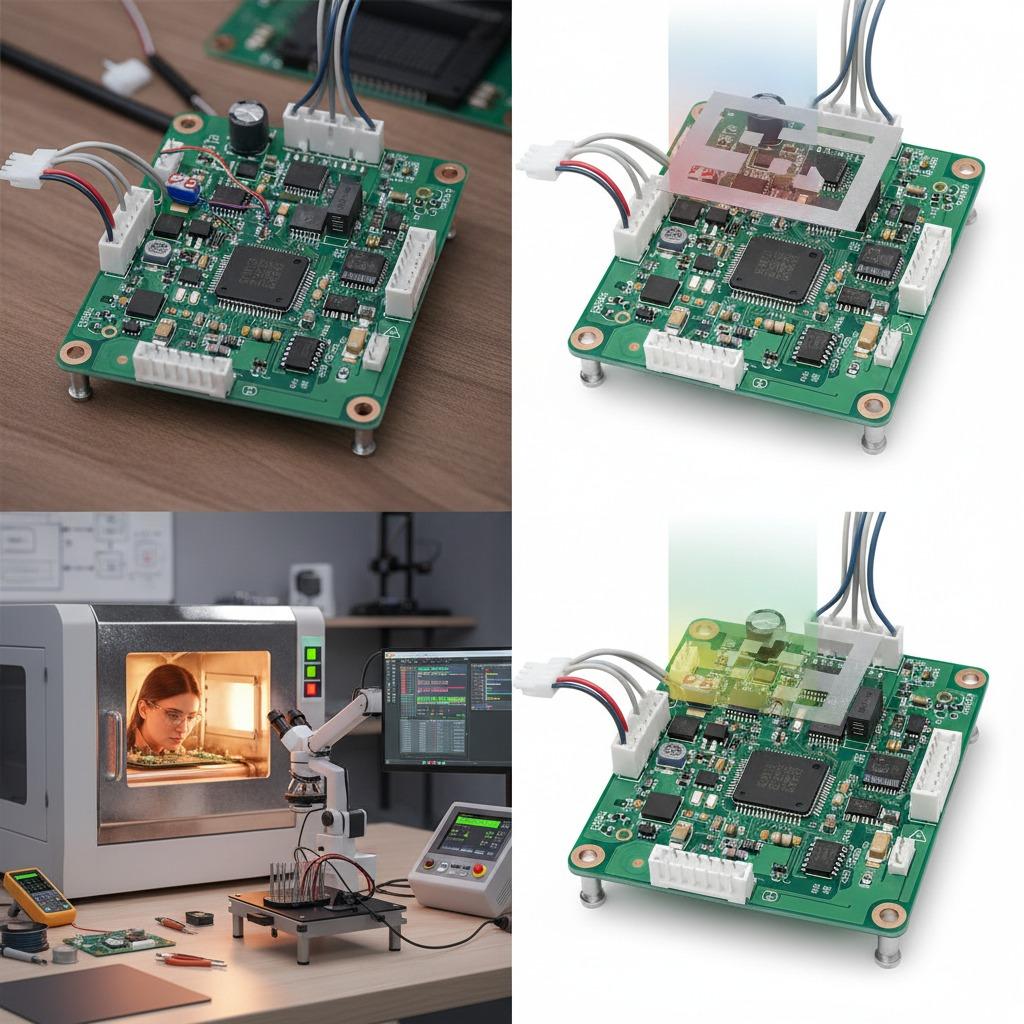
Because the actuator moves thousands of times per day, reliability testing is critical.
| Test Type | Purpose | Parameters |
|---|---|---|
| Actuator Life Test | Validate durability | 500,000–1,000,000 cycles |
| Drop and Shock Test | Ensure lens remains aligned | 1.2 m drop, multi-angle |
| Thermal Cycling | Confirm stability in temperature shifts | -30°C to +80°C |
| Focus Accuracy Test | Measure AF repeatability | < ±1.5 µm variance |
| Vibration Simulation | Prevent focus drift | Automotive-grade vibration profiles |
This ensures the focusing mechanism performs reliably in real everyday usage, not just under ideal conditions.
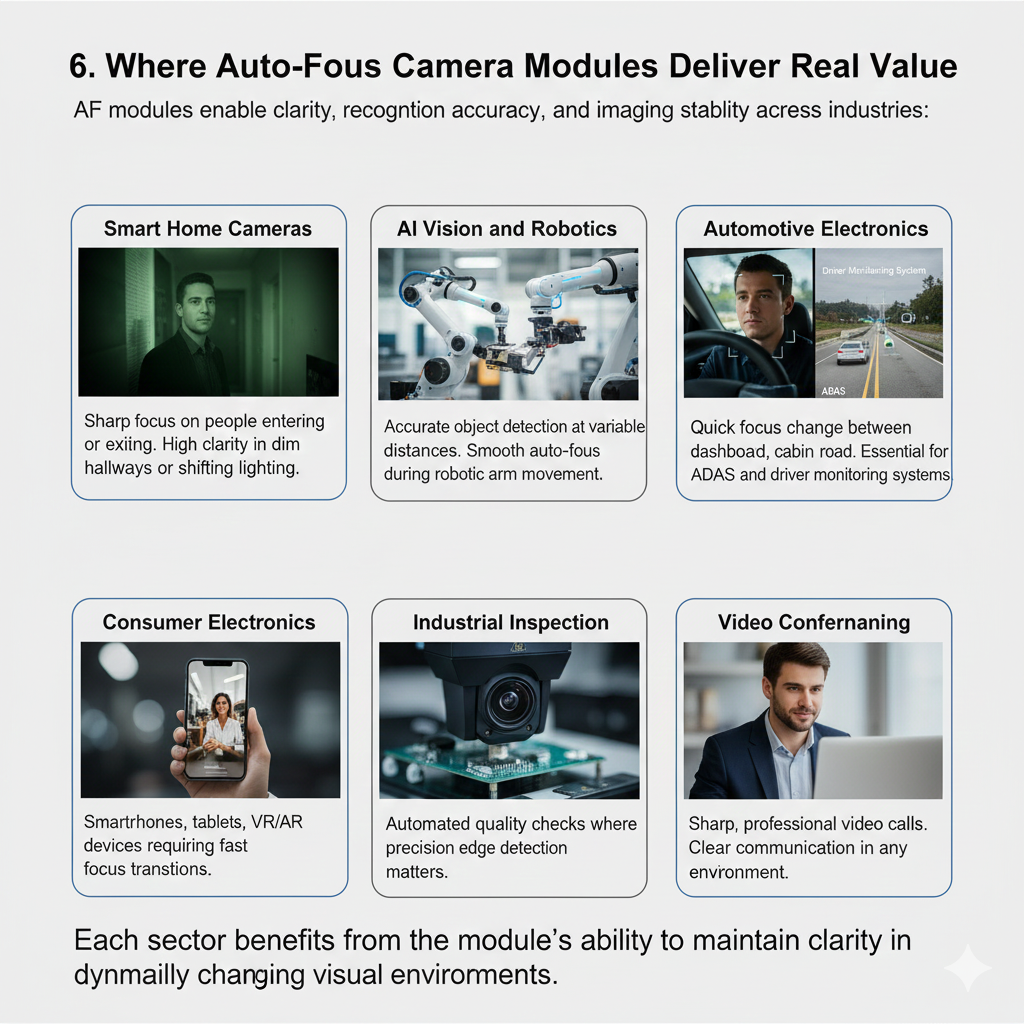
6. Where Auto-Focus Camera Modules Deliver Real Value
AF modules enable clarity, recognition accuracy, and imaging stability across industries:
Smart Home Cameras
-
Sharp focus on people entering or exiting
-
High clarity in dim hallways or shifting lighting
AI Vision and Robotics
-
Accurate object detection at variable distances
-
Smooth auto-focus during robotic arm movement
Automotive Electronics
-
Quick focus change between dashboard, cabin, and road
-
Essential for ADAS and driver monitoring systems
Consumer Electronics
-
Smartphones, tablets, VR/AR devices requiring fast focus transitions
Industrial Inspection
-
Automated quality checks where precision edge detection matters
Each sector benefits from the module’s ability to maintain clarity in dynamically changing visual environments.
7. Why Partner With a Professional Auto-Focus Camera Module Factory
A specialized manufacturer can deliver:
-
Complete vertical integration — optics, actuators, PCBA, alignment, and calibration
-
High-speed SMT + module bonding for consistent batch quality
-
Closed-loop focusing calibration systems with micron-level precision
-
Custom lens holders, housing, and protocols (MIPI, USB, LVDS)
-
Application-specific optimization for smart home, automotive, AI, and industrial imaging
For OEMs, this means faster development cycles, predictable quality, and long-term supply chain stability.
Sharper Vision Starts With Reliable Focusing Control
An auto-focus camera module is both a mechanical and computational system — one that must coordinate lens movement, sensing, and signal processing to deliver clear and consistent imaging.
Whether your application involves smart home security, AI devices, industrial inspection, or automotive electronics, selecting the right module partner ensures that every frame maintains clarity and consistency.
Learn more about high-performance imaging solutions at www.hcdpcba.com, or discuss custom requirements through our contact page.