IoT PCB Assembly Services: Building Reliable Foundations for Connected Devices
IoT devices operate in environments that are unpredictable by nature. They must remain connected, responsive, and energy-efficient while running continuously in homes, factories, cities, and remote locations.
At the center of every IoT product is a PCB assembly that connects sensors, processors, wireless modules, and power management circuits into a stable system.
Professional IoT PCB assembly services focus on more than placing components. They emphasize consistency, wireless performance, and long-term operational stability—factors that directly influence how IoT devices perform after deployment.
1. Why IoT Devices Require Specialized PCB Assembly Services
Unlike traditional electronics, IoT devices combine digital logic, wireless communication, and power control in compact form factors. They often operate unattended for long periods, making assembly quality critical.
Common challenges in IoT PCB assembly include:
-
Mixed-signal layouts combining RF, digital, and power circuits
-
Tight space constraints in compact enclosures
-
Sensitivity to wireless interference
-
Low-power operation requirements
-
Continuous or near-continuous runtime
Assembly services experienced with IoT products understand how these constraints affect placement accuracy, solder quality, and testing strategy.
2. Component Handling and Sourcing for IoT PCBAs
Component stability is essential for IoT devices that may be deployed for years. IoT-focused assembly services emphasize controlled sourcing and preparation to reduce lifecycle risk.
Key sourcing and handling practices often include:
-
Selection of wireless modules with stable supply status
-
Lifecycle-aware component review during BOM validation
-
Proper handling of moisture-sensitive RF and IC components
-
ESD-controlled storage and assembly
-
Clear traceability from sourcing to final assembly
These steps help ensure consistent performance across production batches.
3. Assembly Considerations for Wireless and Low-Power Designs
Wireless performance is directly affected by assembly consistency. Small deviations in soldering or placement can influence antenna behavior and signal strength.
A capable IoT PCB assembly service typically focuses on:
-
Accurate placement of RF modules and antennas
-
Controlled solder paste application near RF paths
-
Reflow profiles tuned for compact, heat-sensitive boards
-
EMI-aware assembly practices
-
Stable grounding references for wireless circuits
These controls support reliable connectivity across different deployment environments.
4. Power Efficiency and Long-Term Stability
Many IoT devices depend on battery power or energy harvesting, making power efficiency a primary concern. Assembly quality influences leakage paths, resistance, and long-term stability.
Manufacturing priorities often include:
-
Clean solder joints on power management components
-
Consistent assembly of low-power regulators and converters
-
Secure placement of battery connectors and charging circuits
-
Prevention of micro-defects that increase standby current
When assembly supports power efficiency, device lifespan improves significantly.
5. Testing Strategy for IoT PCB Assembly
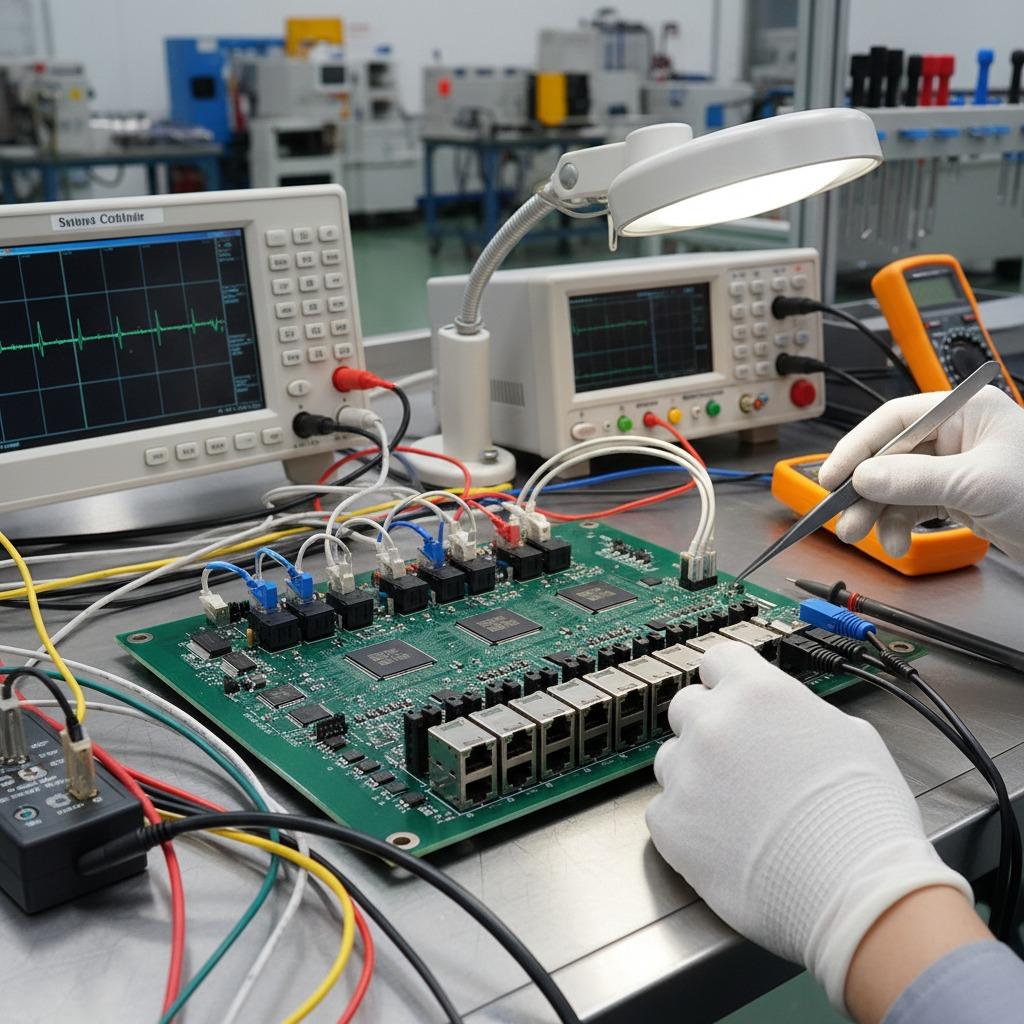
Testing IoT PCBAs requires balancing speed and coverage. Devices must be verified for both electrical correctness and connectivity.
IoT PCB Assembly Testing Overview
| Test Category | Purpose | Typical Devices |
|---|---|---|
| AOI / X-ray | Verify placement and solder joints | Dense SMT boards |
| Electrical Testing | Confirm power and signal paths | Sensor and control boards |
| Wireless Validation | Check signal strength and stability | Wi-Fi, BLE, Zigbee devices |
| Functional Testing | Verify firmware-based behavior | Gateways, hubs, sensors |
| Power Cycling | Confirm startup and sleep behavior | Battery-powered IoT devices |
This layered testing approach helps reduce field failures after deployment.
6. Supporting IoT Products from Prototype to Volume
IoT products often begin with pilot runs before scaling to thousands or millions of units. Assembly services must support this transition without introducing variability.
Typical support includes:
-
Flexible low-volume assembly for early validation
-
Consistent processes maintained during scale-up
-
Stable sourcing strategies for wireless and MCU components
-
Repeatable test logic across production stages
This continuity reduces risk as IoT products move toward mass deployment.
7. What to Look for in an IoT PCB Assembly Service Provider
Selecting the right IoT PCB assembly partner affects product reliability and time to market. Buyers should evaluate providers beyond price alone.
Important considerations include:
-
Experience with wireless and low-power PCBAs
-
Ability to manage compact, mixed-signal layouts
-
Integrated testing for connectivity and power behavior
-
Clear communication during sourcing and production
-
Consistent quality across multiple production batches
These factors determine whether an IoT product performs reliably in real-world conditions.
Supporting Connected Devices with Reliable IoT PCB Assembly Services
IoT PCB assembly services provide the manufacturing discipline needed to support connected devices operating in diverse environments. By aligning sourcing, assembly, and testing with IoT-specific requirements, manufacturers help brands deliver reliable, scalable products.
To discuss IoT PCB assembly requirements or request manufacturing support, visit www.hcdpcba.com or contact the team directly through:
https://www.hcdpcba.com/contact-us