Overview: PCB LED Bar DMX TKA Architecture
Integrating dynamic multi-channel lighting into architectural and entertainment fixtures presents critical thermal and electrical engineering challenges. The PCB LED Bar DMX TKA assembly addresses these challenges by uniting solid-state RGBW emitters, localized signal routing, and thermal substrates onto a unified rigid board. Designed primarily for addressable linear installations, this hardware platform accepts DC24V inputs and interfaces directly with DMX512 communication protocols. Luminaire builders, stage system integrators, and architectural fixture designers rely on this subassembly format to avoid component congestion and minimize thermal degradation across long linear lighting runs.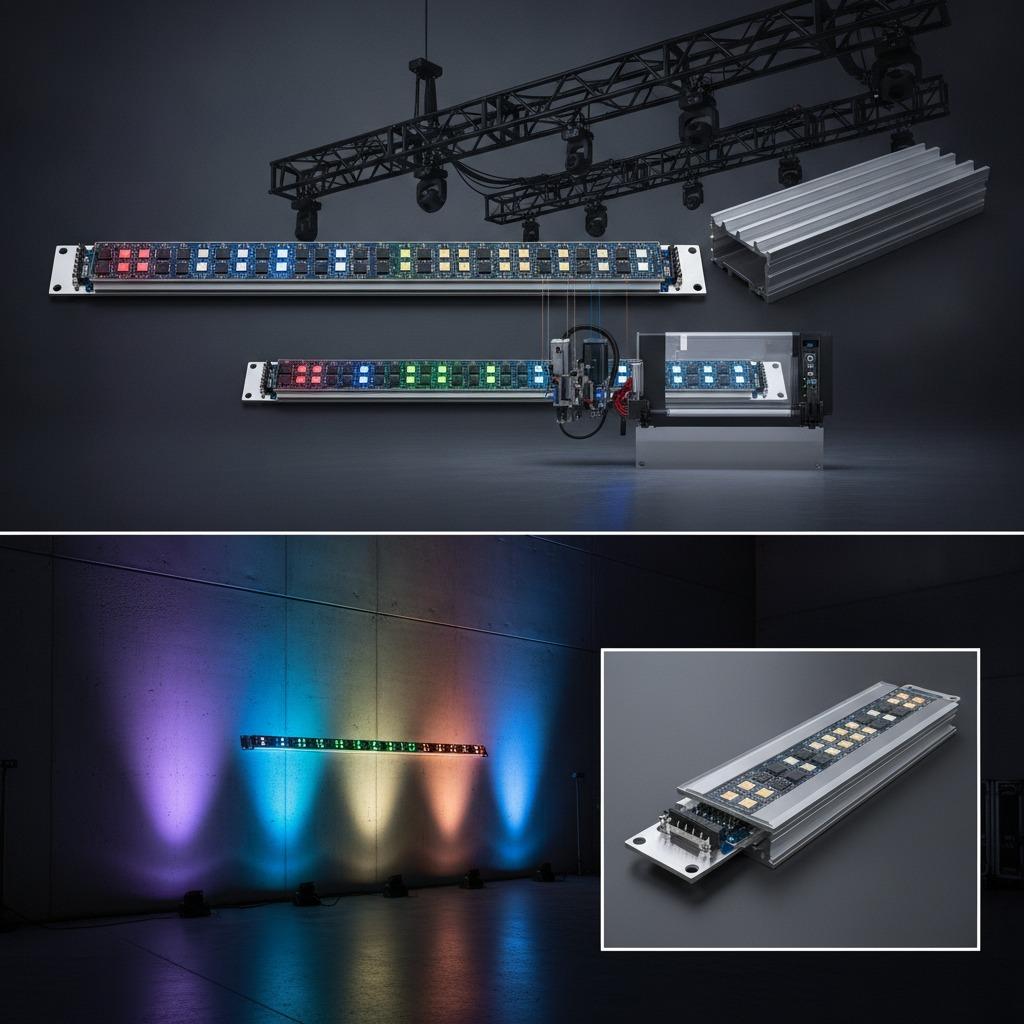
Technical Specifications and Core Capabilities
Operating complex solid-state lighting arrays requires tight adherence to input and control tolerances. The TKA series subassembly incorporates standardized functional sections across the board span:
- Operating Voltage: DC24V power bus configuration, reducing trace current draw across extended multi-module layouts.
- Control Interface: DMX512 standard serial protocol compliance for direct color mixing, fading, and multi-pixel dynamic output.
- Color Geometry: 4-channel RGBW arrangement, allowing independent calibration of warm or cool whites alongside full chromatic spectrum blending.
- Substrate Topology: Rigid metal-backed base, commonly deployed as an MCPCB LED Bar to facilitate lateral heat conduction away from emitter diodes.
- Interconnection: Terminal solder pads or end-mounted header connectors supporting daisy-chained control signals and line-level DC supply feeds.
- Passive Components: Surface-mounted driver ICs, current-limiting resistors, and reverse-polarity protection diodes distributed uniformly between emitter packages.
Material Properties and Thermal Management Substrates
Solid-state fixtures with dense emitter groupings generate concentrated thermal flux at each diode junction. Without adequate heat extraction, chromatic drift and luminous degradation occur rapidly. Building the assembly on an aluminum MCPCB significantly reduces junction-to-ambient thermal resistance compared to traditional synthetic resin laminates.
An aluminum core provides mechanical rigidity across long, narrow linear runs, preventing board warping under prolonged operational heat cycles. The board features a dielectric layer with high electrical insulation strength and controlled thermal conduction, bonded over the base metal plate. Copper trace weights can be configured to minimize line drop over the DC24V rail. Solder mask options typically include high-reflectivity white to prevent internal absorption of emitted photons, or matte black to eliminate stray reflections in dark-aperture entertainment fixtures.
Manufacturing Process and SMT Assembly Capabilities
hcdpcba delivers full turnkey fabrication and component loading for every DMX512 LED Bar PCBA revision. The assembly pipeline integrates Design for Manufacturing and Assembly (DFMA) reviews prior to stencil creation, verifying pad geometry, clearance, and thermal relief patterns against high-speed pick-and-place tolerances.
Surface-mount technology (SMT) lines populate mid-power or high-power 4-in-1 packages alongside fine-pitch DMX interface ICs. Reflow soldering profiles are strictly calibrated to the high thermal mass characteristic of metal-core substrates. The heating curves are sustained to ensure proper solder wetting without subjecting sensitive diode encapsulants to thermal stress. For end-to-end integration, hcdpcba supports component sourcing, connector pin placement, and secondary fitting into extruded aluminum channels or heatsinks when specified.
Application Scenarios
The geometric profile and protocol adaptability of the platform make it suitable for several lighting sectors:
- RGBW Wall Washer PCBA Applications: Deployed inside outdoor or indoor grazing fixtures to illuminate architectural facades, perimeter walls, and structural columns with continuous chromatic sweeps.
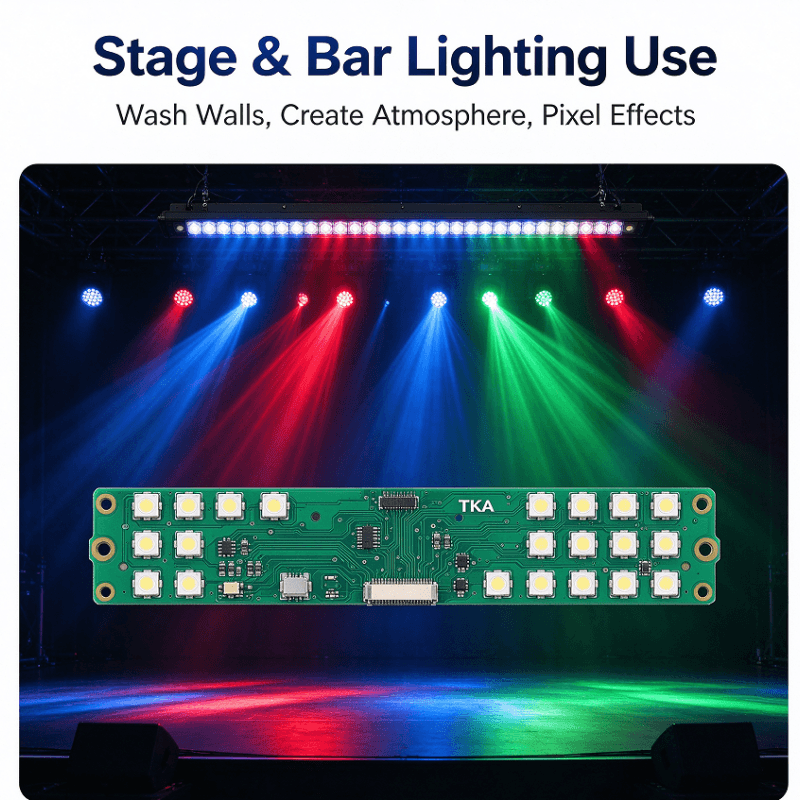
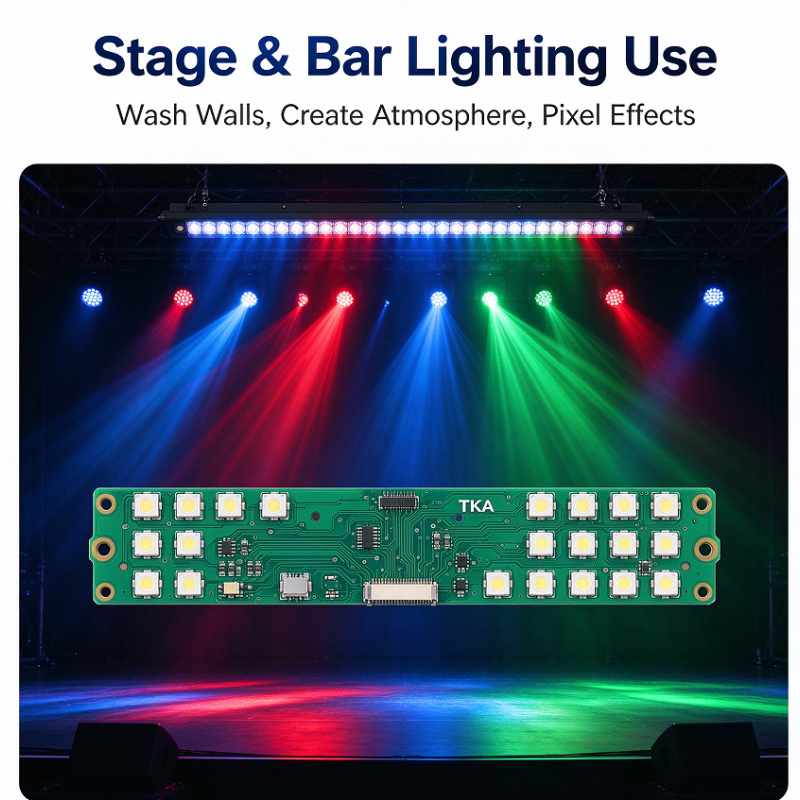
- Stage and Entertainment Lighting: Used in linear battens, footlights, and touring multi-section bars where local operators require instantaneous DMX console control over brightness, strobe effects, and palette changes.
- Studio and Broadcast Backdrops: Installed behind diffusers or linear lenses to deliver flicker-free, dimmable background wash and accent illumination.
- Commercial and Hospitality Accentuation: Concealed in coves, under-counter profiles, or structural recesses where thermal dissipation requires an aluminum-backed board directly coupled to building structures.
Quality Control and Testing Standards
Linear boards must demonstrate operational consistency across every pixel channel. At hcdpcba, assembled strips undergo continuous verification to ensure field reliability:
- Automated Optical Inspection (AOI): Scanning of component alignment, solder volume, and bridge formations on small-footprint SMT components and LED leads.
- Electrical Continuity and Isolation Testing: Probing power channels and DMX lines against the metal core plate to rule out short circuits and confirm dielectric barrier integrity.
- Functional Burn-In: Dynamic cycling through red, green, blue, and white channels under DC24V drive conditions to detect infant mortality in diodes or surface-mount drivers.
- Protocol Verification: Feeding explicit DMX512 packet sequences through the data input line to observe dimming linearities and channel responsiveness across the array.
Customization Guidance for Engineers
Because linear form factors vary widely across luminaire extrusions, project-specific customization is supported through OEM and ODM engagements. OEM buyers can provide Gerber layouts, bill-of-materials (BOM) files, and channel mappings tailored to proprietary fixtures. Key customizable variables include:
- Linear module dimensions: custom length, width, and mounting hole layouts for mechanical compatibility with native extrusions.
- Diode distribution: adjustments to LED center-to-center pitch for beam blending or uniform diffusion.
- Channel configuration: setting DMX pixel segment counts per bar (e.g., single-channel bar control versus multi-pixel addressable segments).
- Connector terminations: pre-wired pigtails, push-in terminal blocks, or edge connectors.
Procurement and Engineering Evaluation Factors
Before releasing a linear DMX subassembly for volume production, mechanical and electrical engineering teams must reconcile several design variables:
- Thermal Boundary Conditions: Calculate the dissipation capability of the outer fixture housing to verify that the aluminum board substrate can shed heat safely into the ambient envelope.
- Voltage Drop Planning: Account for power supply distribution over continuous run lengths to avoid color shifts or intensity drops at the tail end of interconnected modules.
- Signal Termination: Determine whether onboard DMX termination resistors are required at the final board in a continuous series line to maintain packet integrity.
- Environmental Ingress Needs: Determine whether bare boards will be secondary-potted, encapsulated with silicone extrusions, or shielded by IP-rated luminaire bodies.
Initiate Your Linear PCBA Production
hcdpcba supports rapid prototyping and volume production of custom metal-core linear lighting boards. Contact our engineering team at +86 18924624188 to review your PCB LED Bar DMX TKA project requirements, request a DFMA evaluation, or schedule PCBA sampling for your next fixture platform.