ESP32-32E 2.8 inch resistive touch display 2. Overview
The ESP32-32E 2.8 inch resistive touch display 2. is a compact display module kit designed for embedded electronics, prototyping, and small control interfaces. For buyers building a handheld controller, a bench test UI, or a simple HMI, the main problem it helps solve is straightforward: it gives a microcontroller a visual screen and an on-board interaction point without requiring a custom display design from scratch. Based on the supplied data, this module is presented as a small TFT/LCD-style board with a rectangular active area, four mounting holes, a PCB carrier, and accessory wiring for plug-and-connect use.
The product appears suitable for development work around an ESP32 Development Board or similar controller platform. It is also referenced as ESP32-2432S028R in the provided keywords, which suggests a common naming pattern used for compact display-controller combinations. Because exact specifications are not fully verifiable from the image and source notes, the page below focuses on visible structure, likely use cases, and practical buyer considerations rather than unsupported performance claims.
Product Overview
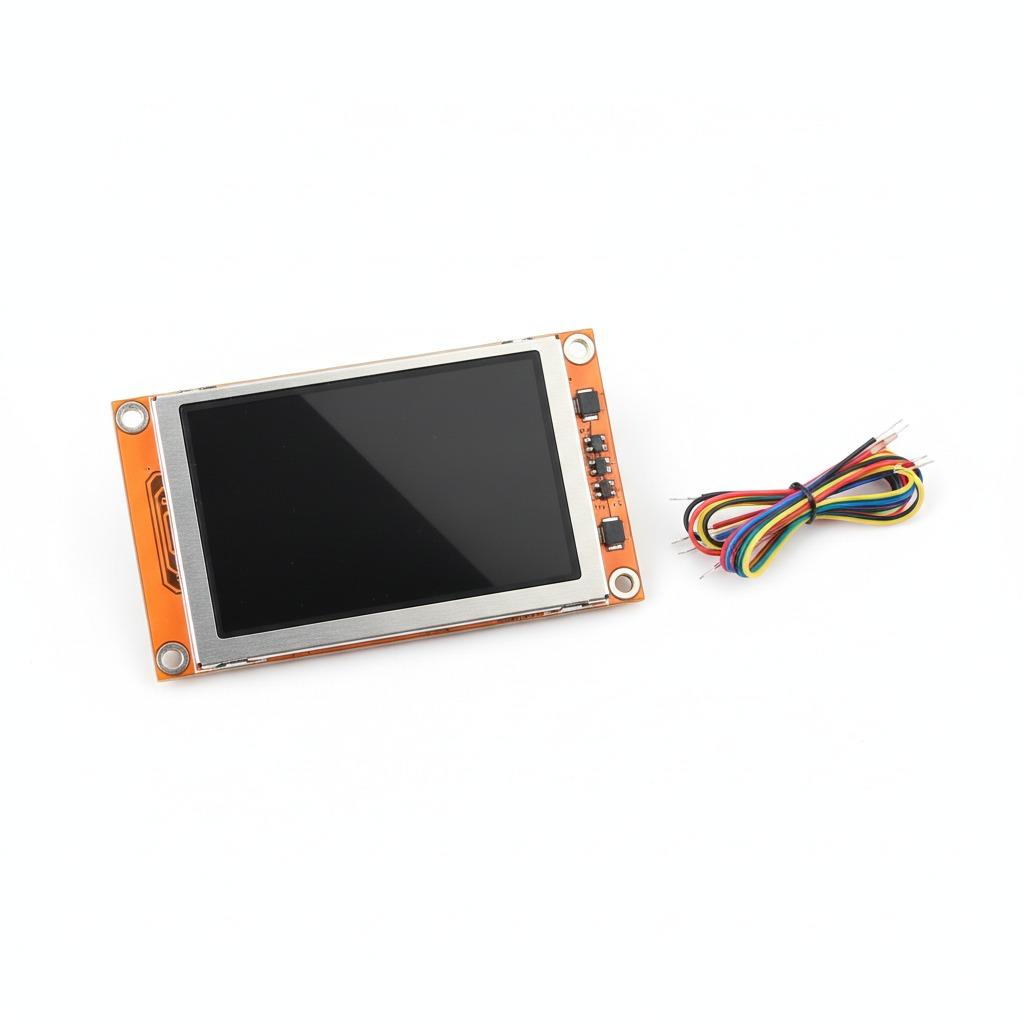
This module is best understood as a small TFT LCD display module for electronics integration. The visible hardware includes an orange PCB base, a dark rectangular display window, a silver-toned bezel or frame, and a connector area along the side or lower edge. A white stylus-like pointer and jumper wire set are shown with the module, indicating that the kit is intended for development and test rather than final consumer packaging.
From the layout alone, the product is aimed at builders who need a compact screen for menus, status readouts, touch input, or simple graphical interfaces. It can serve as the front end for instruments, appliance prototypes, automation panels, or DIY control stations. The display is not presented as a large-format HMI; instead, it is a space-efficient interface for embedded systems where board area and wiring simplicity matter.
Key Specifications and Visible Capabilities
What can be confirmed from the supplied material
The most reliable visible points are the module’s rectangular shape, compact footprint, four corner mounting holes, and integrated PCB construction. The image notes an overall size of about 86 mm by 50 mm, with a display/window area marked around 58 mm by 44 mm and an inner framed area around 69 mm wide. These figures should be treated as image-based references, not guaranteed manufacturing tolerances.
The visible accessory set supports bench testing and wiring experiments. The screen appears to be intended for text, icons, menus, and basic graphics. The on-screen example content suggests interface elements such as home, pointer, settings, product pages, and date display. That points to a human-machine interface role, though the exact touch technology and controller protocol are not confirmed.
Items that should not be assumed
Exact resolution, brightness, viewing angle, backlight type, voltage, and interface protocol are not supplied. The display may be TFT LCD, but hidden panel details should be verified by the buyer before integration. If your application depends on electrical compatibility, pinout, or touch layer type, request a datasheet or sample test before moving to production.
Materials, Finish, and Structural Features
The module uses a visible PCB substrate in orange tone, exposed copper traces and solder points, and a dark display surface that is flat when unpowered. The bezel looks metallic or coated, helping protect the panel edge and define the viewing area. The stylus is white plastic, which is common for touch-oriented test kits.
Structural details matter for mounting and enclosure design. Four corner holes make screw installation easier on panels, brackets, or test fixtures. For buyers creating a custom enclosure, this reduces the need for adhesive mounting and helps keep the module stable under repeated button presses or light stylus use.
Manufacturing and Assembly Approach
Based on the provided description, this product belongs to the category of electronic assembly with PCB fabrication and display integration. In practical terms, that typically means the board is produced through standard SMT assembly, then combined with the display panel and interface parts. For custom orders handled by hcdpcba, similar products may be supported through PCB打样, SMT贴片, 元器件代采, 组装, and 测试 services, which is useful when a buyer wants to move from sample to small or medium batch production.
For projects that require a derivative version, DFMA review can help reduce rework by checking component placement, connector access, and enclosure compatibility before mass build. That is especially relevant for display modules, where cable direction, button position, and mounting geometry affect final product usability.
Application Scenarios
This type of display module fits a wide range of low- to mid-complexity interface tasks. Common uses include Arduino/MCU prototyping, embedded control panels, laboratory instruments, handheld testers, smart device prototypes, and industrial prototype HMIs. In an automation cabinet or small equipment panel, a compact screen can present status, prompts, and simple settings without taking much space.
It is also relevant for IoT and maker projects where the interface must be understandable at a glance. A small TFT LCD display module can show sensor readings, Wi-Fi status, operating modes, or menu items. When paired with an ESP32 WiFi Bluetooth Module, the system can support wireless configuration, local display output, and basic touch interaction in one compact enclosure.
Quality Control and Buyer Checks
Before purchasing, buyers should confirm the exact display interface, power requirements, and supported library or driver stack. Since the image does not verify panel technology, treat touch support and panel performance carefully. Ask for a sample test if your project depends on response speed, readability under ambient light, or compatibility with a specific MCU platform.
For production use, look for consistency in connector quality, solder joint appearance, mounting hole alignment, and screen bond integrity. If the module is to be installed in a field device, also verify cable strain relief and the fit between bezel and front panel opening.
Customization Guidance
If you need a version tailored to your product, discuss the following early: board outline, connector location, mounting hole spacing, pin assignment, silkscreen labeling, and whether the interface should match a specific ESP32 Development Board layout. These details can affect assembly efficiency and the final user experience.
Custom buyers should also decide whether the screen will be used as a standalone UI, a sub-display, or a touch-enabled menu system. That decision influences enclosure depth, cable routing, and whether the module should be supplied as a complete kit or integrated into a larger PCBA. If your program involves OEM or ODM work, a clear requirement list helps avoid later changes.
How to Choose This Product
Choose this module if you need a compact display board with a practical mounting structure and a development-friendly form factor. It is a good fit when the project calls for a small visual interface rather than a large touchscreen panel. The visible accessories make it especially useful for prototyping, evaluation, and bench testing.
Do not choose based only on appearance if your design depends on precise electrical or optical characteristics. Instead, confirm compatibility with your firmware, your power budget, and the physical enclosure. For buyers comparing display options, the key decision factors are footprint, interface support, mounting method, touch behavior, and ease of integration with your controller.
Request Support or a Custom Build
hcdpcba supports PCB打样, SMT贴片, PCBA板 assembly, testing, and OEM/ODM service for electronics projects that need reliable manufacturing support. If you are developing a display-based product and want help with prototype build, component sourcing, or assembly planning, contact the team to discuss your requirements and confirm the best implementation path.
For inquiries, you can reach hcdpcba by phone at +86 18924624188. Share your board outline, target controller, interface needs, and quantity target so the sample or production plan can be prepared more efficiently.