Drone Circuit Board Overview
A drone circuit board is the core electronics platform that connects flight control, sensing, communication, and power management into one compact assembly. For buyers, the main challenge is not just fitting components onto a small board; it is keeping signal routing stable, mechanical mounting secure, and thermal behavior manageable while supporting the required interfaces. In practice, this kind of board helps solve integration problems for embedded systems where space is limited and multiple peripherals must work together reliably.
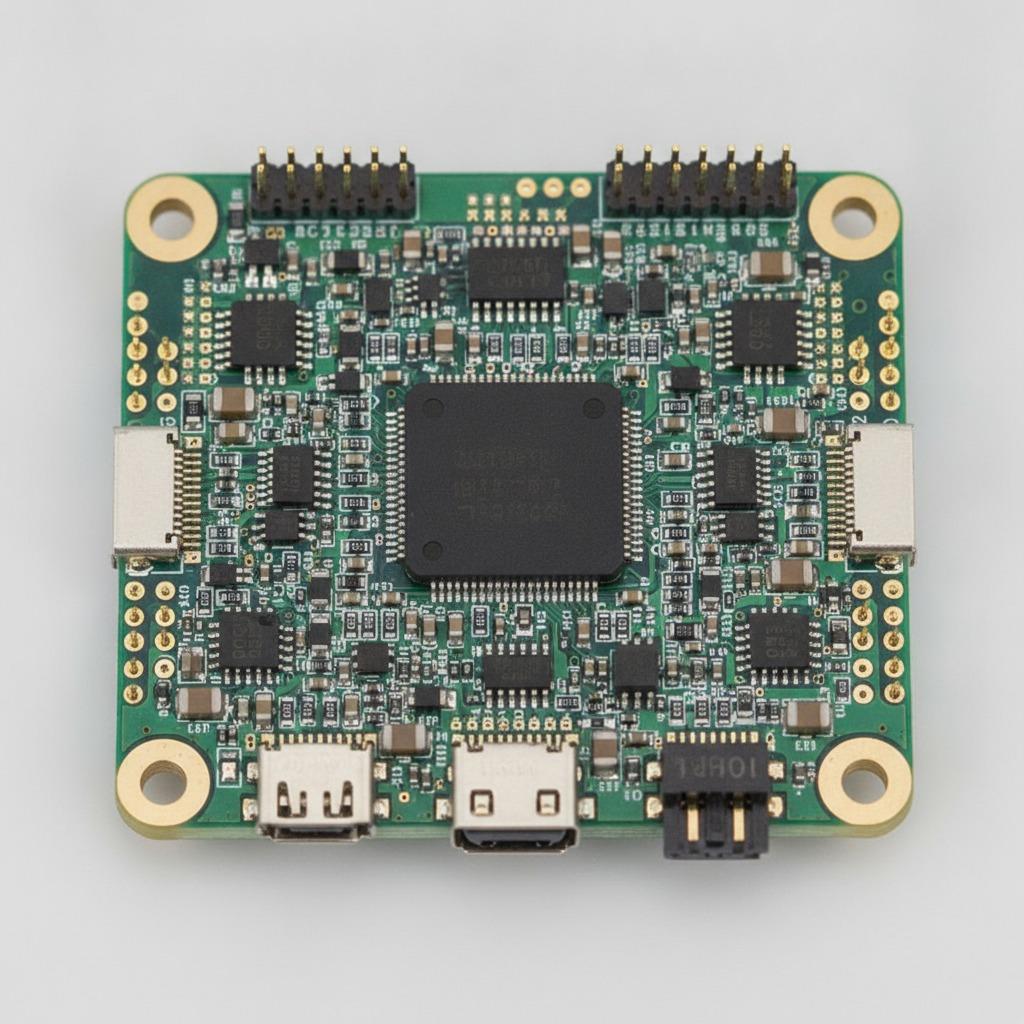
The board shown here appears to be a densely populated printed circuit board assembly with a square form factor, corner mounting holes, a central high-density IC package, and several surface-mount components around the perimeter. Multiple board-edge connectors are visible, including a USB-style port and other headers, which suggests a design intended for external interfacing. Because the exact model and electrical performance are not identifiable from the image alone, it is best treated as a reference for board structure and assembly style rather than a finished product specification.
Product Reference and Functional Layout
From a manufacturing perspective, this drone PCB board shows the typical traits of a compact control or computing module: short component spacing, fine routing density, and mechanical mounting points for enclosure integration or fixture fastening. The visible layout indicates a board built to support multiple signals rather than a single simple function.
Visible structural features
Several details can be verified directly from the image:
Square board shape with rounded corners
Four corner mounting holes with gold-plated surfaces
Central integrated circuit package surrounded by smaller ICs and passives
Board-edge connectors and headers for external connection
High component density consistent with a multilayer PCB assembly
Likely Capabilities in Embedded Systems
Although the exact function is not confirmed, a board of this type is commonly used where sensor data, command signals, or communication links must be processed on a compact module. That makes it relevant to drones, robotics, machine vision, industrial control, edge computing, and communication subsystems. In a drone application, a drone flight control board or related control module may need to handle input from sensors, interface with peripheral boards, and maintain stable operation under mechanical vibration.
For a drone mainboard or subsystem PCB, the buyer usually evaluates connector placement, component density, thermal path, and assembly reliability before looking at software or performance tuning. The image suggests a design that prioritizes integration and compact routing, which is often important in UAV electronics.
Materials, Finish, and Board Construction
The visible board uses a green solder mask, a common finish for assembled PCBs, with gold-toned mounting holes and exposed contact areas. The component side is populated with surface-mount devices, including a large central processor or controller package and multiple smaller support chips. This layout is typical of PCB fabrication followed by SMT assembly and reflow soldering.
In some applications, a UAV circuit board may also include thermal hardware, shielding, or interface modules depending on the system architecture. The image-based board appears connector-rich, so integration flexibility is likely a design priority.
Manufacturing and Assembly Process
Boards like this are commonly produced through standard PCB fabrication, solder mask application, surface finish processing, SMT placement, and reflow soldering. After assembly, boards may undergo functional testing, inspection, and interface verification. For complex modules, additional steps can include mechanical integration, connector fitting, and thermal management checks.
hcdpcba supports PCB prototype and production workflows, including SMT贴片, PCBA board assembly, component sourcing, assembly, testing, and DFMA-oriented support. The company also handles multilayer, HDI, and high-frequency boards for industrial, medical, automotive, IoT, and communication applications.
Application Scenarios
Boards with this structure are commonly used in:
Drone control and sensor interface modules
Industrial automation controllers
Robotics and motion systems
Test and development hardware
Edge computing and embedded processing units
Communication gateways or data acquisition modules
Quality Control and Buyer Decision Factors
When sourcing a board of this type, buyers usually focus on a few practical points: the clarity of the assembly drawing, the routing density, the availability of test coverage, the connector strategy, and whether the mounting holes match the enclosure or frame. If the board will be used in a drone or other vibration-prone system, mechanical stability and solder joint quality become even more important.
Quality control for PCBA normally includes incoming material checks, SMT process monitoring, visual inspection, and functional testing where the project definition allows it. Since hidden electrical data cannot be inferred from the image, buyers should request the full BOM, Gerber files, test requirements, and assembly notes before production.
Customization Guidance
If you are planning a custom drone circuit board, start by defining interface count, power input range, board dimensions, mounting constraints, and thermal requirements. From there, the PCB stackup, connector selection, and component placement can be optimized for manufacturability and serviceability. For projects that need quicker iteration, prototype builds can be used to confirm fit and routing before moving to volume assembly.
For OEM and ODM buyers, hcdpcba can support PCB prototyping, SMT assembly, component sourcing, assembly, testing, and one-stop manufacturing coordination. That makes it easier to move from concept board to production-ready hardware without changing suppliers at every stage.
Request a Custom Quote
If you need a drone circuit board or a similar embedded PCBA for control, sensing, or communications, share your schematic, Gerber files, BOM, and assembly requirements. hcdpcba can help review manufacturability, arrange PCB fabrication and SMT贴片, and build a production plan matched to your project needs.
Contact: +86 18924624188