Hand Fan PCB A Overview
Hand Fan PCB A is a compact electronics assembly designed for portable cooling and controlled airflow in a small device footprint. For buyers, the main problem it solves is straightforward: how to add active cooling, fan drive, and basic electronic control inside a space-limited product without building a board and mechanical structure from scratch. Based on the visible structure, this assembly combines a printed circuit board, a small fan, and a battery-powered or low-power integration layout, making it suitable for compact devices that need thermal management, airflow, or fan control in a sealed or semi-sealed housing.
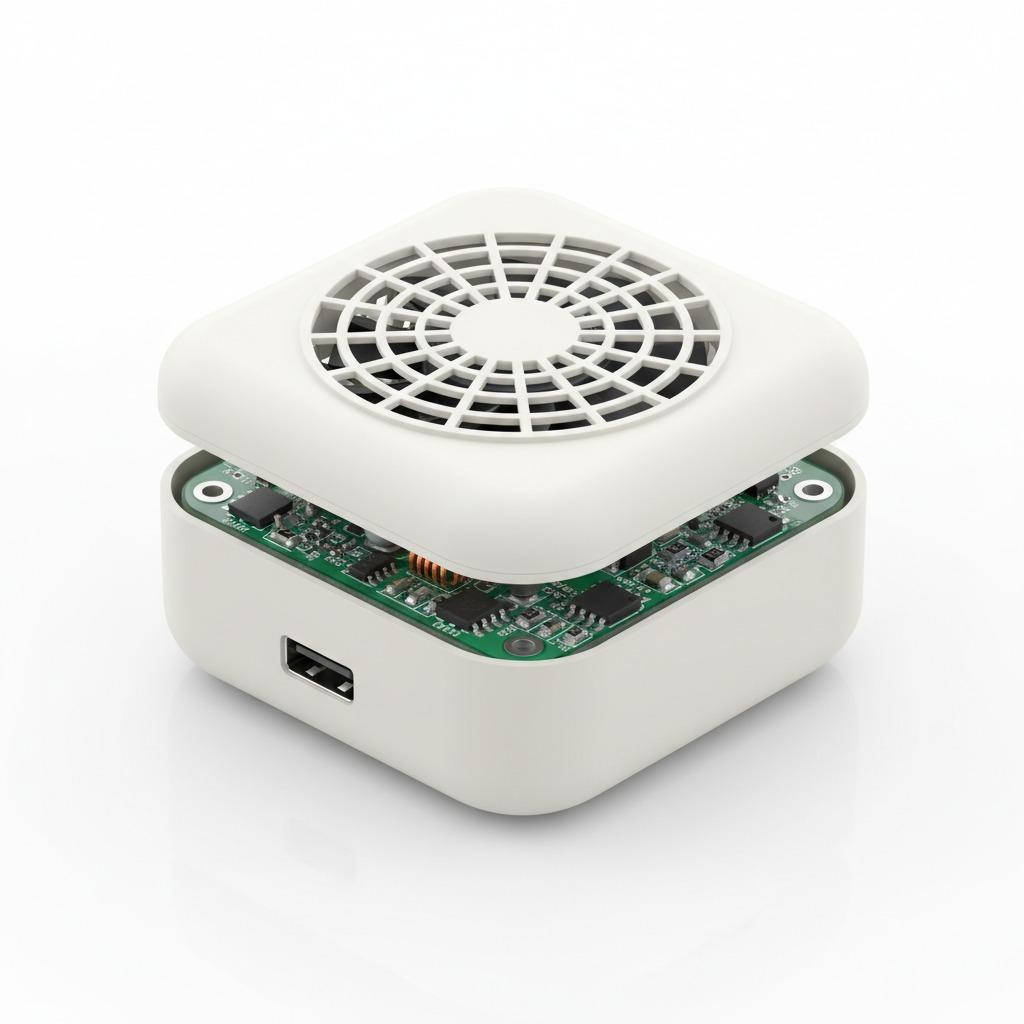
The image shows a compact square-rounded housing concept, a top vent pattern, and a PCB-based control section with surface-mount components. Because the exact model and specifications are not provided, the description here focuses on visible features and common industry use cases rather than hidden performance claims.
Product Structure and Visible Features
This type of Handheld Fan PCB is built around a rigid circuit board with mounted electronic parts and a fan assembly. Visible details include a central integrated circuit, several smaller passive and active components, mounting holes, and a USB-C interface on one version of the board shown in the preparation data. The fan itself appears to be a small axial unit with plastic blades and a hub-mounted motor section.
Visible design characteristics
The board layout is compact and mechanically organized, which matters in products where airflow parts and electronics must share the same enclosure. The visible top grille or vent geometry supports air movement, while the internal battery pack architecture suggests a self-contained portable design. In practical terms, that means the assembly can serve as a Portable Fan Circuit Board inside consumer electronics, prototype hardware, or other embedded cooling modules.
Key Specifications and Capabilities
Because the exact electrical data is not supplied, the safest way to evaluate this Fan Control PCB Board is by its architectural capabilities:
1. Compact form factor for integration into small housings.
2. Surface-mount PCB construction for dense electronics packaging.
3. Mechanical mounting points for secure fixation inside an enclosure.
4. Fan-motor integration for localized airflow or cooling.
5. USB-C or similar power/data interface on the visible board version.
6. Battery-compatible architecture visible in the exploded assembly view.
These characteristics make the board relevant for developers who need a 3 speed hand fan PCB board style interface, fan switching logic, or a compact controller platform. However, speed count, airflow output, current draw, and runtime are not visible and should be confirmed in the engineering documentation.
Materials and Finish Options
The visible product uses standard electronics manufacturing materials. The PCB appears to be FR4 with green or blue solder mask depending on the shown version. Copper routing is visible beneath the solder mask, and the electronic parts are soldered directly to the board surface. The enclosure and fan housing appear to be molded plastic with a matte light-gray finish, while the fan blades are also plastic. Battery cells, where shown, use cylindrical formats with green shrink wrap.
For custom projects, buyers commonly choose between standard FR4, thicker board options for mechanical stability, and different solder mask colors for branding or product differentiation. Surface finish details are not specified here, so any exact finish should be confirmed during the quoting stage.
Manufacturing and Assembly Process
A module like this usually comes from PCB fabrication, SMT assembly, and mechanical integration. The electronic side is typically built with component placement, reflow soldering, and inspection. The cooling side involves fitting the fan, attaching the motor hub, and integrating the board with the enclosure or mounting points. If the product includes a battery pack, pack assembly and protection circuitry become part of the workflow as well.
hcdpcba supports PCB prototype work, SMT贴片, component sourcing, assembly, testing, DFMA review, OEM, and ODM services. That service mix is relevant when a buyer wants a custom Handheld Fan PCB rather than an off-the-shelf module. A design-for-manufacture review can reduce assembly issues such as connector clearance, fan alignment, or heat buildup around dense components.
Application Scenarios
This type of Portable Fan Circuit Board is suitable for compact electronics that need controlled cooling. Typical scenarios include prototype airflow modules, small charging devices, embedded thermal management systems, lab hardware, maker electronics, and industrial demonstration units. It may also fit products that require a fan inside a tight enclosure where the board must manage both power distribution and fan operation.
Because the exact end product is not identifiable from the image alone, it should be treated as a general cooling/electronics module rather than a named consumer device.
Quality Control Considerations
For assemblies like Hand Fan PCB A, quality control usually focuses on solder joint integrity, connector alignment, fan rotation smoothness, board cleanliness, mounting-hole accuracy, and electrical function verification. If a battery pack is included, pack safety and connection reliability also matter. For buyers in industrial or product-development environments, testing is often the difference between a working prototype and a stable production unit.
hcdpcba notes testing as part of its service capability, along with component sourcing and assembly support. That is useful for buyers who want one supplier to handle both fabrication and verification.
Customization Guidance for Buyers
When specifying a Fan Control PCB Board, start with the basics: board size, connector type, power input, fan type, speed control method, and enclosure constraints. If the design needs to support a 3 speed hand fan PCB board interface, make sure the control logic, button layout, and user interaction are defined early. If the unit is battery-powered, the battery format, charging method, and protection requirements should also be documented.
Buyers should also confirm whether the fan is intended for continuous operation or intermittent bursts, since that affects thermal load and component selection. For OEM and ODM projects, clear drawings and a function list help avoid rework.
How to Evaluate Fit for Your Project
Choose this kind of assembly if your project needs compact airflow, PCB-based control, and an integrated mechanical layout. It is especially relevant when the product must stay small, portable, and easy to assemble. If your design demands exact airflow, acoustic performance, or certified environmental ratings, those details should be requested separately before production.
Request Custom PCB and Assembly Support
If you are developing a Hand Fan PCB A variant or a custom cooling module, hcdpcba can support PCB prototyping, SMT assembly, component procurement, testing, OEM, and ODM workflows. Share your schematic, enclosure limits, and power target to start a practical manufacturing discussion.
For technical inquiries, contact hcdpcba at +86 18924624188 to discuss your PCB and assembly requirements.