Reliable PCBA Supplier Selection Guide for OEM Electronics: Quality, Testing, BOM Control, and Production Risk
A reliable PCBA supplier is not simply a factory that can populate components onto a printed circuit board. For OEM buyers, reliability means the supplier can repeatedly manufacture the approved product configuration while controlling materials, process parameters, inspection, testing, documentation, and engineering changes from prototype through repeat production.
This distinction matters because many supplier problems do not appear during the first sample build. They appear later when a component becomes unavailable, a PCB revision changes, production quantity increases, a test requirement is misunderstood, or the next batch no longer matches the approved sample.
A useful supplier evaluation therefore begins with a different question:
Can this manufacturer reproduce the same approved PCBA across future orders while controlling the risks that can change its electrical, mechanical, or functional performance?
Buyers who want additional background on what should be included in assembly scope can first review HCDPCBA's PCBA Assembly Service guide.
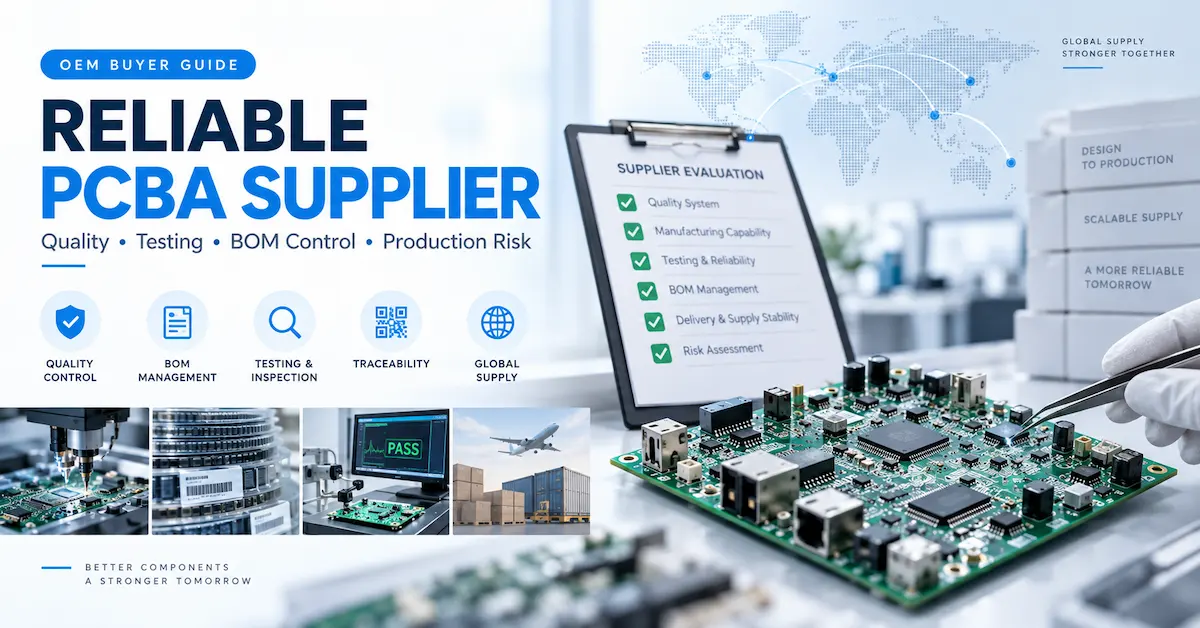
What Does “Reliable PCBA Supplier” Actually Mean?
Reliability in PCBA manufacturing should be evaluated as a system rather than as a single capability.
A supplier may own SMT equipment and still be a poor fit if it cannot manage:
- BOM revisions
- Component substitutions
- PCB revisions
- Firmware versions
- Test requirements
- Assembly instructions
- Traceability
- Repeat-order consistency
- Engineering changes
- Production scaling
For procurement teams, a reliable PCBA supplier should be able to explain how each of these variables is controlled, not simply confirm that the factory “supports them.”
A strong supplier relationship therefore depends on four connected areas:
Engineering control — Can the supplier identify manufacturability risks before production?
Material control — Can it source and verify the correct components while controlling approved alternatives?
Process control — Can it manufacture the board consistently through SMT, THT, soldering, inspection, programming, and testing?
Configuration control — Can it ensure that repeat orders use the correct PCB, BOM, firmware, work instructions, and test requirements?
Reliability comes from the interaction of these systems.
Who Needs a Reliable PCBA Supplier Most?
Every electronics buyer benefits from stable manufacturing, but supplier reliability becomes especially important when projects involve higher product complexity or longer production lifecycles.
Typical buyer groups include:
- OEM electronics brands
- Industrial equipment manufacturers
- IoT and smart-device companies
- Security and camera product developers
- Embedded electronics companies
- Power electronics manufacturers
- Automotive electronics buyers
- Product-development and engineering teams
A startup preparing its first pilot run may care most about engineering responsiveness and flexible sourcing.
An established OEM placing repeat orders may care more about revision control, material consistency, predictable testing, and long-term supply.
An industrial buyer may prioritize traceability and controlled engineering changes.
The right PCBA supplier is therefore not automatically the factory with the largest production line. It is the supplier whose production system matches the project's technical complexity, quantity, lifecycle, quality requirements, and change frequency.
Start by Defining the Manufacturing Scope
One of the most common sourcing mistakes is comparing quotations before defining what each supplier is actually quoting.
“PCBA” can describe very different scopes.
One supplier may quote:
PCB fabrication + SMT placement.
Another may quote:
PCB fabrication + component sourcing + SMT + THT + inspection + programming + functional testing + packaging.
These quotations should not be compared as if they represent the same product.
Before supplier selection, define who is responsible for:
| Production Area | Questions Buyers Should Clarify |
|---|---|
| PCB fabrication | Who sources the bare PCB and controls its revision? |
| Component procurement | Supplier sourced, customer supplied, or hybrid? |
| BOM alternatives | Who approves substitutions? |
| SMT assembly | What package types and process requirements apply? |
| THT assembly | Are through-hole components involved? |
| Programming | Who provides firmware and version control? |
| Inspection | Which inspection methods apply to the board? |
| Functional testing | What functions and limits define a pass? |
| Final assembly | Is mechanical integration required? |
| Packaging | What ESD, labeling, tray, or shipment requirements apply? |
For projects where buyers want one supplier to coordinate multiple stages, HCDPCBA's Turnkey PCBA Manufacturing Guide explains the broader relationship between PCB sourcing, component procurement, assembly, testing, and delivery.
1. Evaluate Engineering Review Before Evaluating Price
A reliable PCBA supplier should not wait until production to discover obvious manufacturability problems.
Before manufacturing begins, the supplier should review the released files and identify questions related to:
- Component spacing
- Package compatibility
- PCB panelization
- Polarity
- Assembly accessibility
- Soldering requirements
- Test-point access
- Mechanical interference
- THT component placement
- Programming interfaces
This is especially important for first-time builds.
A quotation that is returned unusually quickly without technical questions may appear convenient, but speed alone is not proof that the project has been reviewed properly.
For complex products, buyers should look for evidence that engineering review occurs before material commitment and line setup.
2. Check Whether BOM Management Is Controlled
Component sourcing is one of the largest reliability risks in PCBA production.
A BOM may contain hundreds of line items, including:
- ICs
- Passive components
- Connectors
- Memory
- Sensors
- Power devices
- Relays
- Modules
- Oscillators
- Electromechanical components
The supplier should therefore work from a controlled BOM that identifies the required manufacturer part numbers and approved alternatives.
A reliable PCBA supplier should not silently replace a specified component simply because another part is cheaper or immediately available.
Even apparently similar components may differ in:
- Electrical characteristics
- Tolerance
- Package dimensions
- Temperature rating
- Lifecycle status
- Firmware compatibility
- Mechanical fit
- Qualification status
The RFQ should clearly state whether substitutions require buyer approval.
This becomes even more important in turnkey manufacturing, where the supplier has greater procurement responsibility.
3. Ask How Component Authenticity and Supply Risk Are Managed
“Component sourcing available” is not enough information for supplier qualification.
Buyers should understand:
- Which sourcing channels are used
- How manufacturer part numbers are verified
- How incoming parts are matched to the approved BOM
- How shortages are communicated
- How EOL parts are handled
- How proposed substitutes are approved
- How customer-supplied materials are controlled
For long-life industrial or OEM products, procurement decisions made today may affect repeat production months or years later.
A lower component price is not necessarily a lower project cost if it creates:
- redesign work,
- testing changes,
- additional qualification,
- field failures,
- or inconsistent repeat orders.
This is why BOM control should be treated as part of manufacturing reliability rather than as a purchasing-only task.
4. Evaluate SMT Capability Against Your Actual Board
SMT equipment lists are useful, but they should not be the main supplier-selection criterion.
Instead, evaluate whether the factory can support the actual assembly requirements on your board.
Important questions include:
- What is the smallest component package?
- Are fine-pitch ICs used?
- Are BGA or QFN packages present?
- Is the PCB single-sided or double-sided?
- Are there unusual thermal requirements?
- Does the design require special handling?
- Are there high-density components?
- Are large or heat-sensitive components present?
The supplier should connect its manufacturing process to your PCB rather than giving only generic equipment specifications.
The same principle applies to inspection.
AOI may be useful for visible SMT conditions, while X-Ray may be useful for selected hidden solder joints.
Neither method alone proves complete PCBA functionality.
5. Do Not Treat AOI, X-Ray, ICT, and Functional Testing as the Same Thing
Testing terminology is one of the most important areas to clarify when choosing a reliable PCBA supplier.
Different methods answer different questions.
| Method | Primary Purpose | What It Does Not Automatically Prove |
|---|---|---|
| SPI | Checks solder paste deposition | Complete assembly functionality |
| AOI | Checks visible placement and solder conditions | Hidden joints or full electrical operation |
| X-Ray | Examines selected hidden solder structures | Complete circuit functionality |
| ICT | Checks defined electrical nodes/components | Full product behavior |
| Functional Test | Verifies defined product functions | Every possible field condition |
The correct test strategy depends on the product.
For example, a functional test could verify:
- Power-up
- Supply voltages
- Communication interfaces
- Sensor response
- Relay operation
- Inputs and outputs
- Firmware boot
- Product-specific functions
However, the phrase “functional testing included” is still too vague.
The buyer should define:
What is tested?
How is it tested?
What equipment or fixture is used?
What limits define pass or fail?
Which firmware revision is used?
This transforms testing from a marketing phrase into an auditable production requirement.
6. Evaluate Through-Hole and Mixed-Technology Capability When Required
Many modern PCBAs are not SMT-only.
Industrial controls, power electronics, embedded equipment, and interface boards may contain:
- terminal blocks,
- relays,
- transformers,
- large capacitors,
- connectors,
- inductors,
- or other through-hole components.
In these projects, the supplier needs to coordinate SMT and THT processes correctly.
Depending on the design, production may involve:
- SMT reflow
- manual insertion
- wave soldering
- selective soldering
- manual soldering
- secondary inspection
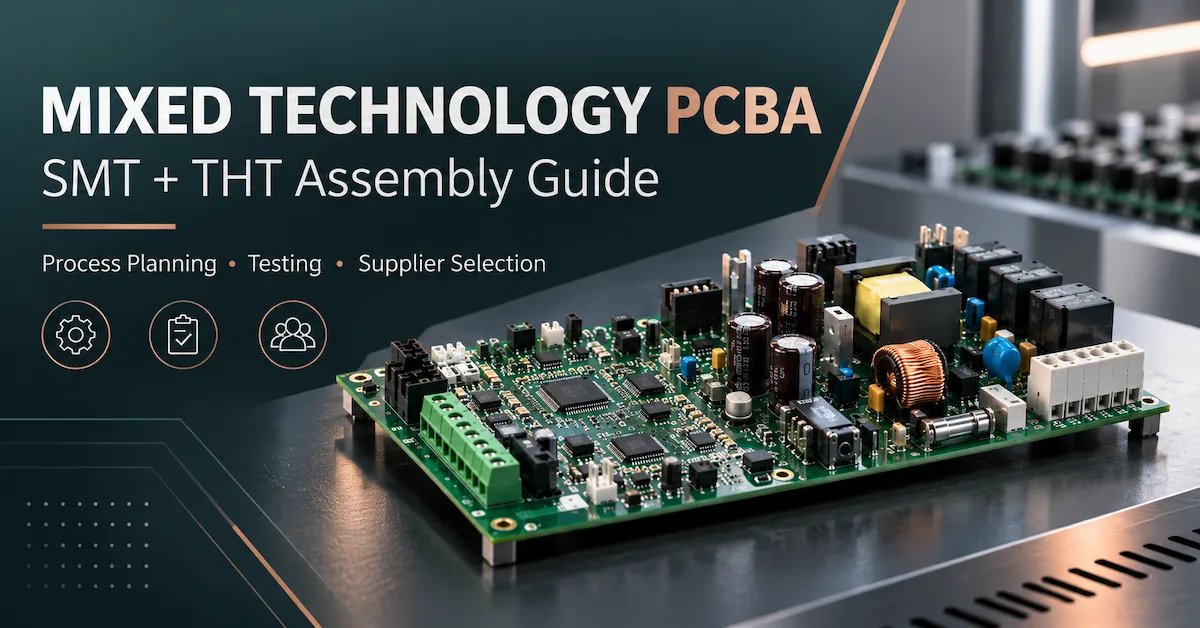
If your project combines SMT and through-hole components, review HCDPCBA's Mixed Technology PCBA Guide for additional process-selection considerations.
A reliable PCBA supplier should explain which THT soldering method will be used and why it fits the board layout.
7. Traceability Should Match Project Risk
Traceability does not mean every project needs the most complex tracking system possible.
It means the level of production history should match the technical and commercial risk of the product.
Buyers may need to trace:
- PCB revision
- BOM revision
- Material lot
- Work order
- Production date
- Firmware version
- Test result
- Rework status
- Inspection record
The required depth varies by application.
A low-cost consumer board and a long-life industrial controller may require very different levels of record retention.
The key is to define this before production.
Do not assume the supplier's interpretation of “traceability” is the same as yours.
8. Engineering Change Control Is a Major Reliability Test
A supplier can produce one good batch and still fail as a long-term manufacturing partner.
The more difficult test comes when something changes.
Examples include:
- PCB revision update
- BOM change
- component EOL
- approved substitute
- firmware revision
- test-limit modification
- connector replacement
- packaging change
A reliable PCBA supplier should have a clear way to prevent old and new production configurations from being mixed.
The controlled production package may include:
- Gerber revision
- BOM revision
- CPL revision
- Assembly drawing
- Firmware revision
- Programming instructions
- Test procedure
- Test limits
- Label specification
- Packaging specification
The important principle is simple:
An approved change should change the controlled documentation before it changes the production line.
9. Prototype Success Does Not Equal Production Reliability
Prototype manufacturing and repeat production have different objectives.
Prototype
The prototype stage should verify:
- Basic manufacturability
- Component fit
- Initial functionality
- Programming
- Mechanical interfaces
- Major design assumptions
Pilot Production
The pilot stage should validate:
- Process sequence
- Fixture access
- Inspection workflow
- Test duration
- Material control
- Rework points
- Work instructions
- Repeatability
Repeat Production
Recurring production requires:
- Released files
- Approved BOM
- Controlled alternatives
- Stable programming
- Defined testing
- Consistent assembly instructions
- Change approval
A reliable PCBA supplier should help maintain continuity between these stages.
The manufacturing question is not merely whether one prototype works.
It is whether the approved configuration can be reproduced consistently after the prototype engineer is no longer standing beside the line.
10. High-Mix and Low-Volume Projects Need Different Supplier Strengths
Some buyers incorrectly assume that the best mass-production factory is automatically the best prototype or small-batch supplier.
That is not always true.
High-mix and low-volume projects involve:
- Frequent setup changes
- Multiple BOMs
- Engineering revisions
- Smaller material quantities
- Different test configurations
- More communication per unit produced
The key capability is controlled flexibility.
If your project includes several board variants, frequent ECNs, or smaller recurring runs, HCDPCBA's Low-Volume High-Mix PCBA guide provides additional context on managing this type of production environment.
For higher-volume programs, supplier priorities shift toward repeatability, supply continuity, process stability, and production capacity.
A supplier should therefore be evaluated against the next manufacturing stage, not only the current order quantity.
11. Factory Capability Is More Than an Equipment List
When buyers review a PCBA factory, visible equipment is often the first thing they notice.
But production reliability depends on the system around the equipment.
A useful factory assessment should consider:
- Engineering review
- Material management
- SMT process control
- THT capability
- Inspection
- Testing
- Rework control
- Documentation
- Production scheduling
- Change management
- Quality response
HCDPCBA's PCBA Factory guide discusses why stable production systems matter in addition to manufacturing hardware.
The supplier should be able to explain the flow of your project from incoming files through shipment.
If responsibility becomes unclear between departments, that can become a production risk.
12. Verify Certifications Instead of Assuming Them
Certifications are important, but buyers should distinguish between different types of compliance.
There may be requirements related to:
- Factory quality-management systems
- PCB material
- Components
- Wireless modules
- Product safety
- EMC
- Market access
- Final-product certification
These are not interchangeable.
A supplier having a quality-management certificate does not automatically certify the final product for a target market.
Likewise, using a certified wireless module does not automatically mean the completed device meets all required regulatory conditions.
When workmanship standards such as IPC-A-610 or process requirements such as J-STD-001 are relevant, include the required acceptance level in the RFQ or quality agreement and confirm how compliance will be verified.
Do not leave critical requirements implied.
13. Compare Quotations by Total Manufacturing Scope
Price remains important, but the lowest unit price does not always represent the lowest manufacturing cost.
A PCBA quotation may be affected by:
- PCB specification
- BOM cost
- component availability
- placement quantity
- package complexity
- THT labor
- fixtures
- programming
- inspection
- testing
- packaging
- order quantity
A lower quotation may exclude services included elsewhere.
Before comparing prices, normalize the scope.
Example Supplier Comparison Matrix
| Evaluation Area | Supplier A | Supplier B | What Matters |
|---|---|---|---|
| PCB included | Yes/No | Yes/No | Same fabrication scope |
| Component sourcing | Full/Partial | Full/Partial | Approved sourcing responsibility |
| SMT assembly | Yes | Yes | Actual package capability |
| THT assembly | Included/Excluded | Included/Excluded | Relevant for mixed boards |
| AOI/X-Ray | Defined/Generic | Defined/Generic | Match inspection to package risks |
| Functional testing | Defined/Undefined | Defined/Undefined | Exact pass/fail scope |
| Firmware programming | Included/Excluded | Included/Excluded | Version control |
| BOM substitutions | Approval required? | Approval required? | Change control |
| Traceability | Defined/Undefined | Defined/Undefined | Match project requirement |
| Engineering support | Pre-production/Reactive | Pre-production/Reactive | Risk prevention |
| Tooling | Included/Separate | Included/Separate | One-time vs recurring costs |
This comparison provides a more useful sourcing decision than unit price alone.
14. Lead Time Should Be Broken Into Its Real Components
Buyers often ask:
“How fast can you deliver?”
A more useful question is:
What determines the schedule?
PCBA lead time may contain several separate periods:
- Engineering review
- PCB fabrication
- Component procurement
- Incoming material preparation
- SMT scheduling
- THT assembly
- Programming
- Functional testing
- Rework if required
- Final inspection
- Packaging
The schedule should also distinguish between:
prototype lead time and repeat-production lead time.
A first build may take longer because files, test fixtures, work instructions, and assembly processes are still being validated.
A repeat order should benefit from already released manufacturing information unless materials or engineering requirements change.
15. Communication Quality Is Part of Manufacturing Reliability
Some supplier problems are technical.
Others begin as communication problems.
A reliable PCBA supplier should communicate clearly when:
- a component is unavailable,
- a proposed alternative is needed,
- a drawing is ambiguous,
- a test fails,
- a fixture needs modification,
- a production date changes,
- or an engineering decision is required.
The most dangerous response is often not “there is a problem.”
It is silence.
Good manufacturing communication creates a traceable decision path between engineering, purchasing, quality, and production teams.
This becomes particularly important for overseas OEM relationships where the customer cannot visit the production floor for every build.
16. Watch for These PCBA Supplier Red Flags
A supplier qualification process should identify warning signs before the first large purchase order.
Common red flags include:
- Quoting without reviewing basic manufacturing files.
- Vague answers about component sourcing.
- Component substitutions without approval.
- Treating AOI as proof of functional testing.
- No clear method for controlling PCB, BOM, or firmware revisions.
- Generic claims of “100% testing” without defining the test.
- Unclear responsibility for failed materials or rework.
- Inability to explain prototype-to-production transition.
- Different answers from sales, engineering, and production teams.
- Quotations that do not clearly state exclusions.
None of these points alone proves that a supplier cannot manufacture a board.
They indicate areas where the buyer should request clarification before committing materials or production quantity.
17. What Files Should You Send to a Reliable PCBA Supplier?
A professional RFQ should provide enough information for engineering and purchasing to evaluate the same manufacturing scope.
Where applicable, prepare:
PCB Data
- Gerber files
- Drill files
- Fabrication drawing
- Stack-up requirements
- Controlled impedance requirements
- Panel requirements
Assembly Data
- BOM
- Manufacturer part numbers
- CPL / Pick-and-Place file
- Assembly drawing
- Polarity information
- Special assembly requirements
Firmware and Testing
- Firmware file
- Firmware revision
- Programming instructions
- Test procedure
- Test limits
- Fixture information
Commercial Requirements
- Prototype quantity
- Pilot quantity
- Expected production quantity
- Target schedule
- Packaging requirements
- Delivery destination
A clear RFQ allows the supplier to identify missing information early and improves quotation comparability.
Buyers ready to discuss a project can submit manufacturing files and requirements through the HCDPCBA Contact Us page.
18. Questions to Ask Before Approving a PCBA Supplier
Before placing a production order, ask the supplier questions that reveal its process rather than inviting a simple “yes.”
For example:
How will you control BOM alternatives?
Which inspection methods will be used on our specific PCB?
What exactly is included in functional testing?
How will our firmware revision be controlled?
How are repeat-order changes approved?
Which production records can be retained if our project requires traceability?
How will prototype findings be transferred into repeat-production documentation?
What is excluded from the quotation?
The answers should be concrete enough for engineering and purchasing teams to understand what happens after the purchase order is issued.
Frequently Asked Questions About Choosing a Reliable PCBA Supplier
1. What makes a PCBA supplier reliable?
A reliable supplier can repeatedly manufacture the approved PCB assembly while controlling materials, assembly processes, inspection, testing, revisions, and engineering changes. Reliability should be demonstrated through process clarity rather than marketing claims alone.
2. How do I choose a reliable PCBA supplier?
Start by defining your manufacturing scope, then evaluate engineering support, BOM control, component sourcing, SMT/THT capability, inspection, functional testing, traceability, revision control, lead time, and repeat-production capability.
3. Should I choose the lowest-cost PCBA supplier?
Not automatically. Compare the total manufacturing scope first. A cheaper quotation may exclude component sourcing, THT assembly, programming, testing, fixtures, or engineering support included in another quotation.
4. What information should I request from a PCBA supplier?
Request clear information about manufacturing capability, sourcing responsibility, inspection methods, testing scope, quality management, change control, production lead time, and quotation exclusions.
5. How important is component sourcing when selecting a PCBA manufacturer?
Very important. Incorrect or uncontrolled component substitutions can change electrical performance, mechanical fit, thermal behavior, firmware compatibility, and long-term production consistency.
6. Does AOI mean the PCBA has been fully tested?
No. AOI primarily checks visible assembly conditions. It does not replace electrical or functional testing. The final test strategy should match the product's actual failure risks.
7. What is the difference between a PCBA manufacturer and a turnkey PCBA supplier?
A basic assembly supplier may only perform defined manufacturing steps. A turnkey PCBA supplier can take broader responsibility for PCB procurement, component sourcing, assembly, inspection, testing, and related production coordination. The exact scope should still be documented.
8. Can one PCBA supplier support both prototypes and mass production?
Potentially, but buyers should verify how prototype processes are transferred into controlled pilot and repeat production. A factory that performs well at one quantity level may not automatically fit another.
9. How should engineering changes be handled during PCBA production?
Changes should be approved and reflected in controlled production documents before implementation. PCB revisions, BOMs, firmware, test procedures, and assembly instructions should remain synchronized.
10. What should I send when requesting a PCBA quotation?
Provide Gerber files, BOM, CPL/Pick-and-Place data, assembly drawings, quantity requirements, testing requirements, and firmware/programming information where applicable. The more complete the production package, the more meaningful the quotation.
Conclusion
Choosing a reliable PCBA supplier is ultimately a risk-management decision, not simply a price comparison. The right manufacturing partner should be able to show how it controls the approved BOM, sourcing decisions, PCB revisions, SMT and THT processes, inspection, programming, functional testing, engineering changes, and repeat-production documentation.
Before approving a supplier, define what the finished PCBA must include and how acceptance will be measured. Compare suppliers against the same manufacturing scope, request clear answers about testing and substitutions, and make sure prototype knowledge can be transferred into controlled repeat production.
For buyers evaluating a new manufacturing project, reviewing HCDPCBA's PCBA manufacturing service framework and company manufacturing information can provide additional context. When your Gerber files, BOM, CPL, quantities, firmware, and testing requirements are ready, submit them through the HCDPCBA project inquiry page so the manufacturing scope can be reviewed before quotation.