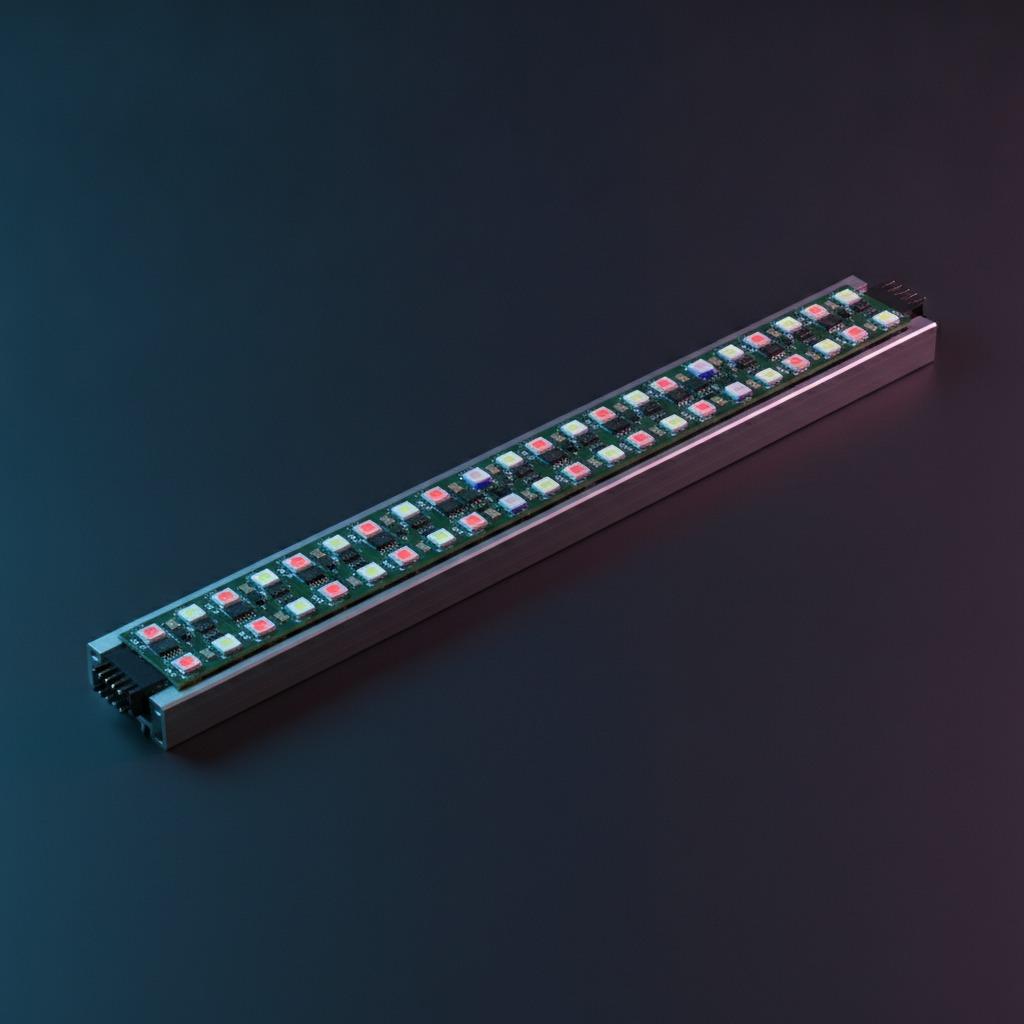
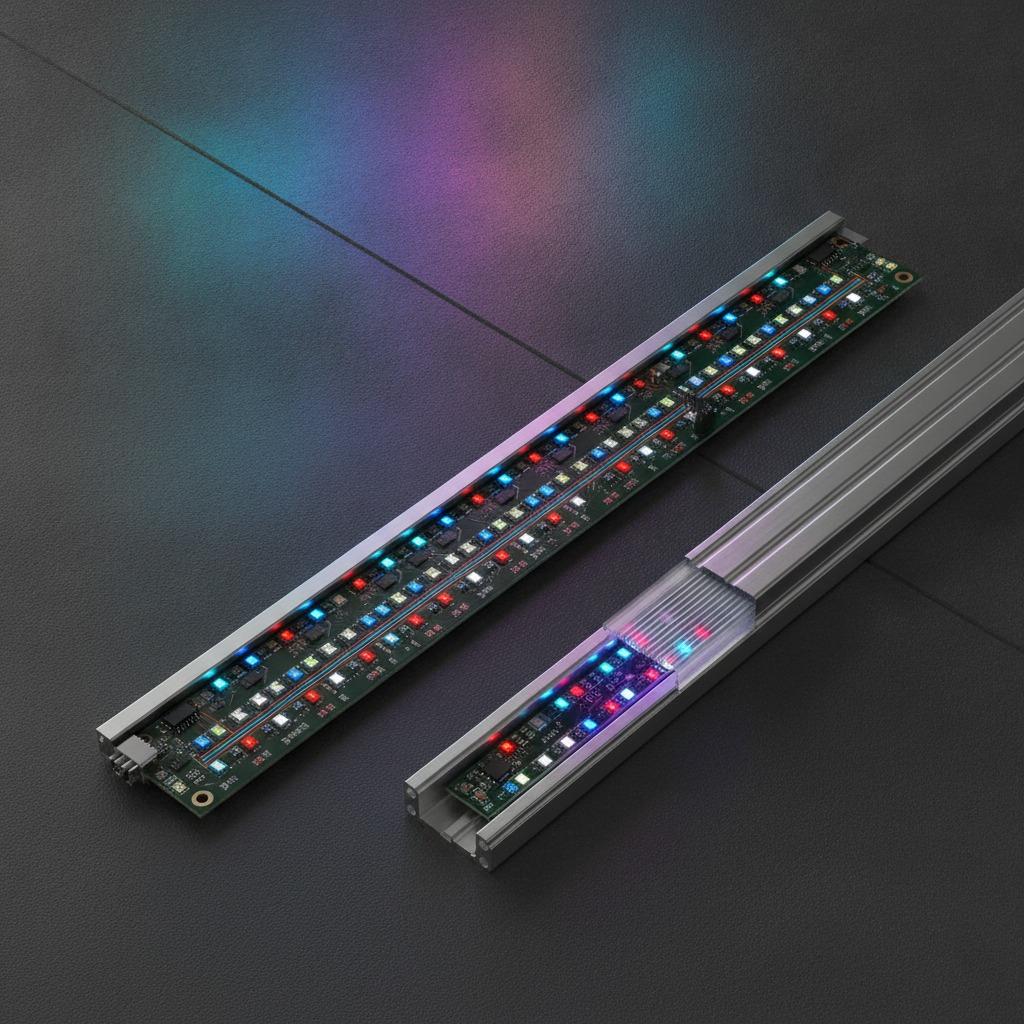
Designing controllable linear lighting fixtures requires balancing optical spacing, signal routing, and thermal paths across very narrow circuit boards. When developing luminaires for stage wash, venue effects, or dynamic architectural facades, engineering teams frequently evaluate the PCB LED Bar DMX TKA format to satisfy both standardized communications and multi-channel color mixing. Operating on a DC 24V platform with native DMX512 control compatibility and an RGBW component arrangement, this linear architecture represents an industry-standard baseline for modern programmable illumination.
For lighting manufacturers, system integrators, and sourcing managers, choosing or manufacturing a dedicated linear board is not merely a question of matching forward voltages. It involves analyzing how data signals traverse long runs, verifying mechanical mounting interfaces, and ensuring that component layout supports repeatable surface-mount production.
Architecture of the TKA DMX512 Linear Module
The TKA series is configured as a narrow, elongated assembly featuring surface-mounted LEDs paired with local discrete electronic components. Unlike basic constant-voltage analog strips that require external PWM dimming racks, a fully featured DMX512 LED Bar PCBA integrates data reception and addressing directly along the fixture run or pairs with specialized on-board driving stages to interpret control packets directly from a lighting desk or master console.
| Parameter Focus | TKA Model Baseline Details | Engineering Significance |
|---|---|---|
| Operating Voltage | DC 24V | Reduces overall current draw compared to 5V or 12V systems, mitigating resistive voltage drops over extended linear spans. |
| Control Interface | DMX512 Compatible | Provides addressable universe integration, allowing smooth cross-fades, color switching, and synchronized effect triggering from standard lighting consoles. |
| Color Configuration | RGBW (Red, Green, Blue, White) | Enables true pastel tones and tunable white output alongside saturated primary colors without compromising chromatic rendering. |
| Form Factor | Narrow Linear Strip | Designed to slide or mount directly into linear aluminum extrusions, compact moving heads, or wall washer bodies. |
Key Design and Production Challenges in Linear Form Factors
Developing or sourcing a reliable linear LED PCB requires special attention to manufacturing nuances that do not appear on standard square or rectangular circuit assemblies.
1. Thermal Dissipation in Constrained Widths
Because these boards pack multi-die RGBW packages and control circuitry onto a narrow footprint, heat accumulation is inevitable. A bare board cannot operate at full continuous output without conductive dissipation. Integrators must plan for structural heat sinking—typically an aluminum carrier or extrusion body—and evaluate how dielectric thermal conductivity affects junction temperatures. During high-intensity stage wash or sustained white-mode operation, poor thermal planning will quickly accelerate lumen depreciation and cause color-point shifts.
2. High-Frequency Signal Integrity Alongside Power Bus Lines
Routing differential DMX data lines across a narrow, high-current board demands disciplined trace separation. The DC 24V power traces feed multiple LED banks, creating localized switching noise. If the data lines lack adequate impedance control, ground shielding, or termination protection, fixtures down the chain can suffer packet loss, causing visible flicker or dropped frames during live events.
3. Mechanical Rigidity and Warpage
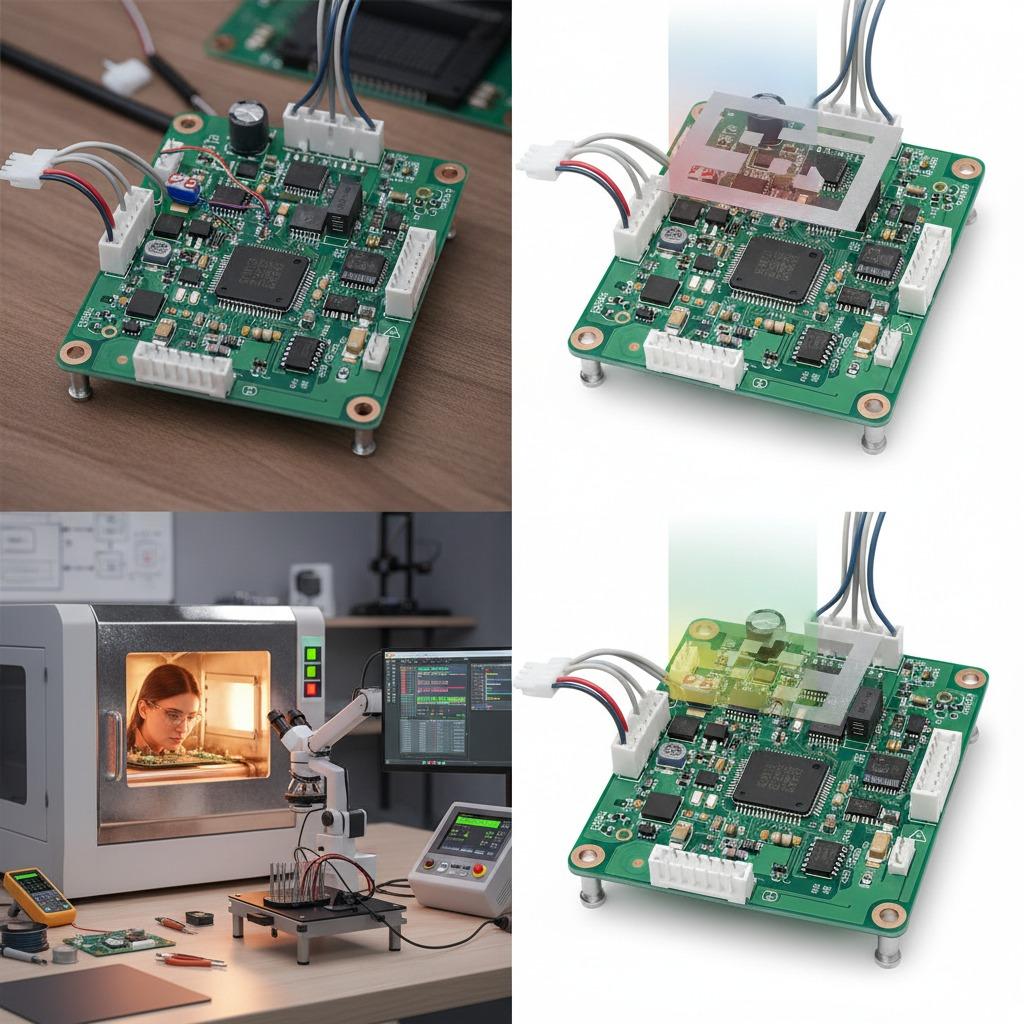
Long, thin circuit boards are notoriously prone to bowing or twisting during reflow soldering. Proper panelization with balance rails and breakaway tabs is essential. If copper distribution across layers is uneven, thermal expansion in the reflow oven will warp the board, complicating assembly into tight fixture housings or optical lens channels.
Primary Application Environments
While the board itself is an unencapsulated sub-assembly requiring mechanical integration, its electrical profile targets specific B2B lighting segments:
- Entertainment and Stage Lighting: When integrated into a rugged chassis, this layout functions effectively as a stage lighting PCBA. Lighting designers demand immediate response times, strobe capability, and smooth low-end dimming for touring rigs and theater backdrops.
- Architectural Wall Washers: When equipped with secondary collimating lenses or asymmetric optics, the assembly translates directly into an RGBW wall washer PCBA, delivering uniform vertical illumination across building facades, hotel lobbies, and interior galleries.
- Exhibition and Dynamic Accent Fixtures: Linear modules allow custom retail and display builders to program chasing patterns and dynamic branding cues without bulky external driver enclosures.
Manufacturing and Sourcing Advice with HCDPCBA
For product teams looking to manufacture linear lighting hardware, sourcing raw components and securing high-precision SMT placement are critical operational hurdles. Narrow boards present specific handling constraints on pick-and-place lines, requiring dedicated support tooling to avoid board flexing under nozzle pressure.
Partnering with an experienced electronics manufacturing provider like hcdpcba simplifies this transition from CAD file to commercial production. HCDPCBA provides comprehensive surface-mount technology (SMT) services, PCB prototyping, component procurement, and turnkey box build assembly. Leveraging early DFMA (Design for Manufacturability and Assembly) analysis allows engineering teams to identify trace bottlenecks, solder pad sizing issues, and optical component spacing before cutting prototype stencils. From automated optical inspection to functional testing under DC 24V load, standardized assembly ensures every strip responds accurately to control commands before final fixture integration.
Common Sourcing Mistakes to Avoid
A frequent error among product developers is finalizing the external housing and optical diffusers before locking in the board's exact physical boundaries and connector clearances. End-mounted connectors, terminal blocks, or solder pads require sufficient mechanical clearance for wiring harnesses; ignoring wire-exit bend radiuses often forces expensive mechanical revisions.
Another pitfall is neglecting to verify the board's addressing methodology early. Hardware designers must clarify whether the board uses fixed physical addressing DIP components, software-based RDM (Remote Device Management), or autoprogramming ICs to fit their end-user deployment scenario.
Frequently Asked Questions
Can the TKA module be powered directly from an AC mains line?
No. The unit is designed strictly for DC 24V input. Connecting it directly to AC line voltage will instantly destroy the surface-mount driver components and LED packages. A regulated industrial DC power supply is mandatory.
Does the board include integrated optical lenses?
The base TKA board is typically supplied as a bare PCB assembly. Secondary optics, such as narrow-beam or elliptical lens arrays, must be selected according to the target fixture design and mechanical housing profile.
How can we avoid signal degradation when chaining multiple linear bars?
DMX line rules apply: ensure that total run length complies with standard transmission thresholds, maintain continuous reference grounds, inject fresh DC 24V power at calculated intervals to counter resistive voltage loss, and place a 120-ohm termination resistor across the data pair at the final module in the universe.
Next Steps for Your Project
Whether you are developing a new fixture line or refining an existing architectural fixture, reliable SMT placement and component sourcing determine your product's field lifespan. Contact the engineering and sales team at hcdpcba (Phone: +86 18924624188) to discuss your PCB prototyping, DFMA reviews, or full-scale SMT assembly requirements.