What Should You Expect From an OEM Electronics Manufacturer in China?
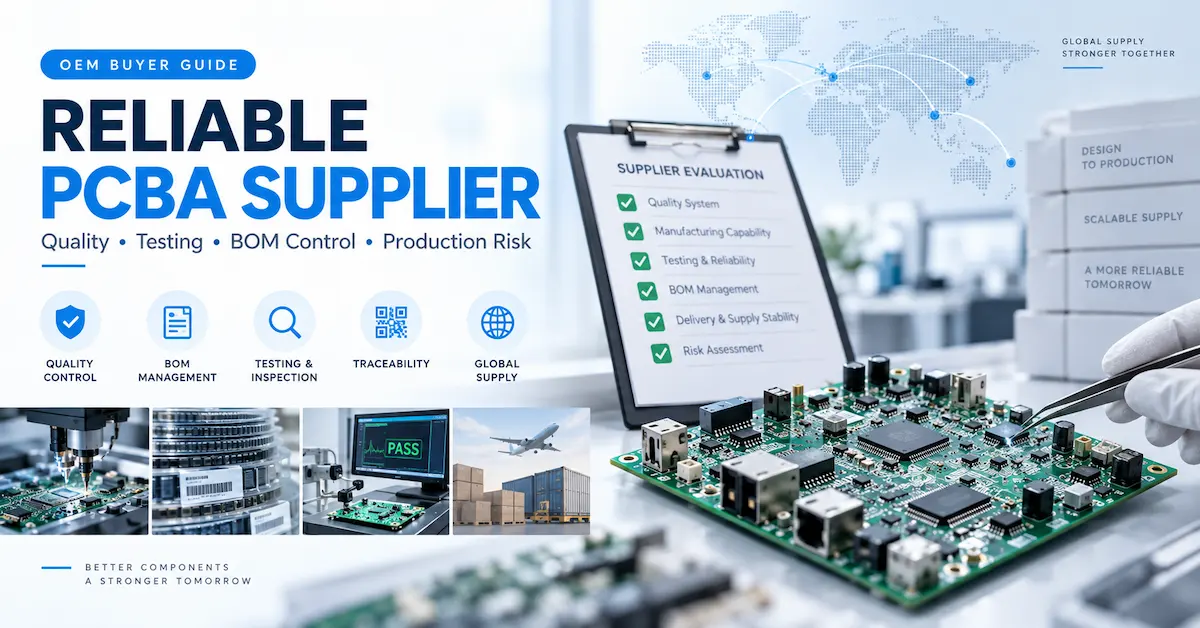
An OEM electronics manufacturer China buyer selects should do more than place components on a PCB. For a custom electronics project, the real value is the manufacturer's ability to coordinate PCB fabrication, BOM sourcing, SMT and through-hole assembly, inspection, testing, engineering review, and the transition from prototype to mass production.
For procurement managers, the biggest sourcing risk is rarely the quoted SMT price alone. Problems usually appear when a supplier cannot manage engineering changes, component substitutions, hidden solder defects, incomplete test requirements, or production scaling.
A qualified electronics manufacturing partner should therefore help answer five questions before you place a production order:
- Can this design be manufactured consistently?
- Can the BOM be sourced with controlled alternatives?
- How will critical components and solder joints be inspected?
- What functional tests will prove the PCBA works?
- Can the same supplier support prototype, pilot build, and mass production?
HCDPCBA positions itself as a one-stop electronics manufacturing partner providing PCB prototyping, SMT assembly, customized PCBA, DFMA, component sourcing, assembly, testing, and OEM/ODM services. The company currently states that it operates a 5,000 m² plant with 50+ employees and lists ISO 9001, ISO 14001, ISO 45001, and RoHS among its certifications.
For buyers who already have Gerber, BOM, and production requirements, the most useful next step is not asking for a generic “PCB assembly price.” It is requesting a project-specific manufacturing review and quotation.

Who Should Work With a China OEM Electronics Manufacturer?
OEM electronics manufacturing is particularly relevant when your company owns the product concept, design, specification, or brand but does not want to operate an internal electronics factory.
Typical buyers include:
- Consumer electronics brands
- IoT product companies
- Industrial equipment manufacturers
- Security and surveillance companies
- Smart-home brands
- Communication equipment companies
- Power and energy product developers
- Hardware startups
- Engineering and R&D teams
- Overseas importers requiring customized electronics
HCDPCBA currently lists industrial control, security and surveillance, medical, IoT, automotive electronics, artificial intelligence, smart home, power and energy, and communications among the industries it serves.
That does not mean every project automatically fits the same production process or compliance scope. Medical, automotive, telecommunications, and other regulated or reliability-sensitive products may require project-specific materials, process controls, certifications, validation, and documentation.
When OEM manufacturing may not be the best fit
A custom electronics OEM relationship may be unnecessary when you:
- Only need a standard retail product with no customization
- Have not yet defined basic product requirements
- Expect the manufacturer to assume ownership of an unfinished product concept without a defined ODM scope
- Require certifications or regulatory approvals that have not been confirmed with the supplier
- Need extremely specialized manufacturing processes outside the supplier's validated capability
A strong supplier should be willing to tell you when a project requires additional validation instead of promising that “everything is possible.”
OEM vs ODM vs Basic PCB Assembly: What Are You Actually Buying?
Buyers often use OEM, ODM, EMS, and PCBA assembly interchangeably, but their commercial scopes can differ significantly.
| Manufacturing Model | Customer Usually Provides | Supplier Responsibility | Best For |
|---|---|---|---|
| PCB fabrication | Gerber/fabrication data | Bare PCB manufacturing | Teams managing assembly elsewhere |
| PCBA assembly | Gerber, BOM, CPL | PCB + component placement/assembly | Established hardware designs |
| Turnkey PCBA | Gerber, BOM, CPL, test requirements | PCB, sourcing, SMT/DIP, inspection, testing | Buyers reducing supplier coordination |
| OEM electronics manufacturing | Product/design specification | Controlled manufacturing to customer requirements | Brands with defined products |
| ODM | Product target and requirements | Deeper design/development + manufacturing involvement | Buyers needing engineering development support |
HCDPCBA describes its OEM service as contract manufacturing and its ODM service as involving in-house design, development, and manufacturing support.
Before requesting a quote, define exactly which responsibility you expect the supplier to assume. A quotation for “assembly only” cannot fairly be compared with one that includes PCB fabrication, full BOM procurement, programming, functional testing, final assembly, and engineering support.
What Services Should a Turnkey OEM Electronics Manufacturer Provide?
For buyers trying to reduce supplier-management work, the most useful model is often an integrated manufacturing workflow.
PCB Prototyping
Prototype PCB production allows the engineering team to check the design before committing to a larger build.
Prototype support is particularly valuable when you need to validate:
- Board dimensions
- Connector locations
- Stack-up
- Component footprint
- Mechanical fit
- Basic electrical performance
HCDPCBA states that it supports rapid PCB prototyping across different layers and specifications.
Component Sourcing and BOM Management
BOM sourcing is often one of the highest-risk parts of outsourced electronics manufacturing.
The buyer should control:
- Manufacturer part numbers
- Approved vendors
- Alternative components
- Lifecycle status
- Substitution approval
- Traceability requirements
HCDPCBA states that component sourcing is part of its one-stop PCBA service and that parts are sourced through a vetted network with third-party authentication.
The important procurement rule is simple:
No critical component should be substituted without a defined approval process.
A cheaper substitute can change electrical behavior, firmware compatibility, thermal performance, EMC behavior, or product reliability.
SMT and Through-Hole Assembly
Modern PCBAs can combine:
- Fine-pitch ICs
- BGA
- QFN
- Passive components
- Connectors
- Terminal blocks
- Large through-hole devices
- Power components
HCDPCBA states that its assembly capability includes SMT, DIP, and final assembly. Its website also states that SMT assembly can support one-board minimum quantities, with no engineering or setup fee under its current service terms.
For a real RFQ, confirm whether these commercial terms apply to your specific project before treating them as fixed quotation conditions.
Why DFMA Should Happen Before You Approve Production
DFMA—Design for Manufacturing and Assembly—is one of the clearest ways an OEM electronics manufacturer can add value before production.
A design can be electrically correct and still be difficult or expensive to manufacture.
A useful DFMA review may check:
- Component spacing
- Footprint accuracy
- Polarity markings
- BGA/QFN layout
- Fiducials
- Panelization
- Solder-paste access
- Connector orientation
- Mounting holes
- Cable clearance
- Test-point accessibility
- Thermal paths
- Assembly sequence
HCDPCBA lists DFMA as part of its service model and describes it as an early-stage review intended to improve manufacturability and assembly efficiency.
For procurement teams, this matters because the cheapest time to correct a manufacturing problem is before components are ordered and boards enter production.
A supplier that immediately quotes production without reviewing obvious design or BOM risks may appear faster initially but create more expensive problems later.
What Files Should You Send for an Accurate OEM Electronics Quote?
One of the fastest ways to improve quotation accuracy is to provide complete manufacturing information.
For a typical PCBA project, prepare:
| File / Information | Why the Manufacturer Needs It |
| Gerber or approved fabrication data | PCB manufacturing |
| BOM | Component sourcing and pricing |
| Manufacturer part numbers | Prevent ambiguous component selection |
| CPL / Pick-and-Place file | SMT placement |
| Assembly drawing | Orientation and assembly guidance |
| Schematic | Engineering review and troubleshooting |
| Test requirements | Define acceptance criteria |
| Firmware/programming file | Programming where required |
| Mechanical drawing | Fit and connector validation |
| Prototype quantity | Sample-build planning |
| Mass-production forecast | Material and production planning |
| Target delivery date | Lead-time evaluation |
If you want a supplier to quote a turnkey project but send only a photo or a vague product description, the resulting price will usually contain assumptions.
Those assumptions can later become change orders.
High-conversion RFQ checklist
When contacting an OEM electronics manufacturer China sourcing team, include these five items in the first message whenever possible:
- Gerber or PCB design files
- Complete BOM with manufacturer part numbers
- CPL / assembly information
- Prototype and expected production quantities
- Required testing and target delivery schedule
This allows the manufacturer to evaluate actual manufacturing risk rather than providing a generic estimate.
How Should Buyers Evaluate PCB and PCBA Capability?
Do not evaluate a supplier only by asking, “Can you make multilayer boards?”
Instead, match manufacturing capability to the board you are actually sourcing.
HCDPCBA states that it produces customized PCBA including multilayer, HDI, and high-frequency applications.
For your own project, confirm:
- PCB layer count
- Board dimensions
- Minimum trace/space
- Minimum drill or via structure
- Copper thickness
- Surface finish
- Impedance-control requirements
- HDI or microvia requirements
- High-frequency material requirements
- BGA pitch
- Double-sided SMT requirements
- Through-hole process
- Special cleaning or coating requirements
Do not copy specifications from another product page and assume they apply to your design.
A serious manufacturer should review the actual Gerber, stack-up, BOM, and assembly data.
AOI, X-Ray, and Functional Testing Solve Different Quality Problems
Inspection should be matched to the failure mode you are trying to detect.
AOI
Automated Optical Inspection is useful for visible assembly conditions such as:
- Missing components
- Placement errors
- Polarity
- Certain solder defects
- Visible joint quality
X-Ray
X-Ray inspection is useful when solder joints are hidden beneath packages such as BGA and certain other bottom-terminated components.
Functional Testing
Even a visually perfect PCBA can fail functionally.
A functional test may need to verify:
- Power rails
- Startup
- Interfaces
- Communication
- Sensor input
- Output control
- Firmware programming
- Network connectivity
- Application-specific behavior
HCDPCBA lists AOI and X-Ray among its current inspection capabilities and also lists sample build verification and testing within its manufacturing workflow.
For external quality references, IPC identifies IPC J-STD-001J as a standard covering materials, methods, process control, and acceptance criteria for soldered electronic assemblies, while IPC-A-610J provides post-assembly acceptance criteria.
IPC electronics assembly standards information
If your project requires a specific IPC class or acceptance criterion, state it in the RFQ, drawing, purchase order, or quality agreement. Do not assume that mentioning IPC in a supplier's marketing materials automatically defines the acceptance standard for your product.
Prototype, Pilot Run, and Mass Production Are Three Different Decisions
One of the most common sourcing mistakes is treating a successful prototype as proof that the product is ready for volume manufacturing.
It is not.
Prototype Build
The prototype stage answers:
- Does the design work?
- Are the selected components suitable?
- Does the PCBA fit the mechanical structure?
- Can firmware communicate with the hardware?
- Are obvious design errors present?
Pilot Run
The pilot build asks a different question:
Can the product be manufactured repeatedly using the intended process?
Use the pilot stage to verify:
- Assembly repeatability
- Production fixtures
- Test coverage
- Material sourcing
- Work instructions
- Process yield
- Firmware control
- Packaging
- Engineering-change handling
Mass Production
Volume production should begin after the design and production process are controlled.
Before approval, buyers should ideally have:
- Released Gerber revision
- Released BOM revision
- Approved alternative component list
- Approved firmware version
- Defined test procedure
- Approved sample or golden unit
- Defined quality criteria
- Engineering change process
This prototype → pilot → mass production structure is often more important to total project risk than obtaining the lowest first quotation.
How Much Does OEM Electronics Manufacturing in China Cost?
There is no useful universal “cost per PCBA.”
A meaningful price depends on the exact technical and commercial scope.
PCB cost drivers
- Layer count
- Board dimensions
- Material
- Copper weight
- HDI structure
- Controlled impedance
- Surface finish
- Production quantity
Component cost drivers
- Processor and IC selection
- Memory
- Wireless modules
- Connectors
- Power devices
- Sensor components
- Availability
- MOQ
- Lifecycle status
Assembly cost drivers
- Component count
- Fine-pitch packages
- BGA/QFN
- Double-sided SMT
- Through-hole components
- Manual operations
Testing cost drivers
- Programming
- ICT or electrical tests
- Functional fixtures
- Communication testing
- System-level validation
- Extended test time
Commercial cost drivers
- Prototype quantity
- Forecast volume
- Component purchasing terms
- Engineering-change frequency
- Packaging
- Delivery requirements
A low initial unit price can become expensive if the quote excludes engineering review, material handling, testing, rework, or controlled sourcing.
The better question is:
What is included in the quotation, and which manufacturing risks remain with the buyer?
China OEM Manufacturer vs Assembly-Only Supplier
| Decision Factor | Assembly-Only Supplier | One-Stop OEM Manufacturing Partner |
| PCB fabrication | Buyer may coordinate | Integrated |
| BOM sourcing | Buyer often manages | Can be integrated |
| SMT | Yes | Yes |
| DIP/THT | Varies | Can be included |
| DFMA | Limited or separate | Engineering review |
| AOI | Often | Should be confirmed |
| X-Ray | Varies | Available when supplier has capability |
| Functional testing | Buyer-defined, may be limited | Project-specific |
| Prototype support | Usually | Yes |
| Pilot-production planning | Varies | More structured |
| Mass-production scaling | Depends | Core requirement |
| Supplier coordination | Higher buyer workload | Lower |
| Engineering change control | Must verify | Should be defined |
For hardware companies with their own purchasing and quality teams, an assembly-only model can work well.
For overseas buyers trying to reduce the number of vendors they manage, a turnkey OEM model can provide greater commercial value.
8 Questions to Ask Before Choosing an OEM Electronics Manufacturer in China
1. Can you review our design before production?
A supplier that provides DFMA can identify manufacturing problems before they become rework.
2. How do you source and verify components?
Ask about approved suppliers, traceability, counterfeit-risk controls, and alternative-part approval.
3. How are BOM substitutions controlled?
The safest answer is a documented customer-approval process for critical substitutions.
4. What inspection will our specific PCBA receive?
Do not accept “we inspect everything” as the complete answer. Ask whether your design needs AOI, X-Ray, functional testing, or another method.
5. Can you support prototype and pilot quantities?
A manufacturer able to support development quantities can simplify the transition to scale.
6. What happens when the design changes?
Ask how Gerber, BOM, CPL, firmware, and production revisions are controlled.
7. How do you protect customer intellectual property?
HCDPCBA states that it uses one-to-one service and confidentiality agreements to protect customer files and data.
For sensitive projects, put confidentiality, file access, ownership, and data-retention requirements into your commercial agreement.
8. What exactly do you need before giving a firm quote?
A supplier asking detailed technical questions is often easier to evaluate than one providing an immediate low price without reviewing project files.
Manufacturing Capabilities Buyers Should Confirm With HCDPCBA
Based on its current website, HCDPCBA publicly lists the following capabilities. Exact applicability should still be confirmed against your project.
| Area | Currently Stated Capability |
| PCB development | Rapid PCB prototyping |
| PCBA | Customized multilayer, HDI, high-frequency PCBA |
| SMT | SMT assembly |
| Through-hole | DIP assembly |
| Final assembly | Available as part of assembly workflow |
| Engineering | DFMA |
| Components | Component sourcing |
| Inspection | AOI and X-Ray |
| Testing | Sample-build verification and testing |
| OEM | Contract manufacturing |
| ODM | Design/development/manufacturing support |
| Factory | 5,000 m² |
| Team | 50+ employees |
| Certifications shown | ISO 9001, ISO 14001, ISO 45001, RoHS |
Source: HCDPCBA's current company profile.
You can review its broader PCBA manufacturing services or learn more about HCDPCBA's electronics manufacturing capabilities before submitting project files.
How to Reduce Risk When Moving Electronics Production to China
Price negotiation should come after risk definition.
A practical sourcing process is:
Step 1: Freeze the RFQ package
Create one controlled set of:
- Gerber
- BOM
- CPL
- drawings
- firmware
- test requirements
Step 2: Request a DFMA and BOM review
Do this before placing the full order.
Step 3: Identify long-lead and critical components
Separate components that can stop the entire production schedule.
Step 4: Define substitution rules
Specify which parts may never be changed without approval.
Step 5: Build prototypes
Validate electronics and mechanical integration.
Step 6: Define functional acceptance
Do not wait until production to decide what “working” means.
Step 7: Run a pilot batch
Use it to validate production consistency.
Step 8: Approve a golden sample
Create a shared reference for quality and function.
Step 9: Lock revisions
Ensure the factory is manufacturing the same files you approved.
Step 10: Scale production
Increase volume only after technical and process risks have been reduced.
This process also makes supplier comparison easier because manufacturers are responding to the same controlled information.
Why Overseas Buyers Choose HCDPCBA for OEM Electronics Projects
For a buyer evaluating an OEM electronics manufacturer China partner, HCDPCBA's main value proposition is the combination of multiple manufacturing stages within one supplier relationship.
Its current service portfolio covers:
PCB prototyping → component sourcing → SMT/DIP assembly → DFMA → inspection → testing → OEM/ODM → production scaling.
This structure is most relevant for buyers who want to reduce the need to coordinate a separate PCB factory, component sourcing company, SMT factory, and testing provider.
The company also states that confidentiality agreements are available to protect customer files and commercial information.
For projects involving industrial control, IoT, security, communications, smart home, consumer electronics, power, or other custom PCBA applications, buyers can use HCDPCBA's PCBA product and manufacturing section to evaluate relevant board types.
What Should You Send HCDPCBA to Get a More Useful Quote?
If your project is already designed, prepare:
- Gerber files
- BOM with manufacturer part numbers
- CPL / Pick-and-Place file
- Assembly drawing
- Prototype quantity
- Estimated mass-production quantity
- Required test procedure
- Target delivery date
- Any special material or quality requirements
If the product is still under development, clearly identify which requirements are fixed and which areas are open for DFMA or ODM optimization.
Instead of sending:
“Please quote PCB assembly.”
send:
“We need 10 prototype PCBAs followed by an expected production build. Attached are Gerber, BOM, CPL, and assembly drawings. Please review BOM availability, DFMA risks, BGA inspection requirements, functional-test scope, prototype lead time, and mass-production pricing.”
That gives both sides enough information for a commercially meaningful discussion.
Contact HCDPCBA for a project review and quotation
Frequently Asked Questions
What does an OEM electronics manufacturer in China do?
An OEM electronics manufacturer produces electronic products or PCB assemblies according to the customer's approved design, specifications, BOM, and quality requirements. Depending on the supplier, services may include PCB fabrication, component sourcing, SMT, DIP, inspection, testing, final assembly, and production scaling.
What is the difference between an OEM electronics manufacturer and a PCBA factory?
A PCBA factory may focus primarily on board assembly. An OEM electronics manufacturer can have a broader responsibility covering sourcing, manufacturing, testing, final assembly, project management, and production support. Always confirm the exact commercial scope.
What files are required for a PCBA quotation?
For most projects, provide Gerber files, BOM, CPL/Pick-and-Place data, assembly drawings, quantities, and testing requirements. Schematics and mechanical drawings can improve engineering review.
Can HCDPCBA support prototype quantities before mass production?
HCDPCBA states that its PCB service includes rapid prototyping and that SMT assembly can support one-board minimum quantities. Project-specific component availability, price, and lead time should still be confirmed before ordering.
Does HCDPCBA provide component sourcing?
Yes. HCDPCBA currently lists component sourcing as part of its PCBA service and states that it uses a vetted supplier network with third-party component authentication.
Does HCDPCBA provide AOI and X-Ray inspection?
HCDPCBA's current About Us page lists both AOI and X-Ray among its quality-control equipment and capabilities. The actual inspection plan should be defined according to your specific PCBA design.
How can buyers protect Gerber files, BOMs, and firmware?
Use an NDA or confidentiality agreement, control file access, define IP ownership, restrict unauthorized substitutions, and include data-handling requirements in the commercial agreement. HCDPCBA states that confidentiality agreements are part of its customer-protection approach.
What determines OEM electronics manufacturing lead time?
Lead time depends on PCB complexity, component availability, prototype quantity, SMT/DIP complexity, testing, tooling or fixtures, engineering changes, and production volume. A supplier should quote lead time after reviewing the complete project package.
Is the lowest PCBA quotation usually the best option?
Not necessarily. Buyers should compare what each quote includes: PCB fabrication, components, assembly, inspection, testing, engineering support, rework policy, packaging, and logistics. A lower unit price can create a higher total cost if essential manufacturing steps are excluded.
How do I request a quote from HCDPCBA?
Prepare your Gerber files, BOM, CPL, quantity, testing requirements, and target schedule, then submit them through the HCDPCBA contact page. A detailed RFQ gives the engineering and sourcing team more information to assess manufacturability, material availability, and production cost.
Conclusion
Choosing an OEM electronics manufacturer China sourcing team can rely on is ultimately a risk-control decision, not simply a price comparison.
A strong electronics manufacturing partner should help you manage:
design manufacturability → PCB fabrication → BOM sourcing → SMT/DIP assembly → AOI/X-Ray → functional testing → prototype validation → pilot production → controlled mass production.
For OEM brands and hardware companies, the highest-value supplier is usually the one that makes technical and commercial risks visible before production starts.
HCDPCBA currently combines PCB prototyping, PCBA manufacturing, component sourcing, SMT/DIP assembly, DFMA, testing, OEM/ODM support, and prototype-to-production services within one manufacturing relationship.
If your project is ready for supplier evaluation, prepare your Gerber + BOM + CPL + quantity + test requirements and send HCDPCBA a project inquiry. Asking for a manufacturability, sourcing, inspection, and testing review together with the quotation will give you far more useful information than asking for unit price alone.