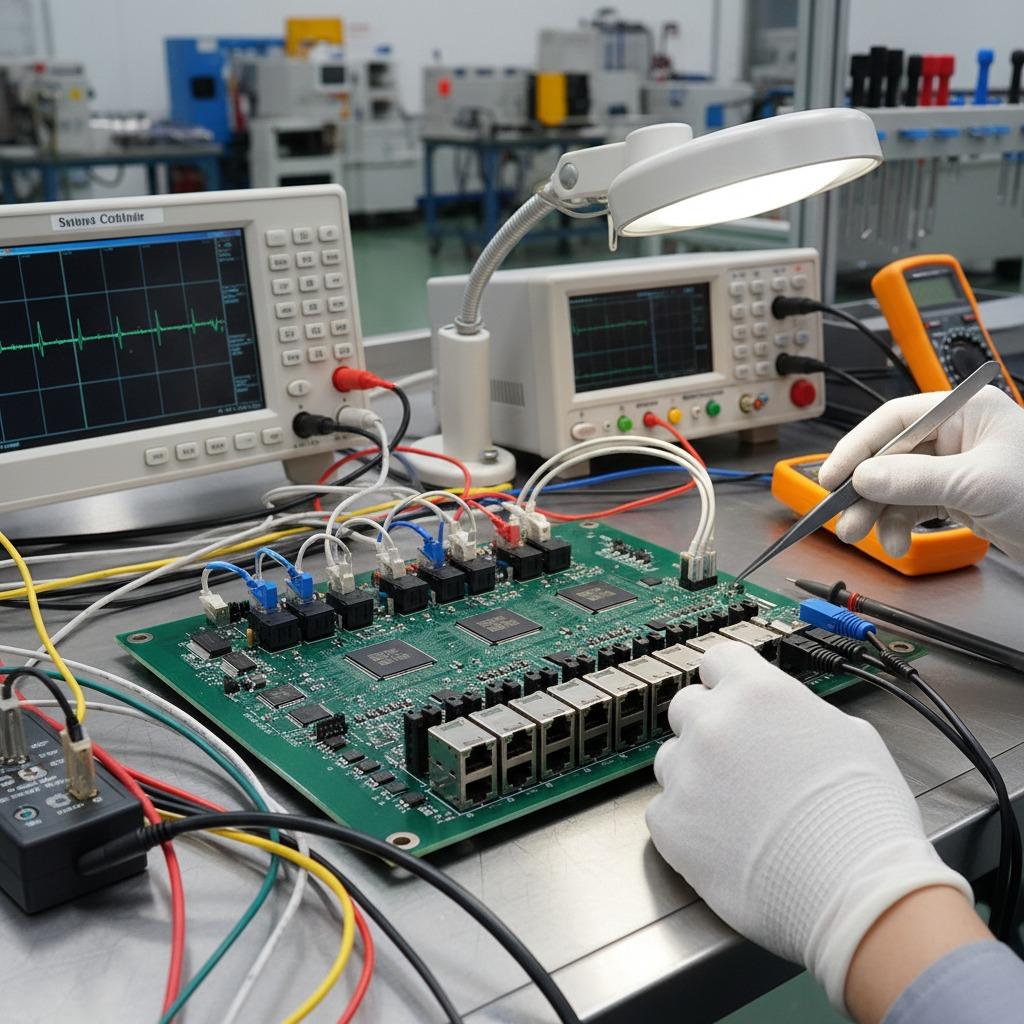
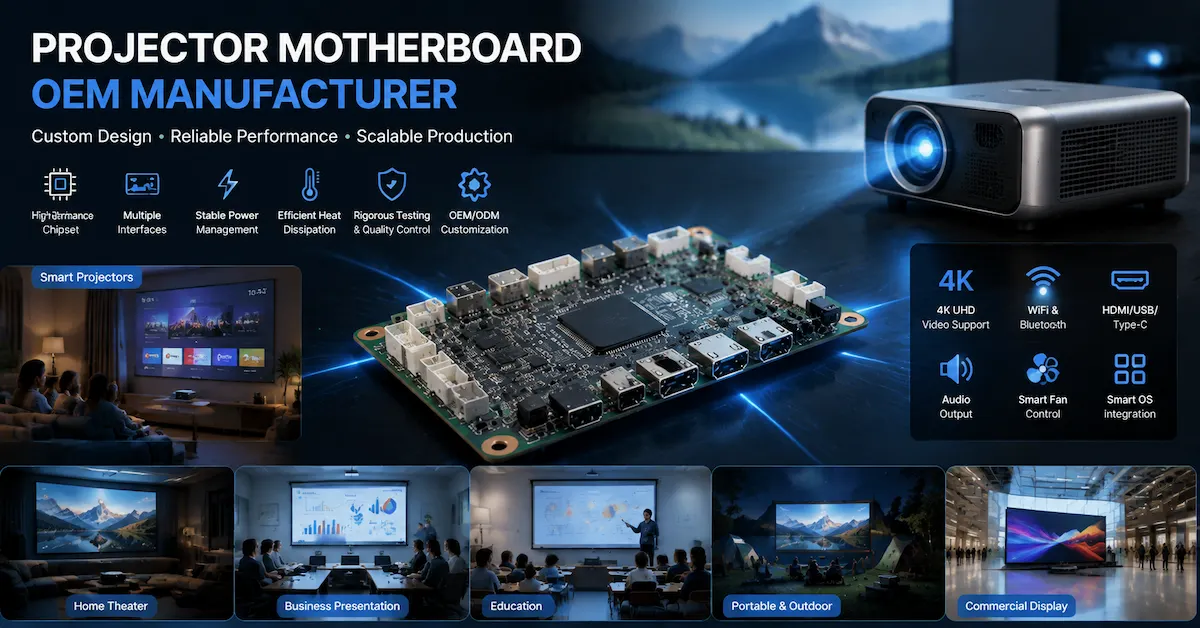
Choosing the right projector mainboard manufacturer is an important decision for brands developing smart projectors, portable projectors, home theater projectors, business projectors, education projectors, and multimedia display devices. A projector mainboard is not only a control board. It manages video input, image processing, power control, wireless functions, audio output, thermal behavior, interface compatibility, and user experience.
For B2B buyers, the mainboard directly affects projector stability. If the PCBA layout is unstable, the chipset is poorly matched, the power circuit overheats, or the testing process is weak, the finished projector may face problems such as screen flicker, boot failure, unstable HDMI input, WiFi disconnection, overheating, audio noise, or short product life.
HCDPCBA supports projector-related electronic projects through one-stop electronics manufacturing services, including PCB prototyping, SMT assembly, PCBA manufacturing, component sourcing, DFMA review, testing, and OEM/ODM production.
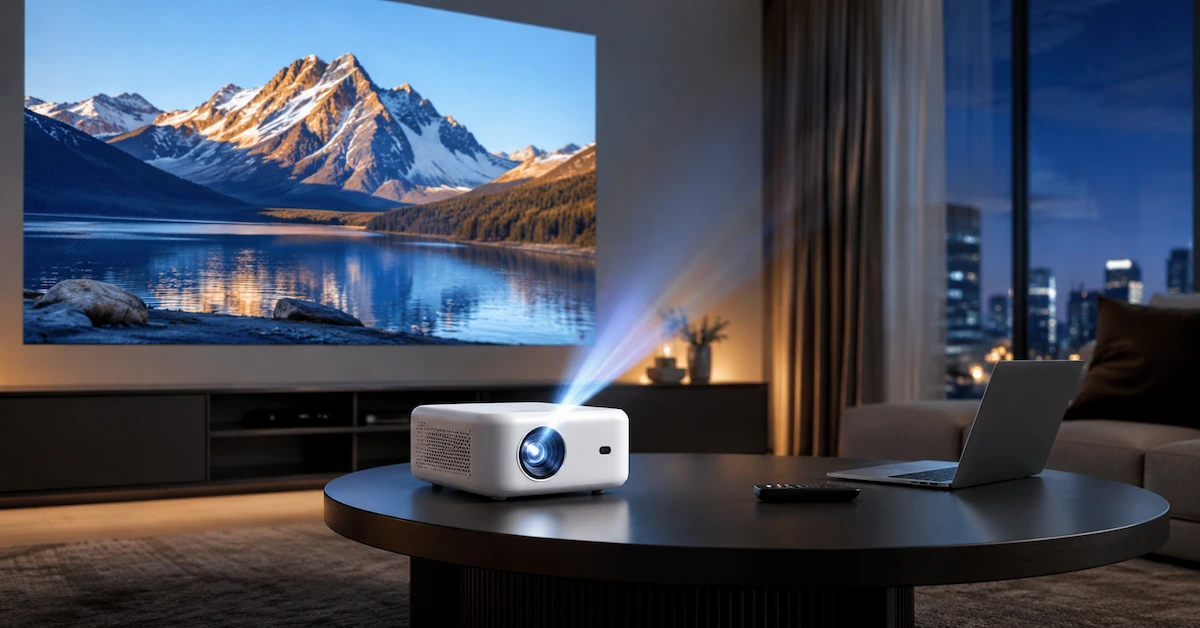
What Is a Projector Mainboard?
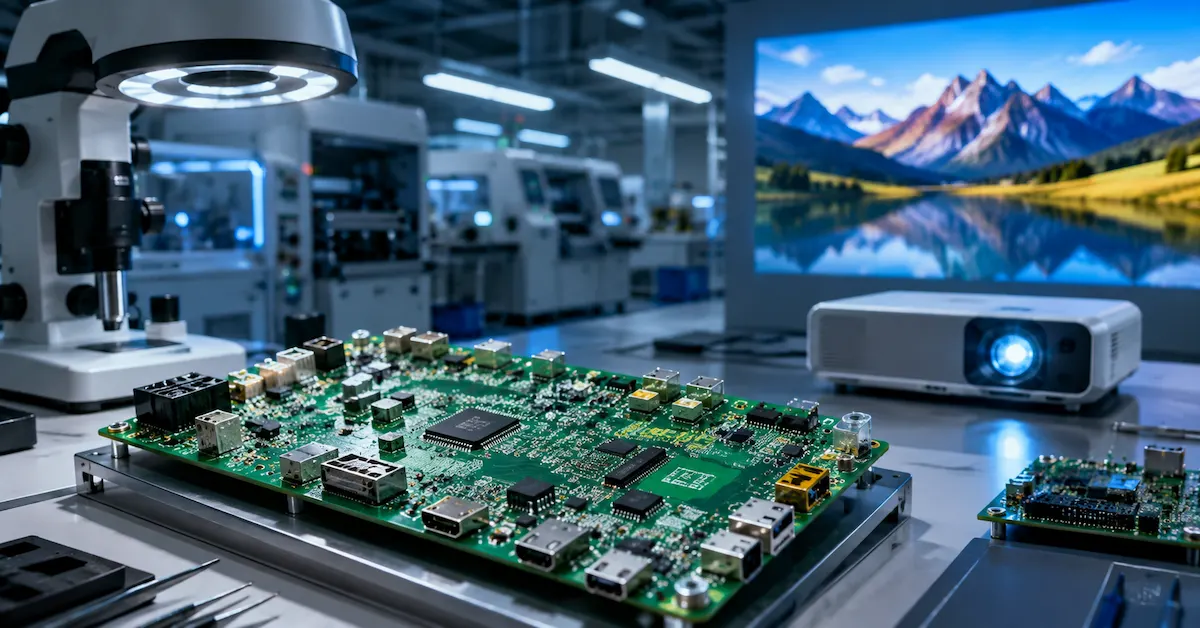
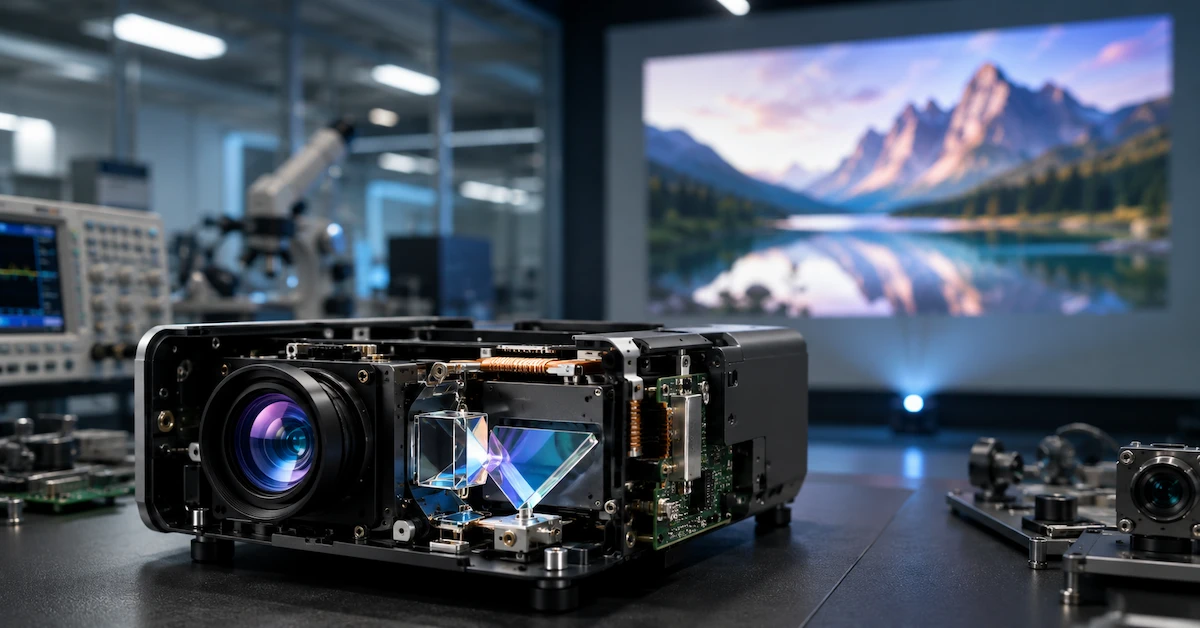
A projector mainboard is the central electronic control board inside a projector. It connects and manages the optical engine, display module, power supply, input/output interfaces, audio system, wireless module, cooling system, and control firmware.
A typical projector mainboard may include:
- Main control chipset
- Video processing IC
- HDMI input circuit
- USB interface circuit
- WiFi or Bluetooth module
- Audio output circuit
- Power management circuit
- Fan control circuit
- IR remote receiver interface
- LED or optical engine control interface
- Speaker or amplifier interface
- Firmware storage
- Connectors for display and peripheral modules
For OEM projector projects, buyers may need customized mainboards based on product size, brightness level, resolution, interface requirements, operating system, wireless function, heat control, and target market positioning.
Why Projector Mainboard Manufacturing Requires Strong PCBA Control
Projector mainboards usually combine high-density electronics, power circuits, signal transmission, multimedia processing, and thermal management. This makes them more complex than simple control boards.
A projector mainboard must support:
- Stable video signal processing
- Reliable HDMI and USB input
- Smooth wireless connection
- Low-noise audio output
- Stable power supply
- Heat control during long operation
- Firmware compatibility
- Compact PCBA layout
- Connector reliability
- Consistent batch quality
A working sample does not always mean the board is ready for mass production. Buyers should check whether the manufacturer can support SMT process control, BOM management, PCBA testing, and production consistency.
Main Applications of Projector Mainboards
Projector mainboards are used in different projector product types.
| Application | Mainboard Requirement | Typical Buyer |
|---|---|---|
| Smart projectors | OS support, WiFi, Bluetooth, app compatibility | Consumer electronics brands |
| Portable projectors | Compact PCBA, low power, thermal control | Portable device brands |
| Home theater projectors | Stable HDMI, audio output, image processing | Home entertainment brands |
| Business projectors | Reliable video input, long operation, stable cooling | Office equipment suppliers |
| Education projectors | Durable electronics, easy operation, multiple inputs | Education hardware distributors |
| Outdoor projectors | Power stability, heat control, rugged structure | Lifestyle electronics brands |
| Mini projectors | High-density PCBA, compact connectors, low heat | OEM/ODM projector brands |
| Custom projector modules | Board-level customization, connector matching | Hardware developers |
HCDPCBA’s Projector Series shows projector-related product directions, while its PCBA manufacturing category supports custom electronic board production for projector mainboards and smart hardware projects.
What Buyers Should Check Before Choosing a Projector Mainboard Manufacturer
1. PCBA Design and Layout Capability
Projector mainboards require careful PCBA layout because video signals, power circuits, wireless modules, audio circuits, and cooling controls often share limited board space.
Buyers should check whether the supplier understands:
- High-density PCBA layout
- HDMI and USB signal routing
- Power circuit design
- Grounding and EMI control
- Connector placement
- Thermal-sensitive component layout
- Fan control interface
- Audio circuit separation
- Testing point design
- Mechanical fit with projector housing
Poor layout can cause signal interference, unstable display, heat issues, and difficulty during assembly.
2. Chipset and Interface Compatibility
A projector mainboard must match the target resolution, display technology, input ports, operating system, and user functions.
Buyers should confirm:
- Resolution requirement
- HDMI input support
- USB playback support
- WiFi/Bluetooth requirements
- Android or custom system support
- Audio output requirement
- Remote control interface
- Display module compatibility
- Firmware requirement
- Future upgrade possibility
For OEM projector projects, interface planning should be confirmed before board production to avoid redesign costs.
3. SMT Assembly Quality
Projector mainboards often include fine-pitch ICs, dense connectors, power components, wireless modules, memory chips, and multimedia processing components. SMT assembly quality directly affects product reliability.
Buyers should ask whether the manufacturer can control:
- Component placement accuracy
- Solder paste printing
- Reflow soldering profile
- Fine-pitch IC assembly
- Connector soldering
- Power component assembly
- AOI inspection
- Batch consistency
- Rework control
HCDPCBA supports SMT assembly and PCBA manufacturing, making it suitable for buyers who need projector electronic board production support.
4. Power Management and Heat Control
Projectors operate with light engines, fans, speakers, wireless modules, and processing chips. These parts create power and heat challenges.
A reliable projector mainboard should support stable power distribution and thermal control.
Buyers should check:
- Working voltage
- Current load
- Power IC selection
- Heat-sensitive component location
- Fan control circuit
- Overcurrent protection
- Overvoltage protection
- Long operation testing
- Heat behavior inside final housing
Thermal problems may cause projector shutdown, shortened component life, image instability, or user complaints.
5. Component Sourcing and BOM Stability
Projector mainboards rely on chipsets, connectors, memory, power components, wireless modules, capacitors, ICs, and interface components. If key components are unstable, the production schedule may be affected.
Buyers should ask:
- Are key ICs available for long-term supply?
- Can alternative parts be approved in advance?
- Is the BOM version controlled?
- Are components sourced from reliable channels?
- Can the manufacturer help review cost and lead time?
- Are high-risk components identified before production?
HCDPCBA’s component sourcing support helps buyers reduce BOM risk before prototype and mass production.
6. Functional Testing Before Shipment
Projector mainboards should be tested for more than basic power-on status. Buyers should define complete functional tests before batch production.
Useful testing items include:
- Power-on test
- HDMI input test
- USB interface test
- WiFi/Bluetooth connection test
- Audio output test
- Fan control test
- Remote control interface test
- Display output test
- Long operation test
- Thermal behavior test
- Final functional verification
Testing should match the final projector application, not just the bare board.
Projector Mainboard OEM Specification Checklist
Before requesting a quotation, buyers should prepare a clear project specification.
| Item | What to Confirm |
| Product type | Smart projector, portable projector, mini projector, business projector |
| Resolution | 720P, 1080P, 2K, 4K, or customized |
| Main chipset | Buyer-specified or supplier-recommended |
| Interfaces | HDMI, USB, Type-C, AV, audio, DC input |
| Wireless | WiFi, Bluetooth, app connection, remote control |
| PCBA | Board size, connector position, mounting holes |
| Power | Input voltage, power load, protection design |
| Thermal | Fan control, heat-sensitive components, long operation |
| Audio | Speaker output, amplifier, microphone if required |
| Testing | Power test, video input test, audio test, thermal test |
| OEM needs | Logo, packaging, firmware, private label, custom board |
| Quantity | Prototype, pilot run, mass production |
| Files | Gerber, BOM, drawings, samples, product photos |
A complete specification sheet helps the manufacturer evaluate feasibility, quotation, lead time, and production risk more accurately.
OEM vs ODM Projector Mainboard Projects
Buyers should choose the right cooperation model based on their project stage.
| Project Type | Meaning | Best For |
| Standard projector mainboard | Use an existing board with limited changes | Fast product development |
| OEM projector mainboard | Produce based on buyer’s specifications or samples | Projector brands with defined requirements |
| ODM projector electronics | Supplier supports design, development, and production | Buyers needing a complete solution |
| Projector PCBA manufacturing | Build the electronic board inside the projector | Hardware developers and OEM brands |
| Turnkey electronics manufacturing | PCB, SMT, BOM sourcing, testing, and delivery | Buyers needing supply chain control |
If the buyer already has a projector design, OEM production may be suitable. If the buyer needs help with electronic design, PCBA layout, firmware interface, or production planning, ODM and PCBA support may be more valuable.
Common Mistakes Buyers Should Avoid
Choosing only by board price
A lower mainboard price may hide weak components, poor testing, unstable power design, or limited engineering support.
Ignoring thermal design
Projectors generate heat. If the mainboard is not designed and tested for the final housing, failures may appear after long operation.
Not confirming interface compatibility
HDMI, USB, WiFi, Bluetooth, display interface, and audio output should be confirmed before production.
Skipping pilot production
A small pilot batch helps verify SMT consistency, component supply, assembly fit, and testing standards before mass production.
Not controlling BOM versions
Changing ICs, connectors, or power components after sample approval may affect performance and reliability.
Testing only the bare board
A projector mainboard should be tested inside or with the final projector system to confirm real performance.
How HCDPCBA Supports Projector Mainboard Manufacturing
HCDPCBA can support projector mainboard buyers from prototype to production.
PCB prototyping
Prototype production helps buyers verify board layout, chipset compatibility, interface function, power design, and mechanical fit before batch production.
SMT assembly
SMT assembly supports projector mainboard production with controlled soldering, component placement, and batch consistency.
Component sourcing
Projector mainboards involve chipsets, connectors, wireless modules, memory, power ICs, capacitors, and interface components. HCDPCBA can help buyers manage BOM sourcing and lead time.
DFMA review
DFMA review helps identify risks before production, such as difficult assembly, poor connector placement, weak test point access, thermal concerns, or unnecessary cost.
Testing support
Testing can include PCBA inspection, power-on testing, HDMI/USB testing, audio function testing, wireless connection testing, and final functional verification.
OEM/ODM customization
HCDPCBA can support customized projector electronics, private label requirements, board-level modification, and long-term manufacturing cooperation.
Buyers can learn more through HCDPCBA’s About Us page.
Quality Control Points for Projector Mainboards
A complete quality control process helps reduce field failures and improve batch consistency.
| QC Point | Purpose |
| BOM review | Confirm components match approved version |
| Incoming inspection | Check PCBs, ICs, connectors, wireless modules, power parts |
| SMT inspection | Verify placement, soldering, and missing components |
| AOI inspection | Detect visible PCBA defects |
| Power test | Confirm stable voltage and current |
| HDMI/USB test | Verify input and data interface function |
| Audio test | Confirm speaker or audio output stability |
| Wireless test | Check WiFi/Bluetooth module function |
| Thermal test | Review heat behavior during operation |
| Functional test | Verify final mainboard operation |
| Golden sample approval | Lock production standard before batch manufacturing |
For projector mainboards, functional testing should cover video, power, audio, wireless, and thermal behavior.
What Information Should Buyers Provide for a Fast Quote?
To receive a faster and more accurate quotation, buyers should prepare:
- Projector type
- Target resolution
- Mainboard size requirement
- Interface list
- Wireless requirements
- Audio requirements
- Power input and load
- Thermal design requirements
- Gerber files if available
- BOM if available
- Existing sample or reference image
- Testing requirements
- Quantity estimate
- OEM/ODM customization needs
- Target delivery schedule
If files are not complete, buyers can still share functional requirements and product photos for an initial feasibility review.
Why Work with HCDPCBA?
HCDPCBA is suitable for buyers who need an engineering-focused projector mainboard manufacturer instead of a simple trading supplier. For projector electronics, buyers often need PCB prototyping, SMT assembly, component sourcing, testing, and OEM/ODM production support in one workflow.
This helps reduce supplier coordination, improve development speed, and control production risk.
For projector brands, consumer electronics companies, smart device developers, and OEM/ODM product teams, HCDPCBA can support projector mainboard projects from prototype validation to batch manufacturing.
FAQ
1. What does a projector mainboard manufacturer do?
A projector mainboard manufacturer produces the electronic control board inside a projector, including video input, power management, audio, wireless, display connection, and control functions.
2. Can projector mainboards be customized?
Yes. Buyers can customize board size, interfaces, chipset, wireless module, power design, connector position, firmware support, and testing requirements.
3. What files are needed for projector mainboard manufacturing?
Useful files include Gerber files, BOM, pick-and-place files, drawings, approved samples, interface requirements, and testing standards.
4. Why is PCBA quality important for projector mainboards?
PCBA quality affects video stability, power safety, heat behavior, connector reliability, wireless performance, and long-term device operation.
5. What testing is needed for projector mainboards?
Common tests include power-on testing, HDMI/USB testing, audio testing, wireless testing, thermal testing, and final functional verification.
6. Can HCDPCBA support projector mainboard PCBA production?
Yes. HCDPCBA supports PCB prototyping, SMT assembly, PCBA manufacturing, component sourcing, testing, and OEM/ODM production for projector-related electronic projects.
7. What applications use projector mainboards?
Projector mainboards are used in smart projectors, portable projectors, mini projectors, home theater projectors, business projectors, and multimedia display devices.
8. How can I get a quote for projector mainboard production?
You can prepare product requirements, interface list, board size, resolution target, BOM, Gerber files, quantity, and testing requirements before contacting the manufacturer.
Conclusion
Choosing a projector mainboard manufacturer requires more than selecting a ready-made board. Buyers need to evaluate PCBA design, chipset compatibility, SMT assembly quality, power management, thermal control, component sourcing, testing standards, and OEM/ODM support.
For smart projector brands, portable projector companies, consumer electronics suppliers, and OEM/ODM product teams, working with an engineering-focused manufacturing partner can reduce development risk and improve production consistency.
HCDPCBA supports projector mainboard projects through PCB prototyping, SMT assembly, PCBA manufacturing, component sourcing, testing, and OEM/ODM electronics manufacturing. If you are developing a custom projector mainboard or projector PCBA project, you can explore HCDPCBA’s Projector Series or PCBA manufacturing services to plan your next OEM project.